A strong credit controller resume Template should make it easy for a hiring manager to understand three things quickly: what you have done, what financial skills you can perform confidently, and what measurable value you have created. Credit control sits at the intersection of accounts receivable, collections, customer communication, reconciliation, credit risk, and cash-flow management. Your resume therefore needs to show more than a list of routine duties. It should connect your responsibilities with outcomes, systems, account volumes, and the types of financial problems you can solve.
Current career guidance for credit controllers consistently emphasizes clear work history, relevant skills, quantified achievements, accounting systems, aged-debt management, reconciliation, collections, and alignment with the employer’s role requirements. A simple structure also makes the document easier to scan and can reduce formatting problems when recruitment software reads the resume.
The most useful approach is to treat your resume as a professional evidence document. Instead of saying that you are “good at collections,” show the type of ledger you managed, the collection activities you performed, the systems you used, the disputes you resolved, and the result you achieved. The examples throughout this guide are illustrative; replace every hypothetical figure, company name, system, and achievement with information that is genuinely true for your own career.

What a Credit Controller Resume Needs to Communicate
A credit controller is generally responsible for helping a business collect customer balances within agreed terms while managing credit exposure and maintaining accurate receivables records. Depending on the organization, the role may include monitoring overdue invoices, contacting customers, resolving billing disputes, reviewing credit limits, reconciling accounts, allocating payments, preparing statements, and escalating difficult debts.
Because the position affects cash flow, a resume should demonstrate commercial awareness rather than presenting credit control as purely administrative work. Employers want evidence that you understand why an overdue account matters, how a dispute can delay payment, how credit limits influence exposure, and how accurate account information supports better decisions. Your professional summary and experience bullets should make that connection visible.
A useful resume also distinguishes between responsibilities and achievements. “Managed customer accounts” describes an activity, while “managed a B2B ledger of 180 accounts and prioritized overdue balances according to risk and age” gives the reader more useful context. Where you have genuine results, add them carefully: reduced overdue balances, improved collection timing, shortened reconciliation cycles, reduced disputed invoices, or improved reporting accuracy.

Recommended Structure for a Credit Controller Resume Template
A practical structure starts with your name and professional contact information, followed by a concise professional summary, key skills, employment history, education, and relevant certifications or professional training. Additional sections such as systems, languages, or professional memberships can be included when they strengthen your candidacy. A reverse-chronological work history is generally easy for recruiters to follow because it shows career progression and recent responsibilities first.
Your contact area should be compact. Include your name, city or region when appropriate, professional email address, telephone number, and a professional profile link if you maintain one. Avoid filling the header with unnecessary personal information. The goal is to create a clean first impression while leaving the majority of the page for evidence about your finance experience.
The professional summary should normally be short and specific. Mention your credit-control experience, type of customers or ledger, strongest technical capabilities, and one or two credible areas of impact. A useful structure is: role identity + experience context + core strengths + business result. For example, a hypothetical summary might describe a Credit Controller with several years of B2B experience managing a multi-account ledger, specializing in collections, reconciliation, dispute resolution, and credit-risk monitoring.

How to Write the Professional Summary
The summary should answer the reader’s first question: “Why is this candidate relevant to this credit controller role?” Avoid vague phrases such as “hard-working professional” unless they are supported by specific evidence elsewhere. A stronger summary identifies your finance environment and the capabilities you actually use, such as aged-debt management, cash allocation, account reconciliation, credit assessment, dispute resolution, and customer communication.
Experience level should also influence the emphasis. An entry-level candidate can highlight transferable experience in customer service, administration, invoicing, Excel, payment processing, data accuracy, or accounting study. A mid-career candidate should focus more heavily on ledger ownership, collection performance, reconciliation, credit reviews, and systems. A senior candidate can add leadership, policy improvement, portfolio oversight, forecasting, process redesign, and stakeholder management.
Do not copy a sample summary word for word. The purpose of a template is to provide a structure that you can adapt. For instance, if you have never used SAP, do not add SAP simply because it appears in a sample. Recruiters value credible evidence, and an interview can quickly expose skills that were listed without genuine experience.
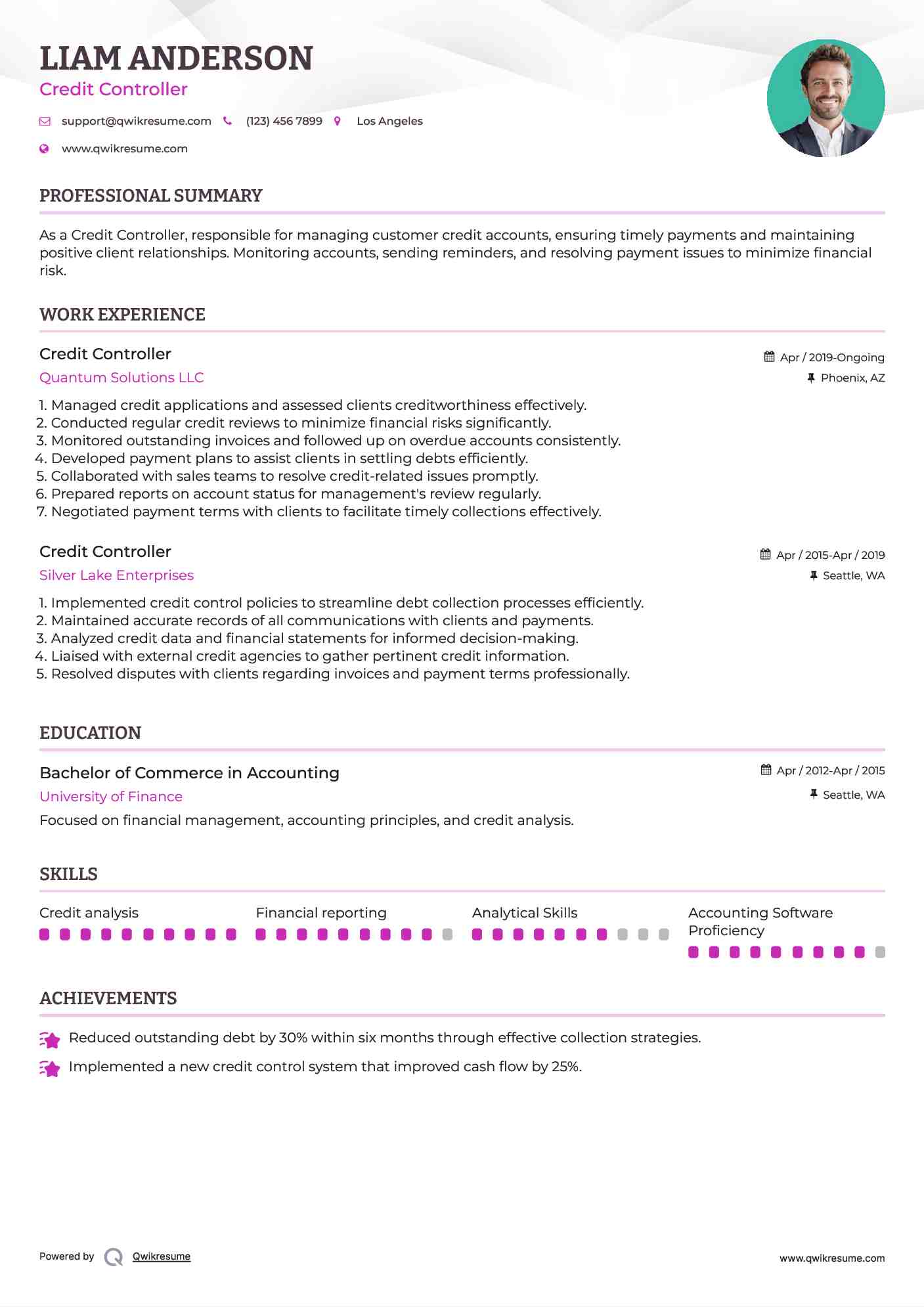
Building the Skills Section
The skills section should reflect the actual capabilities required by the target position. Common credit-control capabilities include accounts receivable management, collections, account reconciliation, credit-risk assessment, payment processing, dispute resolution, cash allocation, financial reporting, customer communication, negotiation, Excel, and enterprise resource planning systems. Recent credit-controller guidance also highlights aged-debt management, DSO awareness, credit limits, query resolution, and reporting.
Technical skills are most persuasive when they are supported by experience bullets. If you list Excel, for example, show how you used it to analyze aging, reconcile accounts, prepare management reports, identify overdue balances, or monitor collection performance. If you list SAP or Oracle, indicate the finance processes you actually handled rather than simply naming the system.
Soft skills should be demonstrated through evidence rather than presented as a long collection of adjectives. Negotiation can be shown through payment-plan discussions. Communication can be demonstrated through resolving account disputes. Organization can be demonstrated by managing a large ledger while maintaining accurate notes and follow-up schedules. Problem solving can be demonstrated by resolving invoice discrepancies that were delaying payment.

Writing Strong Credit Controller Work Experience
The experience section is usually the most important part of the resume because it provides evidence of what you can actually do. Start each role with the job title, employer, location when appropriate, and employment dates. Then use concise bullets that begin with strong action verbs and explain the responsibility, method, and result when a genuine result is available.
Routine responsibilities still matter, but they become stronger when you provide context. Instead of writing “chased overdue invoices,” consider a truthful version such as “Managed weekly follow-up across a portfolio of commercial customer accounts, documenting promises to pay and escalating unresolved disputes according to internal procedures.” This shows the activity, scope, process, and professional judgment without inventing a performance statistic.
Quantification is useful when the number is accurate and meaningful. Possible measures include number of customer accounts, ledger value, invoice volume, collection amounts, overdue-balance movement, reconciliation volume, dispute turnaround time, or reporting frequency. Do not invent percentages simply because quantified bullets look impressive. A smaller but verifiable result is more credible than an impressive figure that cannot be defended.

Using the Credit Controller Job Description
The credit controller job description should be one of the first documents you study before tailoring your resume. Job postings commonly describe responsibilities such as assessing creditworthiness, monitoring customer balances, following up on missed payments, managing payment terms, and coordinating with finance, sales, or customer-facing teams.
Look for repeated technical terms and responsibilities. If the posting emphasizes aged debt, reconciliation, cash allocation, dispute resolution, and SAP, those concepts deserve appropriate visibility in your resume if they genuinely match your experience. This does not mean copying the entire posting. It means using accurate terminology that helps the reader connect your experience to the role.
A useful tailoring exercise is to divide the job requirements into three groups: responsibilities you have performed directly, related responsibilities supported by transferable experience, and requirements you do not currently meet. Build your strongest evidence around the first group. For the second group, explain the transferable skill honestly. Never claim direct experience simply because a term appears in the vacancy.

Showing Accounts Receivable and Collections Expertise
Accounts receivable experience should be visible because credit control frequently depends on accurate customer balances and timely collection activity. Relevant experience can include monitoring aging reports, issuing statements, allocating receipts, investigating short payments, resolving account discrepancies, and maintaining clear records of customer communications.
Collections should not be presented as simply “calling customers.” A professional credit controller often needs to understand why payment has not arrived, distinguish a genuine dispute from a delayed response, verify invoice details, coordinate with internal departments, and negotiate an appropriate next step. Your resume can communicate this judgment through carefully written examples.
If you have experience with difficult or high-risk accounts, explain the process without exposing confidential customer information. You might describe reviewing account history, checking agreed terms, identifying unresolved disputes, escalating material risks, and coordinating with sales or management. This demonstrates financial discipline while respecting confidentiality.

Highlighting Reconciliation and Payment Allocation
Reconciliation is another valuable area to emphasize because inaccurate balances can affect collections, reporting, and customer relationships. A resume can mention matching payments to invoices, investigating unidentified receipts, correcting allocation errors, reconciling customer accounts, and communicating with internal teams when transaction details do not agree.
When describing reconciliation, explain the scale and complexity if you can do so accurately. A statement such as “reconciled customer accounts and investigated unmatched receipts” is useful, but “reconciled a portfolio of commercial accounts and investigated unidentified receipts before month-end reporting” gives the reader more context.
Technology can strengthen this section when it is genuinely part of your experience. Mention Excel functions, ERP modules, accounting platforms, banking systems, or reporting tools that you actually use. The objective is not to create a long software inventory; it is to demonstrate that you can use relevant systems to maintain accurate financial information.

Credit Risk, Credit Limits, and Customer Assessment
Credit control can involve more than collecting money after an invoice becomes overdue. Some roles include reviewing customer creditworthiness, monitoring exposure, supporting credit-limit decisions, identifying risk indicators, and escalating accounts that exceed established thresholds. If you have performed these tasks, they deserve a visible place in your resume.
Describe risk work precisely. Examples might include reviewing payment history, examining financial information supplied by customers, monitoring credit-limit usage, preparing account reviews, or supporting decisions about order release. Avoid claiming authority for decisions that were actually made by a manager or credit committee.
A strong resume also shows the balance between risk control and commercial relationships. Credit control is not simply about refusing credit. It can require judgment about customer history, payment behavior, disputes, commercial importance, and internal policy. Your experience bullets should demonstrate that you can protect the company’s receivables while communicating professionally with customers and colleagues.

Negotiation, Communication, and Dispute Resolution
Credit controllers often communicate with customers who have questions, delayed payments, disputed invoices, or cash-flow constraints. A resume should therefore show professional communication rather than simply stating “excellent communication skills.” Strong evidence can include negotiating payment schedules, resolving invoice queries, documenting customer commitments, and coordinating internally to remove barriers to payment.
Negotiation examples should remain factual. If you helped establish payment arrangements, describe the process and outcome without exaggerating your authority. For example, a hypothetical bullet could say that you negotiated structured payment schedules for overdue commercial accounts while maintaining documented commitments and escalating broken promises according to policy.
Dispute resolution is particularly useful because it shows that you understand the difference between collection pressure and root-cause resolution. If an invoice is disputed because of pricing, quantity, delivery, purchase-order information, or billing errors, a strong credit controller works with the appropriate internal team to clarify the issue. Your resume can show this cross-functional capability clearly.

Choosing a Resume Layout
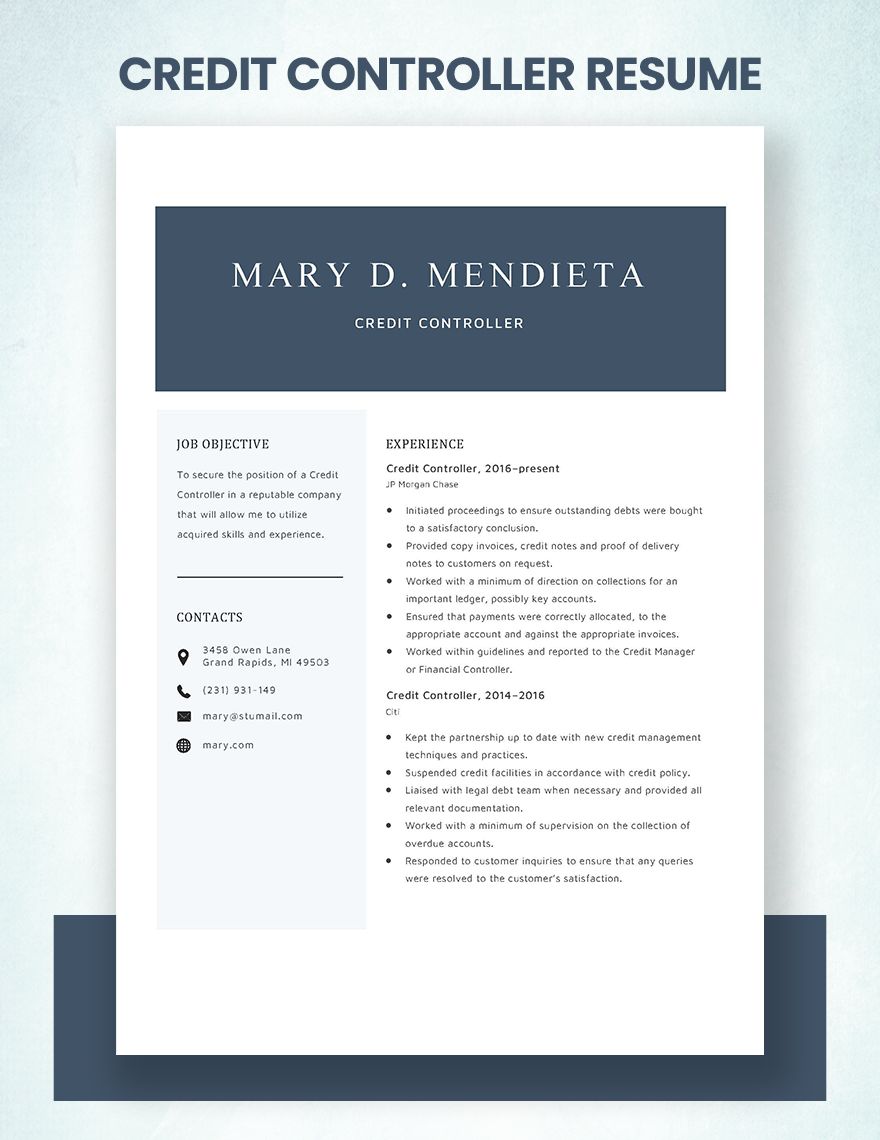
A clean single-column layout is often a sensible choice for a credit controller resume because it provides a straightforward reading sequence. Standard section headings, consistent dates, readable typography, and conventional bullet points help the reader locate information quickly. Some current resume guidance specifically recommends avoiding complex tables, columns, graphics, and unusual formatting when ATS compatibility is important.
A credit controller resume template word format can be useful when you want to make detailed edits to the wording and section order. A credit controller resume template pdf is useful as a fixed-layout reference when checking how the final page will appear. The important point is not the file type itself but whether the finished document remains readable, accurate, and appropriately tailored to the target position.
A credit controller resume template google docs approach can also work when collaboration or browser-based editing is convenient. Whatever editing environment you use, review the final result as a recruiter would: Can the role title be found immediately? Is recent experience easy to identify? Are the strongest achievements visible? Are the dates consistent? Is there unnecessary visual decoration competing with the financial evidence?
Entry-Level Credit Controller Resume Strategy
People entering credit control do not necessarily need years of direct credit-controller experience to create a relevant resume. Transferable experience from accounts administration, customer service, invoicing, billing, banking, bookkeeping, or general finance can demonstrate many of the underlying capabilities. Emphasize accuracy, communication, payment handling, customer records, Excel, reconciliation, and the ability to follow financial procedures.
Education can carry more weight when professional experience is limited. Relevant coursework in accounting, finance, business, economics, risk, or financial management can help establish your foundation. Professional training should be listed accurately, including the status of anything still in progress.
An entry-level resume should also avoid pretending to be a senior credit specialist. A focused profile that says you are building experience in accounts receivable and credit control can be stronger than an inflated statement claiming advanced expertise. The goal is to show readiness, transferable capability, and a credible direction.
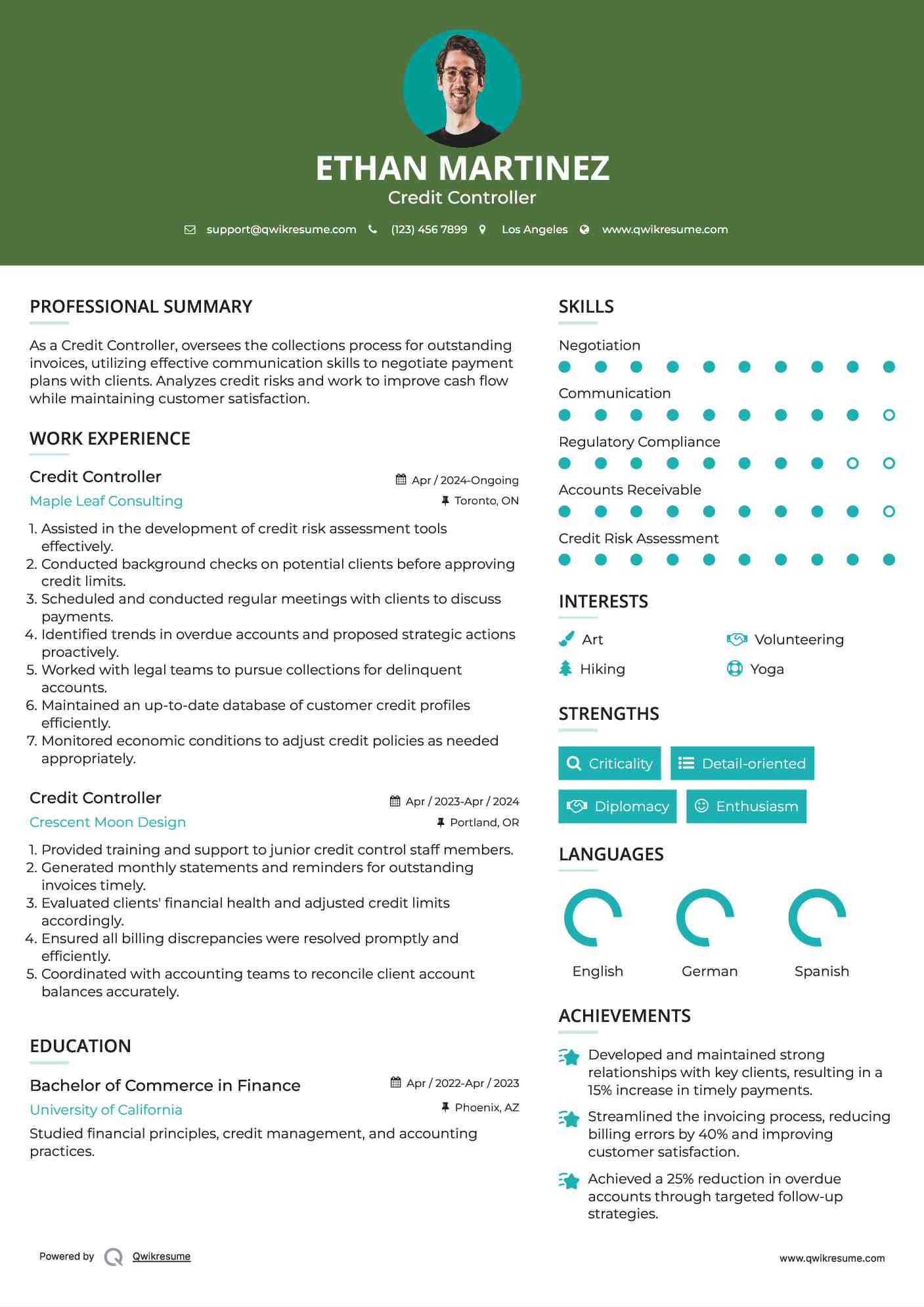
Mid-Level and Senior Credit Controller Resume Strategy
Mid-level candidates should emphasize ownership. This can include responsibility for a defined ledger, independent collection activity, account reconciliations, credit reviews, customer disputes, cash forecasting, and regular reporting. The resume should make it clear where you were personally accountable rather than describing the entire finance department’s work.
Senior candidates can go further by showing leadership and process improvement. Useful evidence may include mentoring colleagues, reviewing collection performance, improving procedures, introducing reporting controls, supporting credit-policy changes, managing escalations, or working with senior finance and commercial stakeholders.
For a senior candidate, a sample financial resume for controller can be useful as a comparison point, but the distinction between credit control and broader financial controllership should remain clear. A financial controller usually has broader responsibility for accounting, reporting, controls, close processes, and financial statements. A credit controller is more focused on receivables, customer credit, collections, and related risk processes.

How to Use Examples Without Copying Them
An example of controller resume can help you understand hierarchy, spacing, section order, and the level of detail expected in a finance resume. However, controller examples should not be treated as ready-made content for a credit controller. Broader controller roles can contain responsibilities that do not belong in a credit-control profile, so use them primarily to understand professional presentation.
A credit manager resume sample can be more closely related when you want to compare credit-risk, customer-account, and collections terminology. Even then, distinguish managerial responsibilities from individual contributor responsibilities. If you supported credit decisions but did not approve them, say that you supported the review rather than claiming approval authority.
The best method is to extract the structure rather than the wording. Identify how the example presents the summary, skills, experience, achievements, systems, and education. Then rebuild each section around your own verified experience. This produces a more credible document and prevents your resume from sounding like a generic sample.

Education, Certifications, and Professional Development
Education should be relevant and concise. Include your qualification, institution, subject, and completion year where appropriate. If you are early in your career, relevant coursework can help show your knowledge of accounting, finance, risk management, business law, or financial analysis.
Professional credentials can add value when they are relevant to the role and genuinely earned or currently being pursued. Credit-management organizations and accounting bodies offer different qualifications, and requirements vary by credential and location. Do not list a credential unless you can accurately state its status and issuing body.
Professional development can also include relevant training in Excel, ERP systems, reconciliation, financial reporting, credit analysis, or collections procedures. Keep the section selective. A long list of unrelated courses can make it harder for the reader to see the capabilities that matter most to credit control.

Common Resume Mistakes to Avoid
One common mistake is writing a duty-heavy resume that never explains impact. If every bullet begins with “responsible for,” the document can sound passive. Replace appropriate bullets with action-oriented statements that explain what you managed, investigated, improved, reconciled, negotiated, or monitored.
Another problem is overloading the resume with technical terms that are not supported by experience. Listing ten finance systems does not necessarily demonstrate proficiency. It is better to name the systems you actually used and connect them to real processes such as customer-account reconciliation, aging analysis, cash allocation, reporting, or collections.
Formatting can also create problems. Avoid excessive graphics, decorative icons, dense text blocks, inconsistent dates, unusual section names, and unnecessary personal information. A hiring manager should be able to identify your current role, previous relevant roles, skills, education, and strongest achievements without having to interpret the design.

Practical Solution
Start by collecting the target vacancy and your existing career information in two separate lists. From the vacancy, identify the recurring responsibilities, systems, financial terms, and performance expectations. From your career history, record the accounts you managed, processes you performed, systems you used, problems you solved, and results you can prove. Then select only the evidence that overlaps with the target role.
Next, build your resume in this order: professional heading, concise summary, targeted skills, recent experience, earlier relevant experience, education, and certifications. For every important experience bullet, ask whether it demonstrates an action, a finance-related responsibility, and an outcome or useful context. If a bullet contains only a generic duty, improve it by adding scope, process, or a genuine result. This workflow turns a generic resume into a targeted credit-control document.
Finally, perform a factual audit before sending the resume. Check every employment date, job title, company name, system, qualification, certification, metric, and achievement. Remove unsupported claims and confidential customer information. Read the document once for content and once for formatting. The final credit controller resume Template should be simple enough to scan quickly while containing enough specific evidence to show that you understand receivables, collections, credit risk, reconciliation, customer communication, and financial reporting.

Final Resume Quality Checklist
Before submitting your resume, verify that the professional summary matches the role you are targeting and that the strongest credit-control capabilities appear near the beginning. Check that the skills section reflects your genuine experience and that the work-history bullets provide evidence rather than unsupported claims.
Review whether your resume demonstrates the core areas that commonly appear in credit-control roles: accounts receivable, collections, reconciliation, customer-account management, credit assessment, dispute resolution, payment processing, reporting, and relevant finance systems. Current credit-controller guidance similarly recommends making cash collection, aged debt, systems knowledge, customer communication, accuracy, and commercial awareness easy to identify.
Finally, compare the finished document with the target vacancy without copying it. The strongest resume is not necessarily the most colorful or the longest. It is the one that makes the connection between the employer’s needs and your verified experience obvious, quickly, and professionally.

Reference Examples
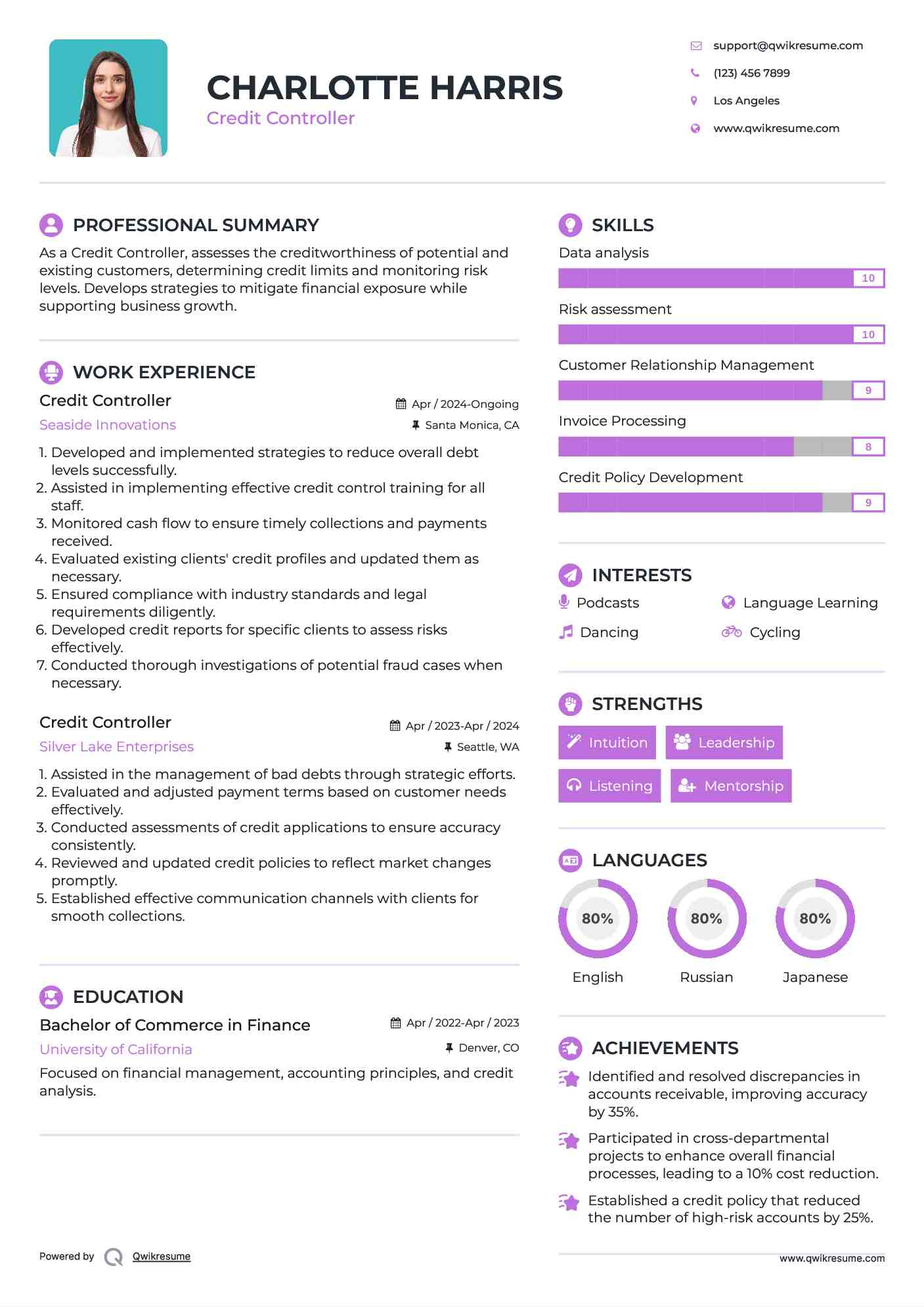
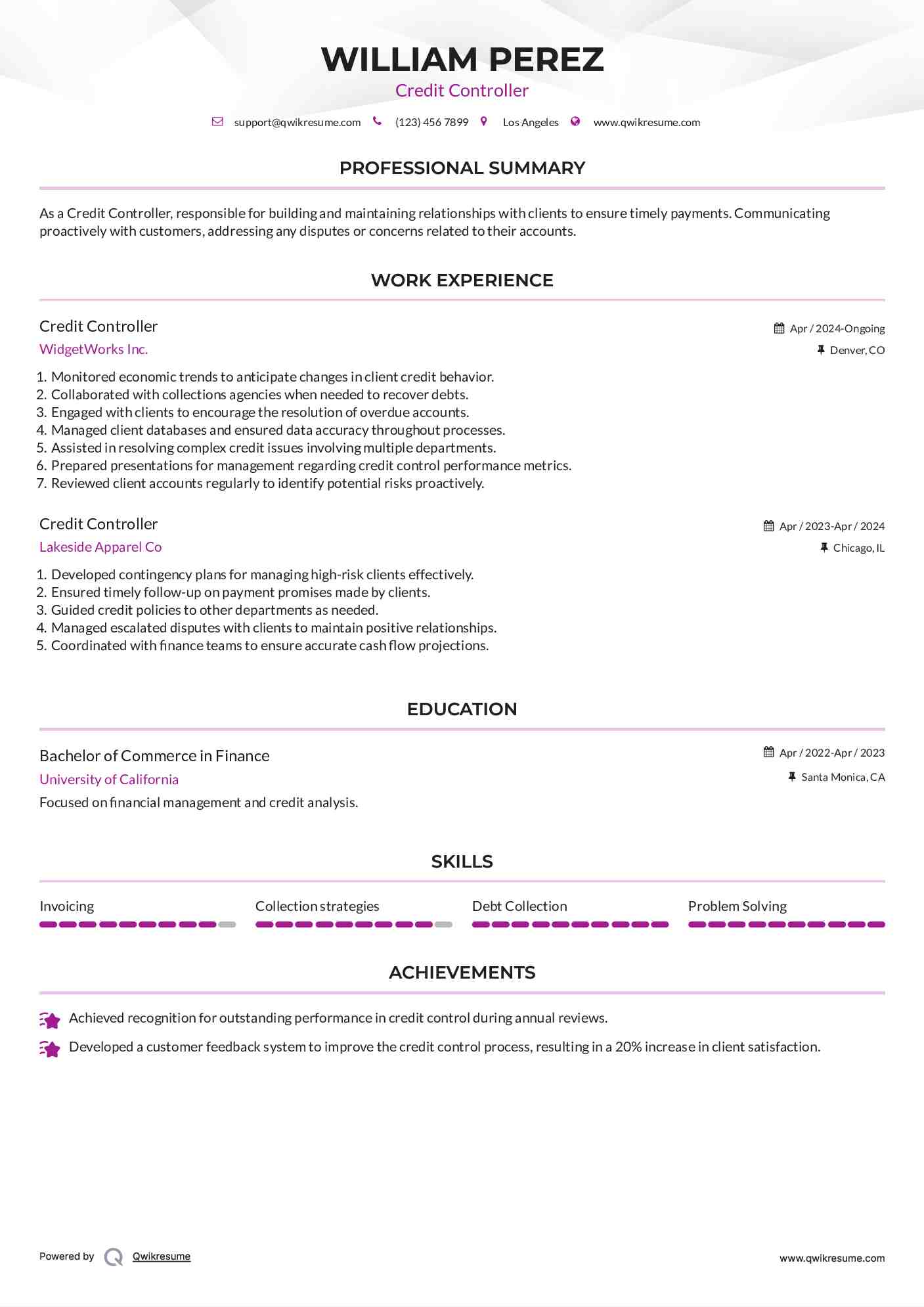
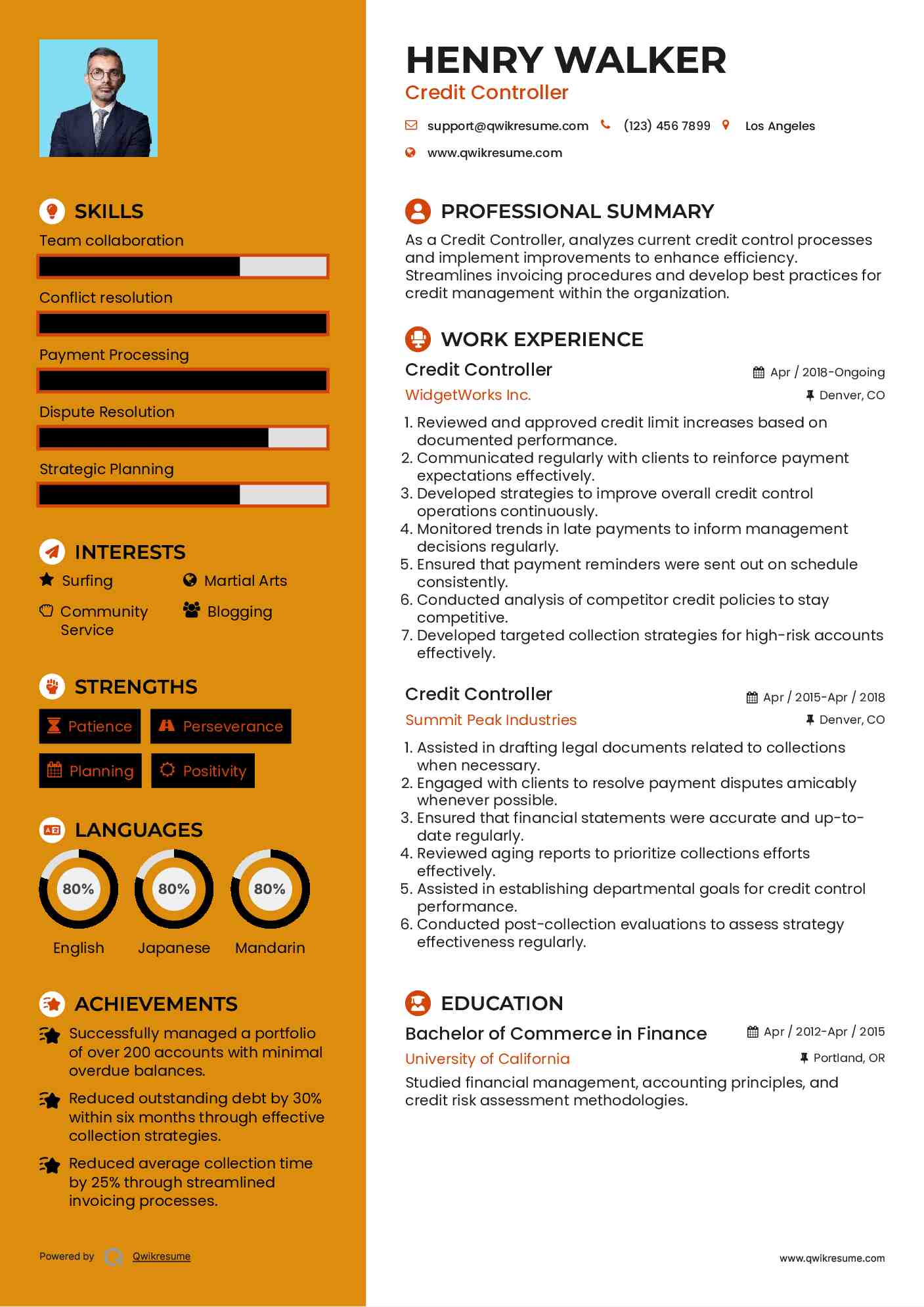
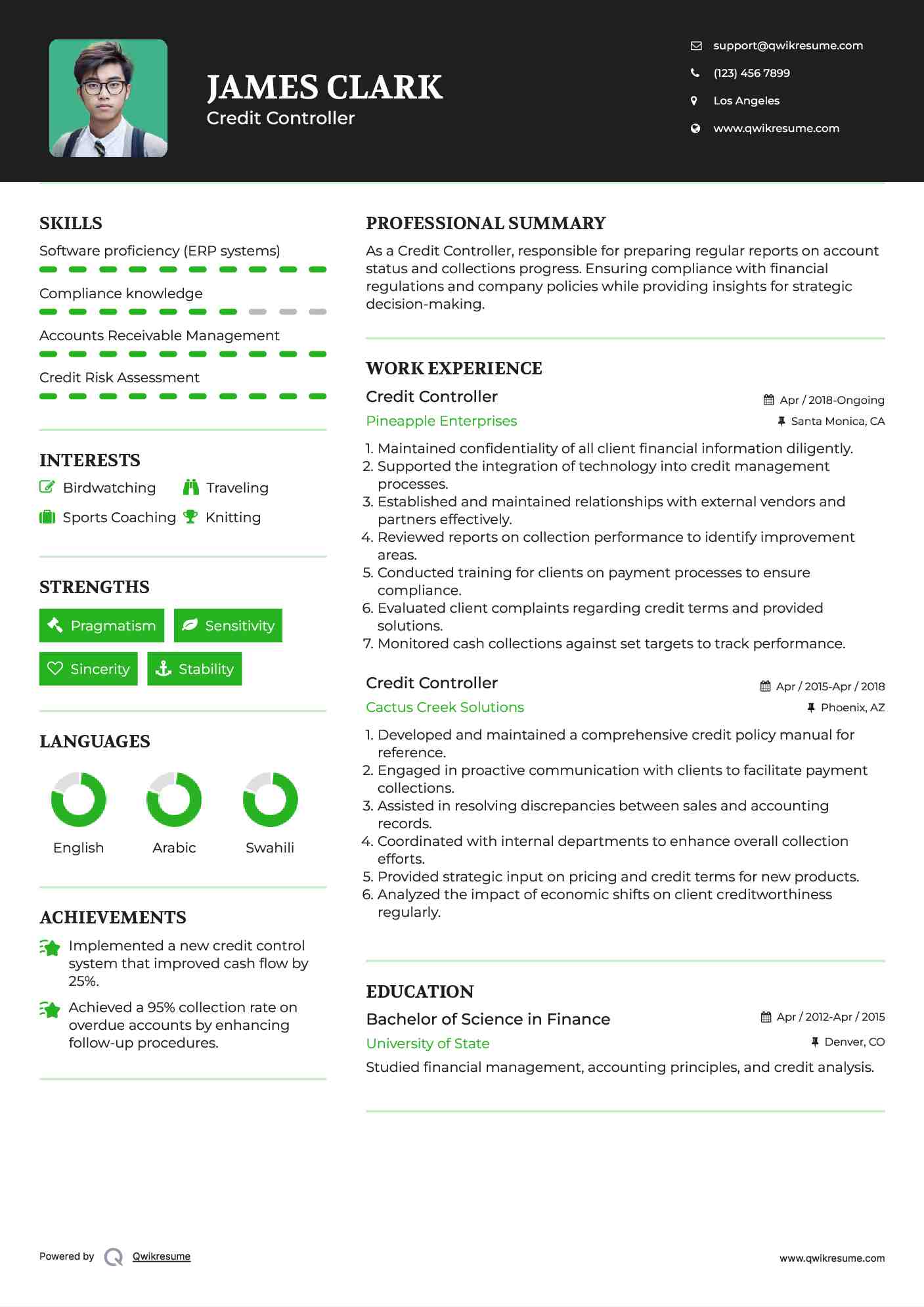
A credit controller resume Template is most useful when viewed as a visual framework rather than as text to reproduce. Strong examples typically make the professional identity, summary, work history, skills, education, and achievements easy to distinguish. They also show how different layouts can emphasize different strengths: one design may prioritize chronological experience, another may give more space to skills, while another may use a compact structure for experienced finance professionals. The references below illustrate real resume and credit-control presentation patterns that can help readers evaluate spacing, hierarchy, section placement, and the balance between technical finance information and measurable professional achievements.
The following visuals also help demonstrate how closely related finance resumes can be adapted for credit-control purposes without confusing different roles. Accounts receivable examples can provide useful ideas for collections and reconciliation sections, while dedicated credit-controller examples can illustrate credit risk, payment negotiation, customer-account management, and collection achievements. Use the visuals for structure and comparison, then write original content based on your own experience, systems, responsibilities, qualifications, and verified results.
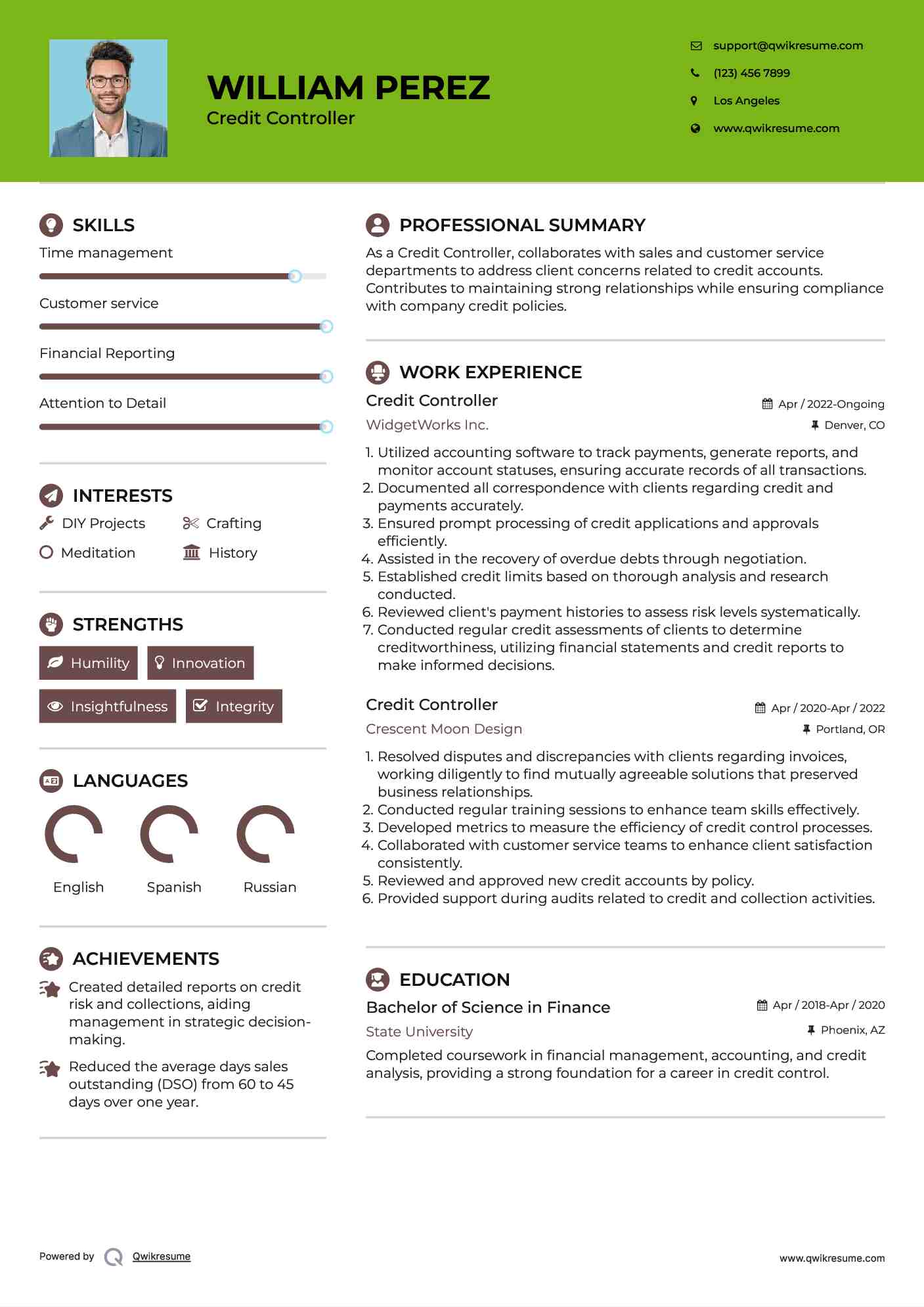
Credit Controller Resume Example with Financial Reporting Skills
Source: QwikResume
Credit Controller Resume Example with Risk Assessment Focus
Source: QwikResume
Credit Controller Resume Example with Collections Skills
Source: QwikResume
Credit Controller Resume Example with Payment Processing
Source: QwikResume
Credit Controller Resume Example with Accounts Receivable Management
Source: QwikResume
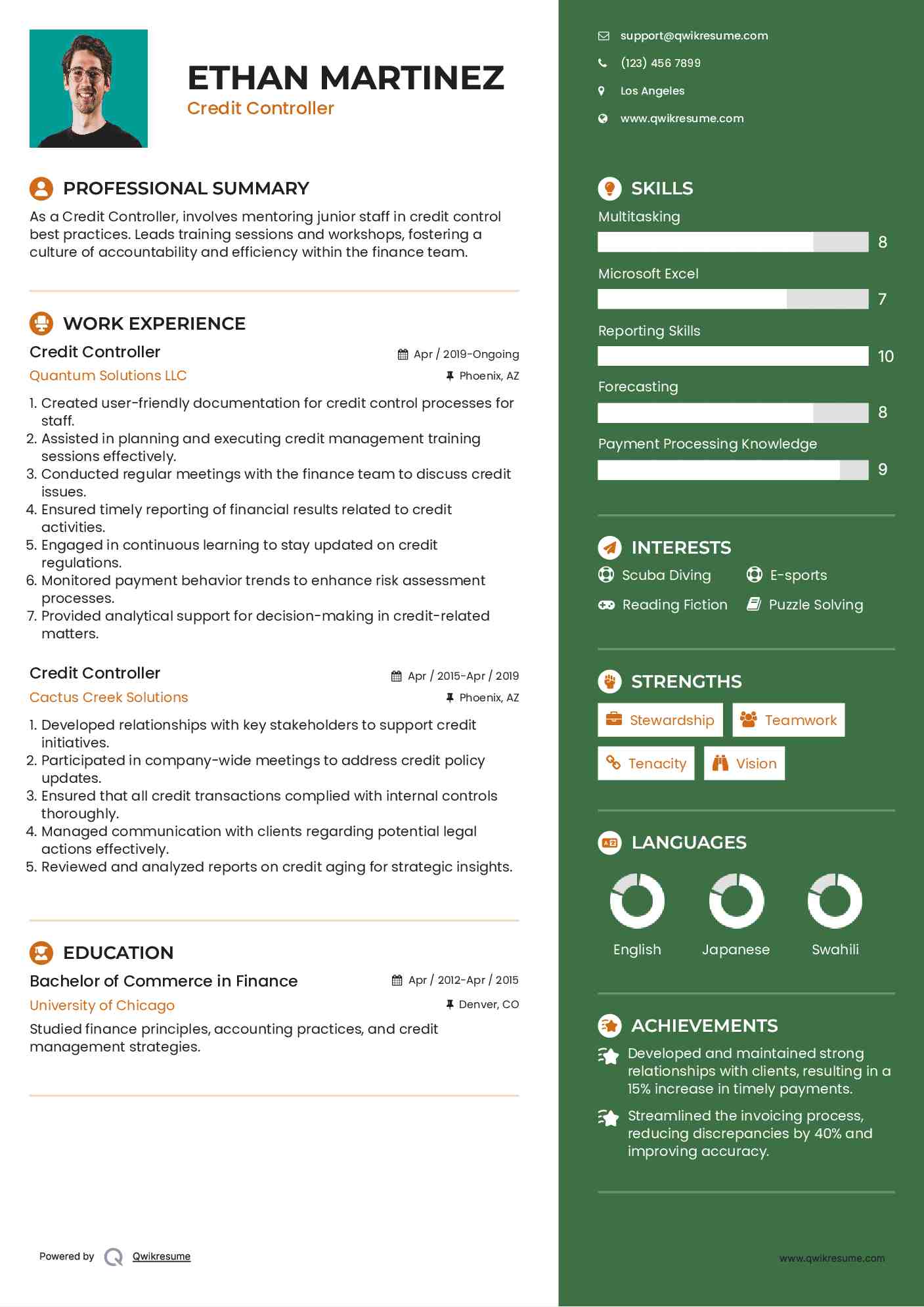
Credit Controller Resume Example with Reporting and Forecasting
Source: QwikResume

Accounts Receivable Dashboard Overview
Source: Projects.co.id

Invoice Aging Report Template
Source: Word Excel Templates
Aging of Accounts Receivable Excel Template
Source: Klariti

Credit Controller Resume Contact Information Example
Source: ResumeCat
