A legal advisory memo is a professional document used to explain a legal issue, evaluate relevant laws and facts, and provide practical guidance to a client, organization, or decision-maker. Unlike a lengthy legal brief, a well-structured memo focuses on clarity, analysis, and actionable conclusions.
Whether you are a law student, attorney, in-house counsel, business professional, or administrator working with legal matters, having a consistent legal memo format can make the writing process significantly easier. A good template provides a logical framework so that important information is presented in an organized and professional manner.
This guide explains what a legal advisory memo should contain, how to structure one effectively, and practical tips for creating a document that is easy to read and useful for making informed decisions.
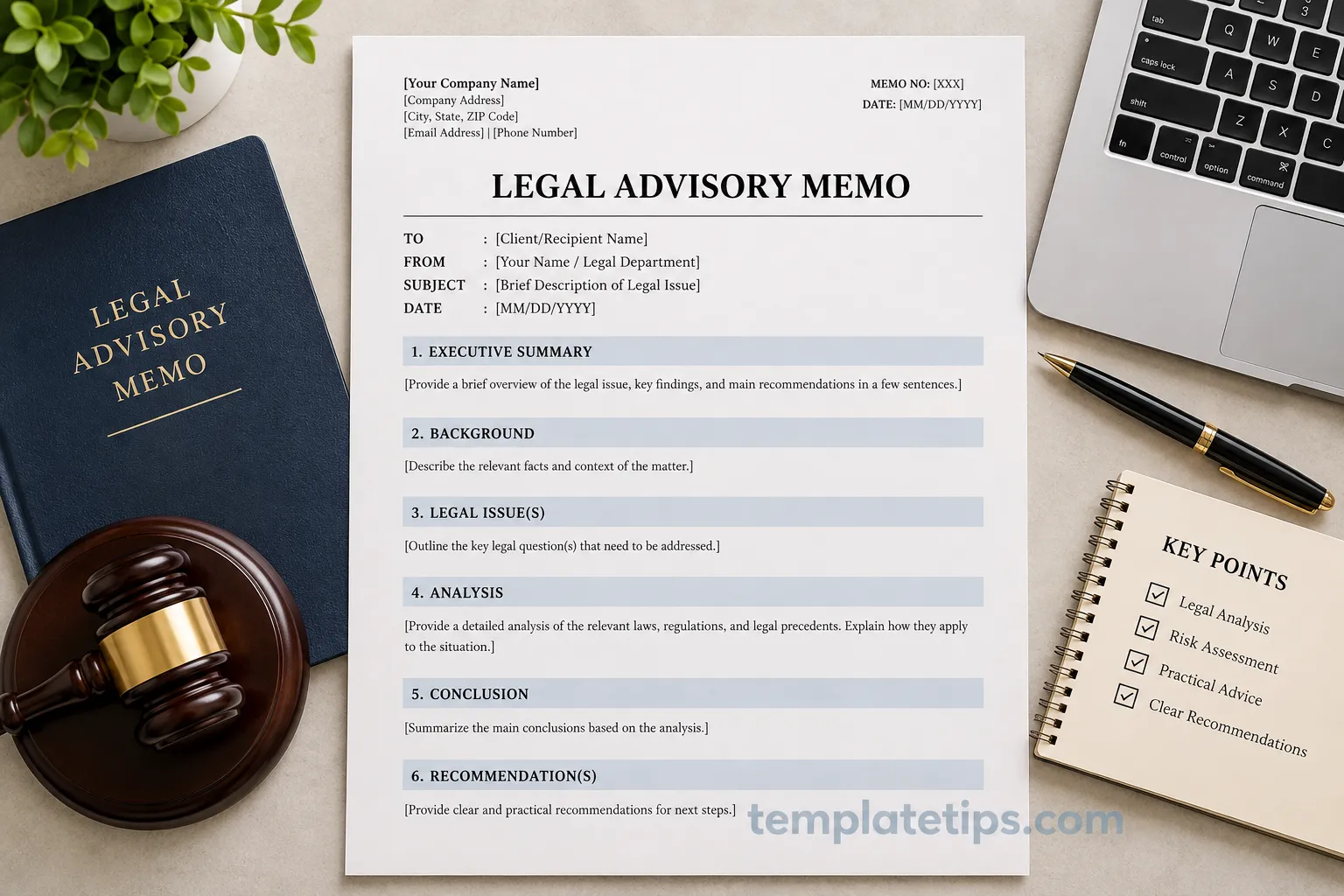
What Is a Legal Advisory Memo?
A legal advisory memo is a written analysis that addresses a specific legal question or situation. It typically identifies the relevant facts, explains the legal issues involved, examines applicable authorities, and reaches a reasoned conclusion.
The primary purpose is not simply to describe the law. Instead, the memo connects the law to the particular circumstances being considered. This makes it useful when a client or organization needs to understand potential legal risks, available options, or appropriate next steps.
A legal advisory memo may be prepared for matters involving contracts, employment, business transactions, regulatory compliance, disputes, intellectual property, corporate governance, or other areas of law.
Why Use a Legal Advisory Memo Template?
Starting with a structured template can improve both efficiency and consistency. Rather than deciding how to organize every memo from scratch, the writer can concentrate on researching the relevant authorities and developing the legal analysis.
- Improves organization: Important information is arranged in a logical sequence.
- Saves time: Standard headings and sections reduce repetitive formatting work.
- Improves readability: Readers can quickly locate the issue, analysis, and conclusion.
- Supports consistency: Organizations can use a similar structure across different legal matters.
- Clarifies recommendations: Decision-makers can more easily understand the practical implications of the analysis.
Essential Sections of a Legal Advisory Memo
Although formatting requirements vary by organization and jurisdiction, most effective legal advisory memos contain several core components. The exact structure can be adapted to the complexity of the matter.
1. Memo Heading
The opening section should identify essential administrative information. Common fields include the recipient, author, date, subject, and memo reference number.
- To: The intended recipient or decision-maker
- From: The attorney, legal department, or author
- Date: The date the memo was prepared
- Subject: A concise description of the legal matter
A descriptive subject line helps the reader immediately understand what the document concerns.
2. Executive Summary
The executive summary gives the reader a short overview of the legal issue, principal conclusion, and significant recommendation. It should be concise but informative enough for a busy reader to understand the main point without reading the entire memo.
For complex matters, the executive summary can also briefly identify major risks, limitations, or assumptions that affect the analysis.
3. Background and Relevant Facts
The background section explains the circumstances that led to the legal question. Include facts that are relevant to the legal analysis while avoiding unnecessary information.
It is particularly important to distinguish established facts from assumptions or information that has not yet been verified. Clear factual boundaries help prevent the legal analysis from relying on incorrect premises.
4. Legal Issues
This section identifies the specific questions the memo is intended to answer. A well-defined legal issue is usually narrower and more precise than a general description of the situation.
For example, instead of asking whether a company has a “legal problem,” the memo might identify whether a particular contractual provision is enforceable under the applicable law.
5. Legal Analysis
The analysis is the central part of a legal advisory memo. It explains the relevant statutes, regulations, case law, contractual provisions, or other legal authorities and applies them to the facts.
A useful approach is to organize the analysis around individual legal issues. For each issue, explain the applicable rule, discuss the relevant authority, apply the rule to the known facts, and explain the resulting implications.
The analysis should distinguish between well-established legal principles and areas where the law may be uncertain or subject to interpretation.
6. Conclusion
The conclusion should directly answer the legal questions identified earlier in the memo. It should be consistent with the analysis and should not introduce a major new issue that was not previously discussed.
For complicated matters, the conclusion can identify the most significant legal considerations and explain what they mean in practical terms.
7. Recommendations
When appropriate, the memo can finish with practical recommendations. These may include additional research, document review, contract revisions, compliance measures, further factual investigation, consultation with specialized counsel, or other appropriate next steps.
Recommendations should be connected to the preceding analysis rather than presented as unsupported opinions.
How to Write an Effective Legal Advisory Memo
Start With the Legal Question
Before drafting paragraphs, identify exactly what the reader needs to know. A focused legal question helps determine which facts, authorities, and arguments are actually relevant.
Research Reliable Legal Authorities
Use appropriate primary and secondary legal sources for the jurisdiction and subject matter involved. Depending on the assignment, relevant authorities may include statutes, regulations, judicial decisions, administrative rules, official guidance, and applicable contractual documents.
Always verify that authorities are current and applicable to the particular jurisdiction and factual circumstances.
Separate Facts From Legal Conclusions
A strong memo makes it clear which statements describe facts and which statements represent legal analysis. This distinction makes the document easier to review and helps readers understand where additional factual information may be needed.
Use Clear and Direct Language
Legal writing does not need to be unnecessarily complicated. Short paragraphs, descriptive headings, and precise language can make sophisticated legal analysis easier to understand.
Avoid excessive jargon when a simpler expression communicates the same idea accurately. At the same time, important legal terms should be used precisely when their technical meaning matters.
Address Uncertainty Honestly
Not every legal question has a definitive answer. If the outcome depends on unresolved facts, conflicting authorities, jurisdictional differences, or an unsettled area of law, explain those limitations clearly.
Identifying uncertainty can be more useful to a decision-maker than presenting a complicated issue as certain when the available authorities do not support that level of confidence.
Common Mistakes to Avoid
- Using too much irrelevant background: Focus on facts that affect the legal issue.
- Failing to answer the actual question: Keep the analysis connected to the purpose of the memo.
- Overstating legal certainty: Explain meaningful limitations and competing interpretations.
- Ignoring unfavorable authority: Address significant contrary authority rather than overlooking it.
- Using inconsistent formatting: Keep headings, spacing, terminology, and citations consistent.
- Writing an unclear conclusion: Make the practical takeaway easy to identify.
- Failing to update research: Confirm that important authorities remain current before relying on them.
Tips for Making a Legal Memo More Professional
A professional legal memo should be easy to scan as well as legally sound. Use descriptive headings to divide major topics and keep paragraphs focused on a single idea whenever possible.
Before finalizing the document, check names, dates, citations, statutory references, defined terms, and factual assumptions. A careful proofreading process can also catch inconsistencies that could undermine an otherwise strong analysis.
For organizations that prepare legal memoranda regularly, a standardized legal advisory memo template can provide a useful starting point. The template can contain consistent headings and formatting while leaving enough flexibility for different legal matters.
When a Legal Advisory Memo Is Especially Useful
This type of memo can be valuable when a decision-maker needs a concise written assessment before taking action. Common situations include reviewing a proposed agreement, evaluating a compliance question, assessing contractual obligations, researching an employment matter, or considering potential legal risks associated with a business decision.
The appropriate level of detail depends on the complexity and importance of the matter. A straightforward question may require only a short memo, while a complicated issue involving multiple jurisdictions or substantial risk may require significantly more research and analysis.
Final Thoughts
A well-prepared legal advisory memo brings together relevant facts, legal authorities, careful reasoning, and practical guidance in one organized document. The strongest memos do more than summarize the law: they explain how the law relates to the specific circumstances and clearly communicate the implications for the reader.
Using a structured template can make this process more efficient while promoting consistent presentation. By defining the legal issue clearly, researching appropriate authorities, analyzing the facts carefully, acknowledging uncertainty, and presenting practical conclusions, you can create a memo that is both professional and genuinely useful.
