Successful marketing rarely happens by accident. Behind a strong campaign, consistent brand message, and steady stream of customers is usually a clear process for deciding who to reach, what to communicate, where to promote an offer, and how to measure results. This process is known as marketing strategy development.
A well-developed marketing strategy helps businesses turn broad goals into practical marketing activities. Instead of posting content, running advertisements, or sending emails without a clear direction, marketers can use research, customer insights, measurable objectives, and performance data to make better decisions.
Whether you are launching a new business, introducing a product, or improving an existing marketing program, a structured strategy can provide a useful roadmap. This guide explains the key steps of marketing strategy development and shows how to turn strategic ideas into an actionable marketing plan.
What Is Marketing Strategy Development?
Marketing strategy development is the process of researching a market, understanding customers, defining business and marketing objectives, selecting appropriate marketing channels, and creating a plan to achieve measurable results.
The process connects business goals with customer needs. A marketing strategy may cover areas such as brand positioning, content marketing, social media, search engine optimization, email marketing, paid advertising, pricing, distribution, and customer retention.
A useful marketing strategy answers several important questions:
- Who is the target customer?
- What problem does the product or service solve?
- What makes the offer different or valuable?
- Which marketing channels can reach the target audience?
- What marketing goals should be achieved?
- Which metrics will show whether the strategy is working?
Why Marketing Strategy Development Matters
Without a clear strategy, marketing activities can become disconnected. One campaign may focus on brand awareness while another focuses on sales, without a shared understanding of how the activities support the overall business.
A structured approach makes marketing more intentional. It can help teams prioritize resources, maintain consistent messaging, understand customer behavior, and identify opportunities for improvement.
Marketing strategy development is also useful for smaller businesses. A company does not need a large marketing department to benefit from strategic planning. Even a simple framework can help determine which activities deserve attention and which should be postponed.
Key Steps in Marketing Strategy Development
1. Start With a Business Overview
The first step is to understand the business itself. Review the company’s mission, vision, core values, products or services, current customers, and competitive position.
This stage creates the foundation for the rest of the marketing strategy. Marketing goals should support broader business objectives rather than operate independently.
For example, a business focused on increasing recurring revenue may need a marketing strategy that emphasizes customer retention, email marketing, loyalty programs, and customer education instead of focusing only on acquiring new leads.
2. Conduct Market and Competitor Research
Good marketing decisions require an understanding of the environment in which a business operates. Market research can reveal customer needs, industry trends, emerging opportunities, and potential threats.
Competitor research is also valuable. Study how competing businesses position their products, communicate with customers, distribute content, and differentiate their offers.
Useful areas to investigate include:
- Industry trends and changes
- Customer expectations
- Competitor products and pricing
- Competitor marketing channels
- Common customer complaints
- Market gaps and underserved audiences
- Emerging opportunities and potential threats
The goal is not to copy competitors. Instead, research should help identify where your business can create meaningful value and communicate a distinctive position.
3. Define the Target Audience
One of the most important parts of marketing strategy development is defining the audience. Marketing becomes more relevant when messages are designed around the needs, behaviors, and motivations of a specific group.
Depending on the business, audience research may include demographics, location, interests, purchasing behavior, challenges, goals, preferred communication channels, and buying triggers.
Consider creating one or more customer profiles that describe:
- Who the customer is
- What they are trying to accomplish
- What problems they experience
- What influences their purchasing decisions
- Where they look for information
- What objections may prevent a purchase
A clearly defined target audience can make content creation, advertising, product positioning, and channel selection much more focused.
4. Set Clear Marketing Goals
Once the audience and business context are understood, define specific marketing goals. Avoid goals that are too broad, such as “get more customers” or “improve marketing.” Instead, create objectives that can be measured.
The SMART framework can be useful because it encourages goals to be specific, measurable, achievable, relevant, and time-bound.
Examples include:
- Increase qualified website leads by 20% within six months.
- Increase organic search traffic for selected commercial keywords.
- Improve email conversion rates during the next campaign cycle.
- Increase repeat purchases over the next quarter.
- Generate a specific number of qualified leads through content marketing.
Clear objectives make it easier to select appropriate tactics and evaluate performance later.
5. Develop the Marketing Strategy
With goals and audience insights in place, determine how the business will compete for attention and convert prospects into customers.
Your strategy may include several marketing disciplines, such as:
- Content marketing: Create useful articles, guides, videos, and resources that address customer questions.
- SEO: Optimize website content to improve visibility for relevant search queries.
- Social media marketing: Build awareness and engagement on platforms used by the target audience.
- Email marketing: Nurture prospects and maintain relationships with existing customers.
- Paid advertising: Use search, social, display, or other advertising channels to reach defined audiences.
- Referral marketing: Encourage satisfied customers or partners to recommend the business.
The right combination depends on the target audience, business model, budget, competitive environment, and available resources.
Turn Strategy Into an Action Plan
A strategy becomes useful when it can be translated into specific actions. Create a marketing action plan that identifies what needs to happen, who is responsible, which channel will be used, and when the activity should be completed.
For example, instead of writing “improve SEO,” create individual actions such as conducting keyword research, updating existing pages, publishing helpful content, improving internal links, and monitoring organic search performance.
For each activity, consider documenting:
- Action item
- Marketing channel
- Responsible person
- Deadline or timeline
- Expected outcome
- Required resources
This makes the marketing plan easier to execute and easier to review.
Create a Realistic Marketing Budget
Budget planning is another important part of marketing strategy development. Marketing resources may include advertising spend, software, content production, design, freelancers, events, technology, and employee time.
Rather than allocating money equally across every channel, connect spending to strategic priorities. A channel should have a clear purpose and a way to evaluate its contribution.
It can also be useful to separate planned costs from actual costs. Comparing the two over time helps identify areas where spending is higher or lower than expected.
Choose and Track Key Performance Indicators
Marketing performance should be evaluated using metrics that connect to the original objectives. Common marketing KPIs include website traffic, leads, conversion rate, customer acquisition cost, return on advertising spend, email engagement, sales revenue, and customer retention.
The most useful KPI depends on the goal. For example, if the objective is brand awareness, reach and qualified traffic may be more relevant than immediate sales. If the objective is lead generation, lead volume and conversion rate may be more meaningful.
Use a simple performance framework:
- KPI: What are you measuring?
- Target: What result do you want?
- Current result: Where are you now?
- Status: Is performance on track?
- Next action: What should change based on the data?
Review and Improve the Strategy
Marketing strategy development should not be treated as a one-time task. Customer behavior, competitors, platforms, search trends, and business priorities can change.
Schedule regular reviews to determine what is working, what is underperforming, and what should be adjusted. Look beyond surface-level metrics and investigate why results changed.
Ask These Questions During a Marketing Review
- Which activities generated the strongest results?
- Which channels are consuming resources without producing sufficient outcomes?
- Has the target audience changed?
- Are customer needs or objections changing?
- Which messages are generating the strongest engagement?
- What should be tested next?
Small, evidence-based improvements can make a marketing strategy more effective over time.
Practical Tips for Better Marketing Strategy Development
A strong strategy does not have to be complicated. The following practices can make the planning process more practical:
- Keep the customer at the center: Build marketing decisions around real customer needs rather than assumptions.
- Prioritize a few important goals: Too many objectives can spread resources too thin.
- Use data alongside creativity: Creative campaigns are valuable, but performance data helps guide future decisions.
- Document decisions: Record the reason behind major strategic choices so the team can evaluate them later.
- Test before scaling: Use smaller experiments to learn what works before committing significant resources.
- Review regularly: A marketing plan should evolve as new information becomes available.
Common Marketing Strategy Mistakes to Avoid
Some marketing plans fail not because the ideas are poor, but because the strategy is unclear or execution is inconsistent.
Common mistakes include targeting everyone, selecting channels without audience research, setting vague goals, ignoring competitors, focusing on vanity metrics, and failing to review results.
Another common problem is confusing tactics with strategy. Posting on social media, publishing blog articles, or running advertisements are tactics. The strategy explains why those activities are being used, which audience they serve, what objective they support, and how success will be measured.
Conclusion
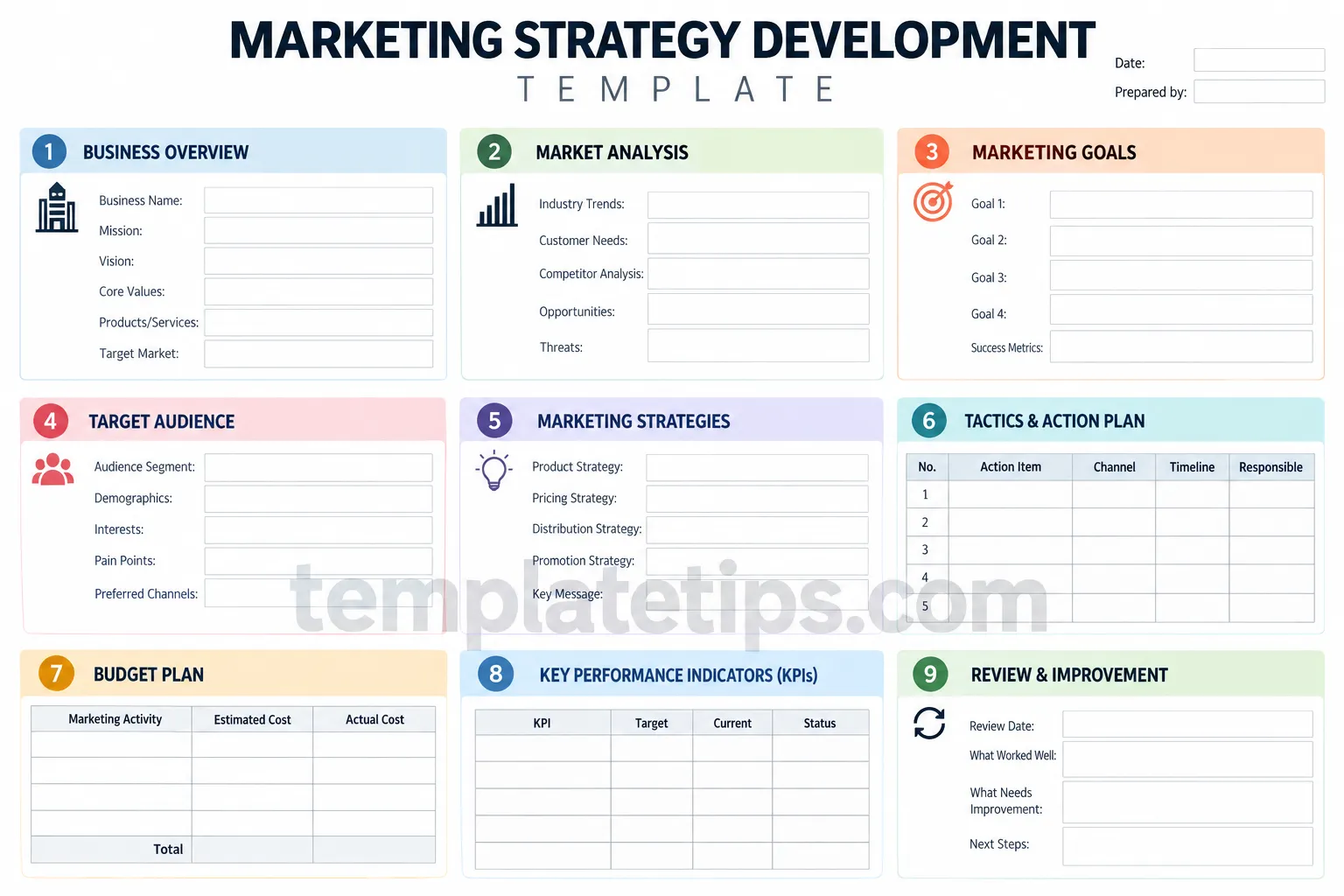
Marketing strategy development provides a structured way to connect business objectives with customer needs and measurable marketing activities. By starting with business and market research, defining the target audience, setting clear goals, selecting appropriate strategies, creating an action plan, managing the budget, and tracking KPIs, businesses can make their marketing efforts more focused.
The most effective strategy is not necessarily the most complicated one. A clear, practical plan that can be executed, measured, reviewed, and improved is often more useful than a large document filled with disconnected ideas.
Use a structured marketing strategy development template to organize your research, objectives, audience insights, marketing tactics, budget, KPIs, and review process in one place. With a consistent planning framework, marketing decisions become easier to communicate, execute, and improve over time.
