Parking arrangements can create surprisingly common disputes. Two renters may believe they have rights to the same space, a vehicle may remain after a rental ends, a tenant may use a space for storage instead of parking, or the parties may disagree about damage, access, maintenance, towing, or termination. A written agreement reduces ambiguity by turning those expectations into documented terms that both sides can review before the arrangement begins.
The best template is not necessarily the longest one. It is the document that accurately reflects the actual parking arrangement and addresses the risks that matter for that property. A single residential stall may need only a few pages, while a commercial parking lot arrangement involving multiple spaces, employees, permits, access controls, insurance, or operating responsibilities may require substantially more detail.
This guide explains what a parking lease agreement should contain, how to select an appropriate format, how to customize a template, how California considerations can differ, how commercial and truck parking arrangements should be approached, and how to review the completed document before signing. The goal is to help readers understand the structure rather than simply copy generic language without checking whether it fits their situation.
Templates should also be treated as drafting tools rather than automatic guarantees of legal enforceability. Lease and rental rules vary by jurisdiction, property type, and the nature of the arrangement. California’s Department of Real Estate, for example, explains that rental agreements can contain property-specific terms and that parties should understand the applicable legal requirements before signing. For an unusual, high-value, or disputed arrangement, professional legal review can be worthwhile.

What Is a Parking Lease Agreement?
A parking lease agreement is a written contract that gives a person or organization the right to use a defined parking area under agreed conditions. Depending on the jurisdiction and wording, the arrangement may be characterized as a lease, license, rental agreement, or another form of contractual permission. The label matters less than accurately describing the rights the parties intend to create.
At its simplest, the document connects four basic facts: who is providing the space, who is receiving the right to use it, exactly what area is being provided, and what consideration is being paid. A useful agreement then adds the operating rules needed to prevent uncertainty. Those rules can cover vehicle eligibility, access hours, assigned versus unassigned spaces, maintenance, security, insurance, subletting, termination, and responsibility for violations.
The physical description is particularly important because “parking at 100 Main Street” may be too vague if the property has dozens of spaces. A stronger description can identify the stall number, level, section, garage, covered or uncovered status, approximate location, and any access instructions. If a diagram is necessary, it can be incorporated as an exhibit rather than trying to describe a complicated parking layout entirely in prose.
The financial section should be equally precise. It should identify the rent amount, payment frequency, due date, accepted payment methods, any deposit or fee, and the consequences of late payment when legally permitted. Avoid relying on phrases such as “standard monthly rent” or “payment as usual.” A contract is more useful when someone unfamiliar with the arrangement can determine the financial obligations simply by reading it.
A good parking agreement also creates an administrative record. When the tenant changes vehicles, receives a new access credential, requests another space, or terminates the arrangement, the original agreement provides a baseline for documenting the change. That makes a clear template useful not only at signing but throughout the life of the parking relationship.
Why Use a Written Parking Lease Agreement?
Written agreements help convert informal conversations into an objective record. If the owner tells a renter that the space is available “until further notice,” while the renter assumes the arrangement lasts for one year, both parties can remember the conversation differently. A written term eliminates much of that uncertainty by establishing a specific beginning, ending, renewal process, or notice procedure.
The document can also distinguish parking rights from other property rights. A renter may be entitled to use one numbered stall without receiving permission to enter storage rooms, operate equipment, leave personal property elsewhere, or use other areas of the property. Defining the scope of use helps prevent a small parking arrangement from becoming an unintended claim to additional portions of the premises.
Another important function is setting expectations around vehicle responsibility. Parking agreements commonly address registration, insurance, operability, prohibited repairs, storage, hazardous materials, and unauthorized vehicles. These clauses should be written carefully because liability rules and towing requirements differ between jurisdictions. A generic disclaimer should not be assumed to override mandatory law.
Written terms are also valuable for commercial arrangements. A business may need several employee spaces, customer spaces, fleet spaces, or reserved spaces. Without a written allocation, it can become difficult to determine which spaces belong to which users, whether spaces can be reassigned, or how changes in staffing affect parking rights.
Finally, documentation makes administration easier. A property manager can maintain a signed agreement together with vehicle information, permit numbers, payment records, and notices. That creates a consistent process and makes it easier to explain decisions when a parking right expires, a payment is missed, or a vehicle no longer meets the agreed requirements.

Essential Components of a Parking Lease Agreement Template
1. Parties and Contact Information
The first section should identify the owner, landlord, lessor, property manager, or other authorized provider and the renter, tenant, lessee, business, or organization receiving the parking rights. Use the legal name appropriate to the transaction rather than relying only on a nickname or informal business name.
Include mailing addresses and, where useful, telephone numbers and email addresses for notices. If a property manager is authorized to receive payments or notices, the agreement should make that role clear. If a company is involved, identify the legal entity rather than simply naming an individual employee who happens to handle the parking arrangement.
Notice information matters because termination, nonpayment, rule violations, and other important communications may need to be delivered in a particular way. The agreement can state where notices should be sent and when an address or email change becomes effective, subject to applicable law.
Signature blocks should correspond with the parties identified at the beginning. A common drafting mistake is naming an organization in the opening paragraph but having only an unrelated individual sign without identifying that person’s authority. The signature section should make the relationship clear enough that the executed document can be understood later.
If multiple parties share one space or several spaces, decide whether each party has individual responsibility or whether obligations are shared. The agreement should not leave readers guessing whether one renter can terminate independently or whether every renter must agree to a change.

2. Exact Parking Space Description
The parking location should be described with enough precision to identify the space without relying on memory. Useful information can include the street address, garage or lot name, level, section, stall number, and whether the space is covered, uncovered, tandem, compact, oversized, reserved, or otherwise restricted.
If the property has a complex layout, attach a simple parking diagram or reference an existing site plan. The agreement can identify the diagram as an exhibit and state that the marked space is the space being rented. This is especially helpful for commercial lots where several spaces look similar.
Access information can be documented in the same section or a separate provision. Examples include gate hours, access cards, key fobs, assigned entrance points, parking permits, or rules for after-hours entry. If an access credential is issued, the agreement can state whether it must be returned when the parking term ends.
Do not confuse the location of the property with the location of the parking space. A multi-level garage can have hundreds of spaces at one street address. A description such as “parking at the building” may therefore be insufficient for practical administration.
For a business leasing several spaces, consider attaching a schedule that lists every assigned stall. The schedule can include space number, type, user category, and any special restrictions. If spaces may change over time, the agreement can establish a documented process for approving substitutions.

3. Term, Renewal, and Notice
The term should state when parking rights begin and when they end. A fixed-term arrangement can specify exact dates, while a month-to-month arrangement can explain how the relationship continues and how either party may terminate it. Avoid leaving dates in multiple sections if they can conflict.
Renewal provisions deserve special attention. A contract can state that it expires automatically, renews for another defined period, or continues until terminated according to a stated notice procedure. The correct structure depends on the transaction and applicable law.
Notice provisions should distinguish ordinary termination from termination for breach. A party may have one procedure for ending a month-to-month arrangement and another for responding to nonpayment, unauthorized use, or serious rule violations. Do not assume the contract can eliminate statutory notice or procedural requirements.
Renewal terms can also address price changes. If rent may increase upon renewal, explain how the new amount will be communicated and when it becomes effective. If the parties intend to renegotiate the price before each renewal, say so rather than implying automatic renewal at the old rate.
A useful administrative practice is to review the agreement before each renewal rather than simply continuing an outdated document. Vehicle information, access procedures, fees, ownership, parking layouts, and local requirements may have changed since the original signing.

4. Rent, Deposits, and Payment Rules
The payment section should identify the amount and frequency of rent. Common arrangements include monthly, weekly, annual, seasonal, or fixed-period payments. Commercial arrangements may also use different schedules when multiple spaces are involved.
State the due date and payment method. If electronic payment, check, bank transfer, or another method is accepted, identify the process sufficiently to prevent uncertainty. If payment must be made to a particular office or account, include the appropriate instruction in the executed document.
Late fees should be addressed only in a way that complies with applicable law. A template should not automatically insert an aggressive penalty simply because another form contains one. The amount, timing, grace period, and conditions should be reviewed for the relevant jurisdiction.
Deposits should also be clearly characterized. If money is collected as a security deposit, advance rent, access-device deposit, or another fee, the agreement should explain its purpose and any applicable return or accounting procedure. Calling a payment “nonrefundable” does not automatically make it legally nonrefundable.
For a commercial parking lease, consider whether rent is charged per space or as one combined amount. If spaces are added or removed during the term, the agreement should explain how the total charge changes. A schedule can make these calculations easier to audit.

Vehicle Information and Permitted Use
Many parking arrangements work better when the agreement identifies the vehicle that is authorized to use the space. Relevant fields can include make, model, color, license plate, registration jurisdiction, and sometimes a vehicle identification number when appropriate and necessary.
Vehicle identification is particularly useful when a property uses assigned spaces or controlled access. It can help distinguish an authorized renter’s vehicle from an unauthorized vehicle. However, only collect information that is genuinely necessary for administration and protect personal information appropriately.
The permitted-use clause should say what the space is for. A basic arrangement may permit parking of one registered passenger vehicle and prohibit storage, repairs, washing, dismantling, commercial activity, or other uses. A garage arrangement may have different rules if storage is expressly permitted.
Special vehicles need special treatment. Recreational vehicles, trailers, motorcycles, commercial trucks, boats, and oversized vehicles may require different dimensions, access arrangements, surface requirements, or operating rules. The agreement should describe the actual permitted vehicle category rather than assuming that a generic passenger-car clause applies.
If vehicle substitutions are allowed, explain how they are approved. A simple rule requiring the renter to provide updated vehicle information before using the replacement vehicle can make enforcement considerably easier than trying to identify vehicles after a dispute occurs.

Maintenance, Damage, Insurance, and Liability
Maintenance responsibilities should distinguish the physical parking area from the renter’s vehicle. The owner may be responsible for keeping the designated space reasonably accessible under the agreement, while the renter may be responsible for avoiding leaks, debris, unauthorized repairs, or damage caused by the renter or the renter’s vehicle.
Liability language should be realistic rather than absolute. Parking operators often want to explain that they do not take custody of the vehicle or guarantee protection against theft or damage, but the enforceability of a particular liability clause depends on applicable law and the circumstances.
Insurance requirements should identify whose insurance is required and what type of coverage is relevant. For ordinary personal parking, the renter may simply be expected to maintain legally required vehicle insurance. Commercial arrangements can involve broader requirements, particularly where multiple vehicles or business operations are involved.
If the parking area includes gates, lighting, cameras, attendants, security systems, or other services, describe them accurately. Do not promise a level of security that the property does not actually provide. Likewise, do not imply that a camera system guarantees protection against theft.
For higher-risk arrangements, the agreement may benefit from additional provisions concerning indemnification, property damage, environmental contamination, towing, contractor access, or insurance certificates. These clauses are more suitable for careful legal review because their wording can materially affect the parties’ rights.

Rules for Access, Towing, and Unauthorized Parking
Access rules should explain when and how the renter may use the space. Some parking arrangements provide continuous access, while others are limited to business hours, overnight periods, or particular days. A clear schedule is especially important when the same facility supports multiple users.
If access credentials are issued, the agreement can identify the renter’s responsibility for cards, remotes, keys, or permits. It can also explain what happens if a credential is lost or damaged, provided the applicable fee complies with relevant rules.
Towing language requires particular caution. A contract should not be treated as a substitute for state or local towing laws, signage requirements, notice rules, or procedures governing private-property towing. The agreement can establish contractual consequences, but the property owner still needs to follow applicable legal requirements.
Unauthorized parking should be defined. Examples might include parking in another tenant’s assigned stall, using the space after termination, allowing an unapproved vehicle to occupy the space, blocking access, or violating posted restrictions. Specific definitions are easier to enforce than a vague statement prohibiting “misuse.”
For facilities with multiple renters, a parking policy can supplement the lease. The lease establishes the contractual relationship, while the policy can contain operational rules such as speed limits, directional traffic, visitor procedures, loading zones, emergency access, and permit display requirements.

Residential, Commercial, Garage, and Lot Agreements
A residential parking agreement is generally focused on one or a small number of spaces connected with an apartment, condominium, home, or other dwelling. The document should make clear whether parking is included in the main housing agreement or rented separately. That distinction can matter for the parties’ rights and obligations.
Commercial parking agreements are usually more detailed because a business may rent many spaces and need predictable access. The agreement may identify reserved spaces, employee parking, customer parking, fleet vehicles, hours of use, signage, permits, insurance, maintenance, and the allocation of costs.
Garage arrangements can include storage rights, but parking and storage should not be treated as automatically interchangeable. If personal property may be stored, specify the permitted categories and any restrictions. If the space is intended solely for vehicle parking, state that clearly.
Parking lot leases can involve a larger physical area rather than individual stalls. In that situation, the agreement may need a legal description or site plan, access rights, maintenance allocation, operating hours, signage, lighting, snow or debris removal where relevant, and rules governing the operation of the lot.
Shared parking agreements have another layer of complexity because several parties may have rights to the same area. The document should explain scheduling, allocation, priority, maintenance, cost sharing, enforcement, and dispute procedures. A diagram or schedule can be particularly helpful.

How to Choose the Right Template Format
Search results for parking agreements often show PDF, Word, Google Docs, online forms, and printable formats. The best format depends on how the document will be prepared, reviewed, signed, stored, and updated. The content matters more than the file extension.
A PDF is useful when the parties want a stable version for review or signature. A Word document is generally more convenient when the agreement needs substantial editing. An online form can be useful when a property manager needs to collect the same information from many renters, especially when electronic signatures are part of the workflow.
Someone looking for a parking lease agreement template free option should inspect the actual contents before using it. “Free” may refer to a preview, a basic form, a limited download, or a document that becomes paid when customization or signing features are added. Always verify the provider’s current terms rather than assuming that a search-result description guarantees a free file.
The same principle applies to a parking lease agreement template pdf. A PDF preview can be useful for evaluating structure, but a preview is not necessarily a downloadable or editable document. If editing is important, determine whether the provider actually supplies an editable version and whether the document can be legally or practically adapted for the intended jurisdiction.
A parking lease agreement template word can be convenient when the user needs to customize names, dates, parking numbers, rent, and special conditions. Before relying on it, review every clause rather than changing only the blank fields. A template can contain assumptions that do not fit the actual arrangement.

PDF Versus Word: When Each Format Makes Sense
A parking lease agreement template free download can be attractive when a landlord or renter needs a starting document quickly. However, downloading a form is only the beginning. The document should be reviewed for completeness, jurisdiction, payment terms, permitted use, termination language, and any clauses that do not match the transaction.
A parking lease agreement template word document is often preferable when the parties expect to negotiate several provisions. Word processing software makes it easier to revise the parking-space description, add an exhibit, adjust the number of spaces, or insert a vehicle schedule before converting the final version to a stable signed copy.
PDF is often preferable for the final executed version because it can preserve the appearance of the document. The parties can retain the signed PDF together with supporting records such as a parking diagram, payment schedule, vehicle authorization form, or access-device acknowledgment.
The workflow can therefore be simple: draft in an editable format, review the substantive terms, obtain any required legal review, finalize the document, sign it, and retain the completed version. If the arrangement changes later, use a written amendment or replacement agreement rather than silently editing an old signed document.
Electronic signatures may be convenient, but the appropriate signing method depends on the parties, jurisdiction, and document-management system. Regardless of the method, both parties should receive a copy of the executed agreement and any exhibits incorporated into it.

How to Create a Parking Lease Agreement Step by Step
Step 1: Identify the Transaction
Start by deciding what is actually being rented. Is it one assigned stall, an unassigned space within a garage, a driveway, a group of spaces, a commercial lot, a garage, or a specialized vehicle area? The answer determines how detailed the agreement needs to be.
Next, determine who controls the space and who will use it. Confirm that the person signing for the owner has authority to grant the parking rights. If the space is subject to an HOA, condominium declaration, master lease, property-management agreement, or other restriction, verify that the proposed arrangement is permitted.
Determine the intended term and payment structure. Decide whether the arrangement is fixed-term, month-to-month, seasonal, event-based, or another structure. Establish the amount, frequency, due date, and method of payment before filling in the template.
Identify special conditions early. Examples include overnight parking, EV charging, oversized vehicles, commercial use, storage, valet operations, multiple vehicles, access credentials, or reserved hours. These issues are easier to address before signing than after a dispute develops.
Finally, determine what legal or property-specific rules may apply. A general template should be adapted rather than treated as a universal contract. This is particularly important where the parking arrangement is connected to residential tenancy, commercial operations, accessibility requirements, local towing rules, or a regulated property.

Step 2: Fill in the Parties and Space
Enter the full names and notice addresses of the parties. If a business is involved, use its legal entity name and identify the authorized representative. If a property manager acts for the owner, identify the manager’s role and contact information where appropriate.
Describe the parking space precisely. Include the property address, space number, level, section, or other identifying information. If the space is unassigned, explain how the renter selects an available space and whether any areas are excluded.
Include vehicle information if it is relevant to enforcement. A single-space residential arrangement may use only a license plate field, while a commercial agreement may maintain a separate vehicle schedule for several vehicles.
Do not enter unnecessary personal information simply because a template contains a blank field. A well-designed agreement collects enough information to administer the contract without creating avoidable privacy risks.
Before moving to the next section, compare the document against the physical property. The written description should match the actual stall or area. If there is any ambiguity, resolve it before the parties sign.

Step 3: Define Money and Performance
Enter the rent amount and payment frequency. If the agreement covers multiple spaces, specify whether the price is calculated per stall or as a combined charge. If different spaces have different rates, attach a schedule instead of crowding the main paragraph with calculations.
Specify the due date and payment procedure. If a late fee applies, identify the amount or calculation method and any applicable grace period. The provision should be consistent with the law governing the agreement.
Document any deposit or advance payment separately. State why it is collected and how it will be handled. Avoid mixing a security deposit with ordinary rent unless the legal treatment is genuinely the same.
Define maintenance responsibilities. Identify who handles ordinary cleaning, snow or debris removal where relevant, access equipment, lighting, gate equipment, and repairs. The allocation should reflect the physical property rather than copying a residential lease provision without modification.
Define renter responsibilities just as clearly. These can include using the space only for its intended purpose, keeping the vehicle in compliance with registration and insurance requirements, avoiding hazardous activities, following posted rules, and promptly reporting changes that affect the parking authorization.

Practical Examples of Parking Agreement Structures
Example A: One Assigned Apartment Space
Imagine a landlord renting one numbered covered parking stall to an apartment tenant for a fixed monthly amount. The agreement could identify the building address, garage level, stall number, permitted vehicle, monthly rent, payment date, start date, termination procedure, and basic use restrictions.
Because the space is assigned, the document should make clear that the renter does not have a right to occupy other stalls. If a replacement vehicle is permitted, the tenant could be required to provide the new plate number before parking it.
The agreement might also state that the parking space cannot be used for vehicle repairs, personal storage, or commercial activities unless expressly authorized. Such rules should be consistent with the property owner’s policies and applicable law.
If the apartment lease already includes parking, the parties should determine whether a separate parking agreement is appropriate or whether the parking terms belong in the housing lease or an addendum. The two documents should not contradict one another.
This example shows why a short agreement can still be effective. The objective is not to create unnecessary legal language but to eliminate the uncertainties that are most likely to matter for a single assigned space.

Example B: Business Leasing Several Employee Spaces
Consider a business that rents ten spaces from a neighboring property. A suitable agreement would likely include the property description, number of spaces, assigned or reserved status, term, rent, payment schedule, access hours, vehicle or permit procedures, maintenance responsibilities, and rules for replacing spaces.
The agreement could attach a parking schedule showing the ten stall numbers. If employees may use any of the spaces, the contract could instead describe the permitted pool and establish how the property manager identifies authorized vehicles.
Commercial use may also justify more detailed insurance and indemnification provisions. The exact language should be reviewed for the applicable jurisdiction and transaction rather than borrowed blindly from another commercial contract.
The business should also establish an internal process for managing the agreement. Someone should know which spaces are covered, when rent is due, who receives notices, which vehicles are authorized, and how employees report changes.
At renewal, the business can compare actual usage with the contract. If only six of ten spaces are regularly used, the parties may have an opportunity to negotiate a different allocation. A written agreement makes those discussions easier because the original rights are clearly documented.

Example C: Commercial Lot or Fleet Parking
A fleet parking arrangement can be substantially more complex than a single-stall rental. The agreement may need to identify the permitted vehicle categories, maximum dimensions, access routes, operating hours, maintenance rules, loading areas, security procedures, and environmental responsibilities.
If vehicles are regularly entering and leaving the site, access control becomes important. The agreement can identify approved entrances, gates, credentials, and procedures for visitors or substitute vehicles.
If the renter has employees, contractors, or drivers using the property, the agreement can assign responsibility for ensuring that those users follow the parking rules. The owner may also require a current list of authorized vehicles or a permit system.
For large sites, an exhibit can be more effective than a lengthy textual description. A marked site plan can show parking zones, restricted areas, traffic flow, emergency access, and assigned areas. The agreement should identify the exhibit and specify whether it can be changed by written agreement.
Commercial parking should therefore be approached as an operational contract rather than merely a blank form. The more people, vehicles, money, or property involved, the more valuable precise drafting becomes.
California Considerations
Readers searching for a parking lease agreement template california should be especially careful not to assume that a generic form automatically satisfies California requirements. California has specific landlord-tenant rules, and the legal treatment of a parking arrangement can depend on whether the parking is bundled with residential housing, leased separately, or part of a commercial transaction.
California Department of Real Estate guidance explains that rental agreements can contain terms concerning parking and other property-specific matters and that there is no single standard rental agreement form for every situation. This is a useful reminder that a template should be adapted to the actual property and transaction rather than treated as an official universal form.
California also has rules concerning certain residential parking arrangements and the treatment of separately leased parking in qualifying circumstances. The current law should be checked when a parking agreement is connected to residential tenancy, particularly where parking is being unbundled from housing rent.
Electric-vehicle charging can create another California-specific issue. State guidance discusses circumstances involving tenant requests for charging infrastructure and written agreements covering installation, maintenance, costs, and electrical use. A simple parking template may therefore be inadequate when an EV charging station is part of the arrangement.
Because California requirements can change and local ordinances may add additional considerations, the safest approach is to use a California-oriented starting form, verify the current applicable rules, and obtain legal advice when the transaction involves significant money, multiple spaces, residential tenancy rights, or unusual restrictions.

Truck and Oversized Vehicle Parking
A truck parking arrangement should not simply replace the word “car” with “truck” in an ordinary agreement. Trucks may have different dimensions, turning requirements, weight characteristics, operating patterns, and environmental considerations. The contract should describe the actual permitted vehicle category.
A truck parking lease should identify whether trailers, tractor units, box trucks, delivery vehicles, recreational vehicles, or other oversized vehicles are allowed. If trailers may remain attached or detached, the agreement should state the rule explicitly.
Site access should also be considered. A space that is physically large enough for a truck may still be unsuitable because of low clearances, narrow entrances, turning radii, weight restrictions, neighboring property, or local traffic regulations.
Where commercial vehicles are involved, the agreement may need provisions concerning loading, idling, repairs, fuel, hazardous materials, overnight stays, noise, cleaning, and compliance with applicable transportation or environmental rules. These provisions should reflect the actual site and legal requirements.
Anyone searching for a truck parking lease agreement template should therefore treat a generic template as a framework only. The final document should be customized around vehicle dimensions, site conditions, operating practices, and applicable law rather than assuming that passenger-vehicle terms are sufficient.

Researching and Comparing Parking Templates
Researching templates effectively starts with identifying the transaction rather than searching only for the word “template.” A residential assigned-space agreement, a commercial parking lot lease, a municipal parking permit, and a truck storage agreement may all appear in search results even though their purposes are different.
Compare the structure of several reputable examples. Look for recurring sections such as parties, premises, term, rent, permitted use, vehicle information, maintenance, liability, termination, notices, and signatures. These recurring sections can help reveal the practical information that a useful agreement normally needs.
Government and institutional forms can be particularly useful for understanding how parking information is organized, but an official parking application is not automatically a private lease agreement. A permit application may collect vehicle and applicant information without creating the same contractual rights as a lease.
When comparing templates, pay attention to whether the source describes the document as a sample, educational form, editable template, or jurisdiction-specific contract. Those labels can tell you how much adaptation may be necessary before the document is suitable for actual use.
Do not select a template simply because it looks professional. A visually polished document can still omit important terms. The strongest template is the one whose structure matches the transaction and can be accurately customized without creating contradictions.

Common Mistakes to Avoid
Using an Unchanged Generic Form
One of the most common mistakes is downloading a template and changing only the names and rent amount. Generic forms often contain assumptions about term, vehicle type, liability, notice, or use restrictions that may not fit the actual arrangement.
Another mistake is leaving blank fields that are important to the contract. An empty space number, missing start date, or incomplete payment instruction can undermine the usefulness of an otherwise well-structured document.
Vague descriptions create avoidable disputes. “Parking near the building” is much less useful than an exact stall number or a clearly marked area. If the space is unassigned, explain the allocation method instead of pretending that a specific stall exists.
Conflicting documents are another risk. If a residential lease says parking is included in rent while a separate document says the tenant must pay an additional amount, the parties may have a disagreement about which provision controls. Related agreements should be reviewed together.
Finally, avoid copying aggressive legal language without understanding it. Liability waivers, indemnification, towing provisions, late fees, and termination clauses can have legal consequences. Clear, accurate language is generally more useful than complicated wording that does not reflect the actual deal.

Best Practices for Landlords, Owners, and Property Managers
Use one controlled master template and update it when your business practices change. Do not allow several employees to maintain different versions of the same agreement without version control. A simple document title and revision date can help distinguish current and obsolete forms.
Create a standard intake checklist. Before signing, confirm the renter’s identity, parking location, term, rent, vehicle information, access method, insurance requirements, and any special restrictions. The checklist can prevent important fields from being overlooked.
Keep the signed agreement with supporting records. Depending on the arrangement, those records might include a parking diagram, permit number, vehicle authorization, payment record, access-device receipt, or amendment. Good recordkeeping can be as important as good drafting.
Review agreements periodically. If parking layouts change, a new gate system is installed, fees change, or local rules are updated, determine whether the existing agreement needs an amendment or replacement. Do not assume that operational changes automatically become part of an old contract.
Train staff to apply the agreement consistently. A carefully written document is less effective if different employees interpret the rules differently. Consistent administration reduces disputes and helps demonstrate that parking rules are being applied according to documented procedures.

Best Practices for Tenants and Renters
Read the complete agreement before signing rather than focusing only on the monthly price. The most important practical restrictions may appear in sections dealing with permitted use, access, vehicle changes, termination, liability, or unauthorized parking.
Confirm the physical space before accepting it. If the document identifies a stall number, compare that number with the property signage. If the space is covered, confirm the actual clearance and accessibility. If the arrangement is unassigned, understand exactly where parking is allowed.
Ask how vehicle changes are handled. A renter who replaces a vehicle may need to update a permit, plate number, access system, or parking record. Knowing the procedure in advance prevents the new vehicle from being treated as unauthorized.
Keep a copy of the signed agreement and proof of payment. If a dispute occurs, the renter should be able to demonstrate what was agreed, when payments were made, and what parking rights were granted.
If a clause is unclear, resolve the ambiguity before signing. A short written clarification or amendment is generally more useful than relying on an informal conversation that may later be remembered differently by each party.

Practical Solution
The most reliable way to use a parking lease agreement Template is to treat it as a structured checklist for the transaction. Start with the physical parking arrangement, identify the parties, and then work through the financial, operational, and legal terms in a logical order.
First, create a property record containing the exact parking address, stall or area number, parking type, access instructions, and any relevant site restrictions. If the arrangement covers multiple spaces, create a separate schedule rather than relying on a vague description.
Second, create a party and vehicle record. Record the legal names and notice information of the parties and collect only the vehicle information necessary to administer the parking rights. For commercial users, establish a process for updating authorized vehicles when changes occur.
Third, finalize the financial terms. Write the rent amount, payment frequency, due date, payment method, deposit information, and legally permissible late-payment provisions. Make sure the numbers are consistent throughout the document and any attached schedules.
Fourth, customize the use rules. Decide whether the space is for one vehicle, multiple vehicles, commercial vehicles, trucks, trailers, motorcycles, or another category. Address storage, repairs, washing, charging, overnight use, access hours, and other activities only where they are relevant to the property.
Fifth, establish responsibility for maintenance, damage, insurance, access devices, and unauthorized use. Make the provisions match the actual property. If the owner does not provide security services, the document should not imply that the property is monitored or protected beyond what actually exists.
Sixth, review termination and enforcement procedures carefully. Distinguish ordinary expiration or termination from breach-related action. Confirm that notice, towing, fees, and enforcement procedures comply with the law governing the property.
Seventh, perform a consistency review. Compare the parking agreement against the main property lease, HOA rules, commercial lease, parking policy, or other document that affects the same space. Resolve conflicting provisions before the parties sign.
Eighth, finalize and execute the document. Every important blank should be completed or intentionally marked as not applicable. Each party should receive the same final version, including all exhibits and schedules incorporated into the agreement.
Ninth, establish a renewal and recordkeeping process. Set a calendar reminder for expiration or review, maintain payment records, and document amendments rather than changing old signed copies. This workflow turns a simple template into a repeatable parking-management system.
Reference Examples
The following reference examples illustrate different document formats and parking-related forms. They are useful for comparing structure, field organization, and presentation, but a reference document should not be assumed to be an official or legally sufficient form for every jurisdiction.
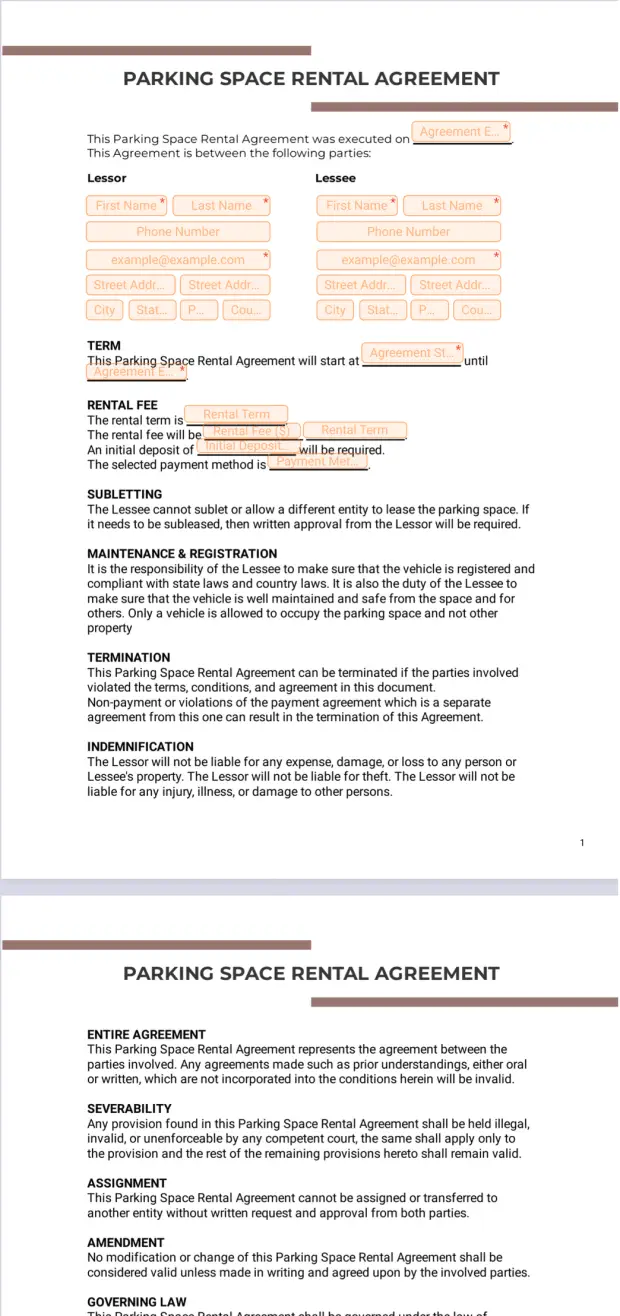
parking lease agreement template free
Source: SampleForms
parking lease agreement template pdf
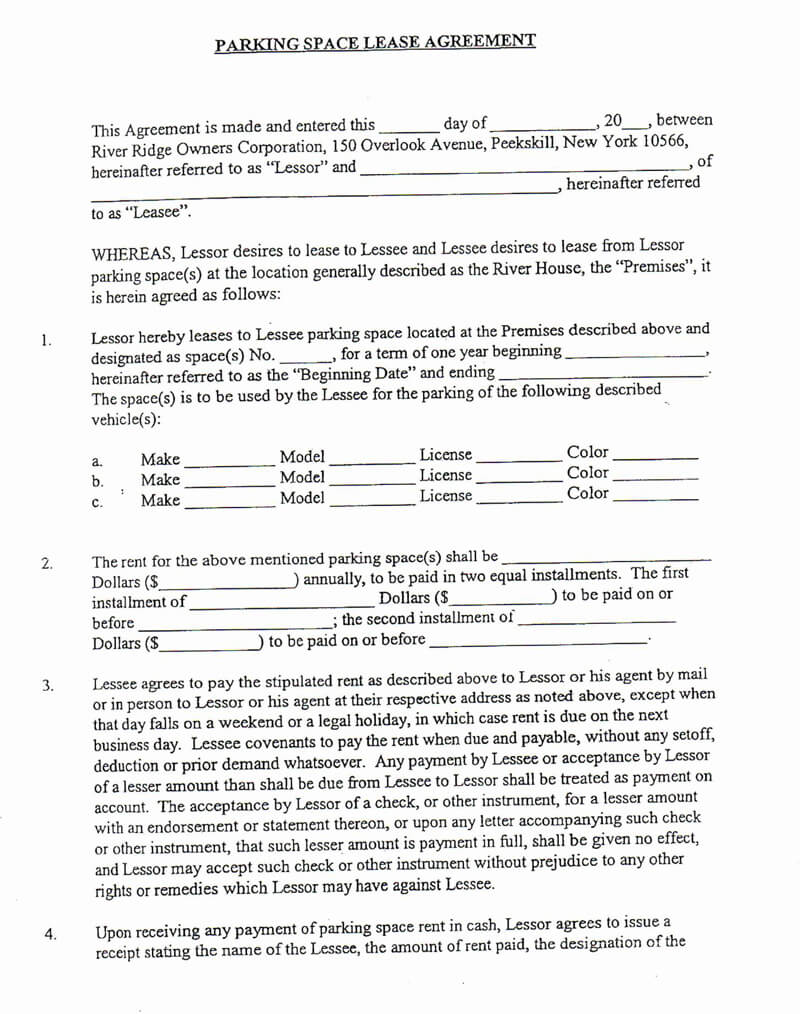
Source: WordTemplatesOnline
parking lease agreement template word
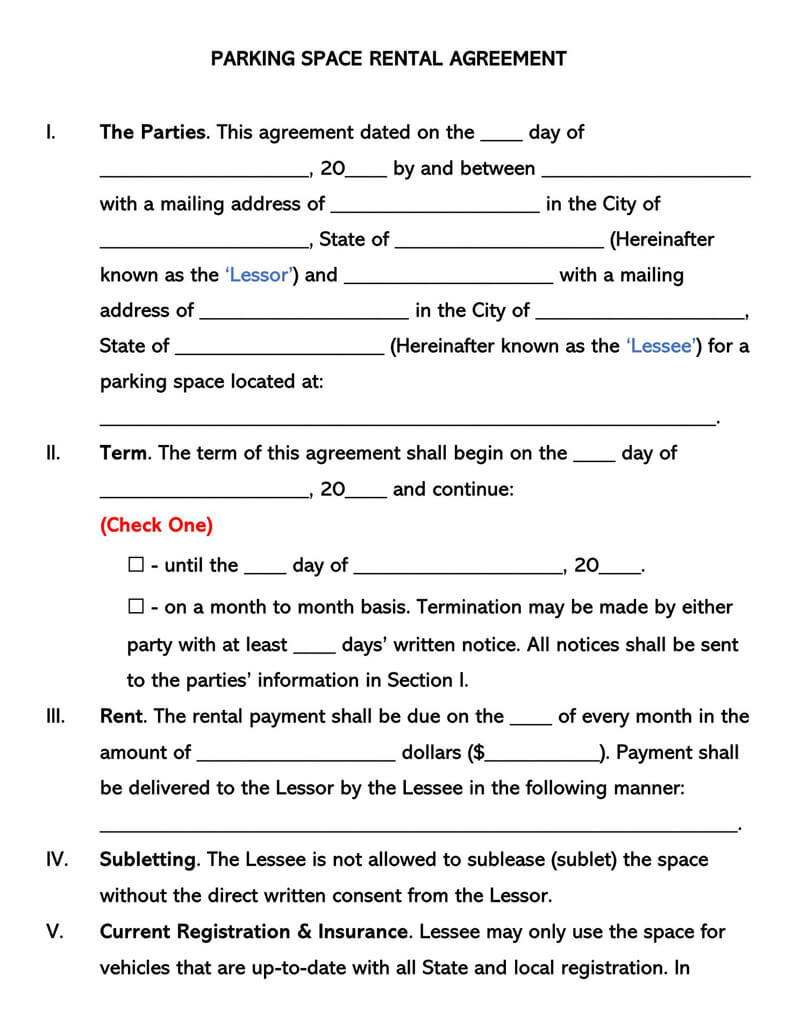
Source: WordTemplatesOnline
parking lease agreement template free download
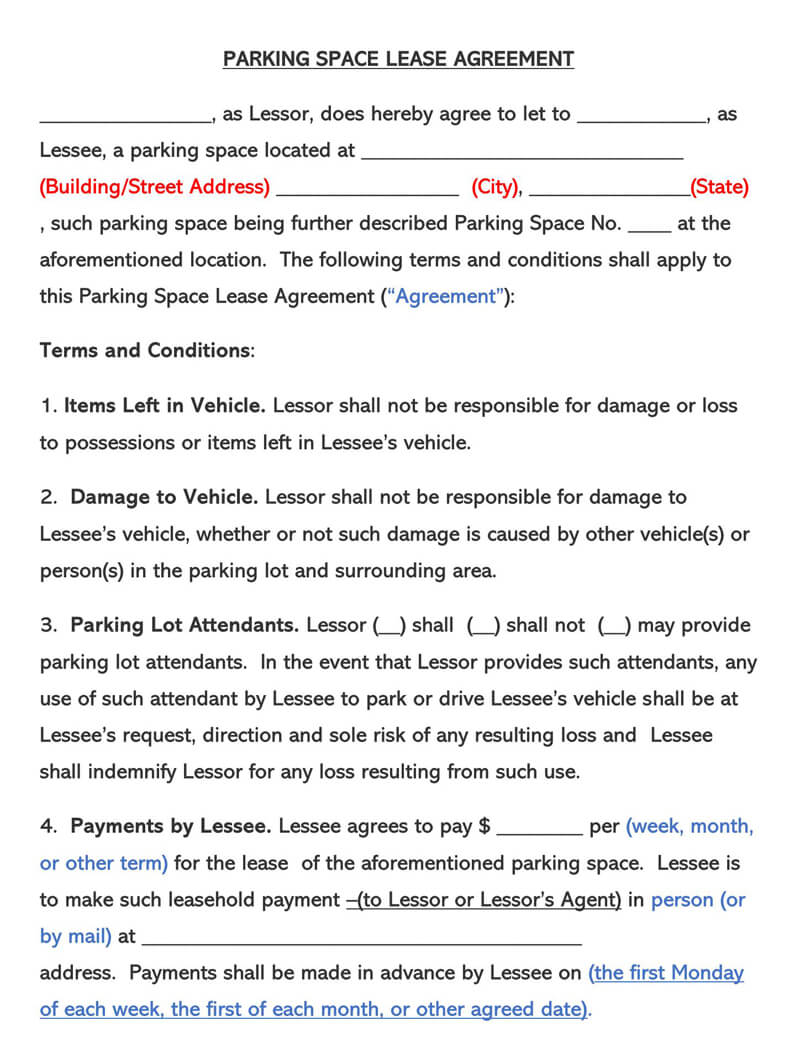
Source: WordTemplatesOnline
parking lease agreement template word document

Source: TemplateRoller
parking lease agreement template california

Source: TemplateRoller / City of Sacramento, California
truck parking lease agreement template
Source: SampleForms
template of lease agreement for parking space
Source: Jotform
Frequently Asked Questions
What should a basic parking lease agreement include?
At minimum, it should identify the parties, describe the parking space, state the term, specify rent and payment terms, define permitted use, explain relevant responsibilities, and provide signature blocks. Depending on the arrangement, vehicle information, access rules, insurance, maintenance, termination, and towing provisions may also be appropriate.
Is a parking lease agreement legally binding?
A properly formed contract can create enforceable obligations, but enforceability depends on the applicable law and facts. A template itself does not guarantee legal validity. Mandatory legal rules can affect provisions concerning rent, notice, towing, liability, accessibility, deposits, and termination.
Can I use the same template for residential and commercial parking?
You can use a common structure as a starting point, but the final agreement should be adapted to the transaction. Commercial arrangements often need more detailed provisions for multiple spaces, employees, fleet vehicles, access, insurance, and operational responsibilities.
Should the parking space number be included?
Yes, when the space is assigned. A specific stall number, level, section, or attached diagram can make the parking right much easier to identify. If the parking is unassigned, the agreement should instead describe the area in which the renter may park.
Can a parking agreement be month-to-month?
Yes, many parking arrangements use recurring terms, but the agreement should clearly state how the arrangement begins, renews, and ends. The notice period should comply with the applicable law and the specific contractual arrangement.
Do I need a separate parking agreement if parking is part of a residential lease?
Not necessarily. If parking is already clearly addressed in the primary lease, a separate agreement may be unnecessary. If parking is separately charged, separately assigned, or subject to different rules, a separate agreement or addendum may provide greater clarity.
Can a parking agreement include vehicle restrictions?
Yes, an agreement can define permitted vehicle categories and operational restrictions, subject to applicable law. The document can distinguish passenger cars from motorcycles, trailers, trucks, recreational vehicles, or oversized vehicles when those distinctions matter.
What should I do before signing a template?
Verify the parties, physical space, term, rent, payment method, permitted use, vehicle information, access rules, maintenance responsibilities, termination procedure, and any jurisdiction-specific provisions. Compare the document with other agreements governing the property and obtain professional legal advice when the transaction is unusual or significant.
Conclusion
A well-prepared parking lease agreement Template does more than put names and rent amounts onto a page. It creates a practical record of who has the right to use a particular parking area, for how long, at what cost, under what conditions, and with what responsibilities. The strongest agreements are specific enough to prevent ordinary misunderstandings while remaining consistent with the law and the actual property arrangement.
Whether you begin with a free form, a PDF, a Word document, an online template, or a jurisdiction-oriented example, review the substance rather than relying on the template’s appearance. Identify the exact space, define the term, document payment, specify vehicle and use restrictions, address maintenance and liability appropriately, and establish a workable process for changes and termination.
For California arrangements, commercial parking, truck or oversized-vehicle use, separately leased residential parking, EV charging, or other specialized situations, additional research may be necessary. Current statutes, local ordinances, property rules, and the underlying lease can affect what the agreement should contain.
The practical objective is simple: both parties should be able to read the finished document and understand exactly what was agreed. A carefully customized parking lease agreement template can provide that clarity, reduce avoidable disputes, and create a reliable foundation for managing the parking arrangement from signing through renewal or termination.
Before finalizing any agreement, verify every blank, confirm that the physical parking location matches the written description, review the applicable rules for the property and jurisdiction, and retain an identical signed copy with any incorporated schedules or exhibits. That final review is often what turns a generic form into a useful, transaction-specific parking agreement.
A carefully customized parking lease agreement template is ultimately a communication tool as much as a contract: it gives the owner and renter a shared written understanding of the parking space, payment, use, access, responsibilities, and end-of-term procedures, making the arrangement easier to administer and easier for both parties to understand.
