For a small agency, consultant, freelancer, or in-house marketing team, the real value of a template is not the visual design alone. It is the repeatable thinking behind the document. A useful template prompts you to clarify objectives, audience, strategy, deliverables, timeline, pricing, measurement, and approval requirements before the proposal reaches the prospect.
Current proposal guidance from established business and productivity resources consistently emphasizes the same fundamentals: understand the prospect, define the problem, explain the proposed solution, establish scope and timing, make costs transparent, demonstrate credibility, and provide a clear path to approval. :contentReference[oaicite:0]{index=0}
This guide explains how to build, customize, and use a marketing proposal for a small business without overcomplicating it. It also covers document formats, research, market analysis, budgets, sales applications, examples, common mistakes, and a practical workflow for turning a reusable template into a persuasive client-specific document.
The goal is not to produce the longest proposal possible. The goal is to create a document that allows a busy decision-maker to understand the opportunity, see why your recommendation fits, evaluate the investment, and know exactly what happens next.

What Is a Marketing Proposal for a Small Business?
A marketing proposal is a persuasive business document that presents a proposed marketing project, service, campaign, or strategy to a prospective client or internal decision-maker. Unlike a general marketing plan, which may guide a company’s own activities, a proposal is usually designed to obtain approval, secure a contract, or authorize a specific investment.
For a small business, the proposal may be prepared by an independent consultant, marketing agency, web specialist, social media manager, SEO professional, advertising provider, or an internal employee requesting approval for a campaign. The document can therefore be short and tactical or detailed and strategic, depending on the decision being requested.
A good proposal answers six basic questions: What problem are we solving? Who are we trying to reach? What will we do? Why is this approach appropriate? What will it cost? How will everyone know whether the work is successful?
The distinction between a proposal and a marketing plan is important. A marketing plan can be a management document containing research, positioning, channels, objectives, budgets, and implementation details. A proposal takes those ideas and organizes them into an offer that another person can evaluate.
This is why the best marketing proposals balance strategy and sales. The document should demonstrate expertise, but it should not become a textbook. The prospect needs enough evidence to trust the recommendation without being buried under unnecessary terminology or dozens of pages of background information.
Why Use a Marketing Proposal Template Small Business Owners Can Reuse?
Creating every proposal from a blank page wastes time and increases the chance of forgetting an important detail. A reusable template establishes a consistent structure so the writer can concentrate on research, recommendations, personalization, and client value rather than rebuilding headings and tables every time.
A template also improves consistency across proposals. When every document follows a recognizable sequence, it becomes easier to compare opportunities, train new team members, review pricing, and identify which sections need improvement. Template-based workflows are especially useful when several people contribute to the same proposal.
Another benefit is speed. A small business may receive an opportunity with only a few days to respond. A prepared framework can provide the foundation for an executive summary, project scope, pricing table, timeline, and measurement section while leaving room for the proposal to be customized around the prospect.
However, a template should never become a copy-and-paste document. Adobe specifically recommends treating a marketing proposal template as something that evolves as you learn what works, while audience customization remains central to the proposal process. :contentReference[oaicite:1]{index=1}
The practical rule is simple: reuse the structure, not the assumptions. Your headings, tables, and workflow can remain consistent, but the problem statement, objectives, audience, strategy, deliverables, evidence, pricing, and examples should be adapted to each opportunity.

Core Components of a Strong Small Business Marketing Proposal
1. Cover Page
The cover page establishes context immediately. Include your business name, proposal title, client name, preparation date, and relevant contact information. A simple design is usually preferable to a crowded cover filled with decorative elements.
The title should identify the proposed engagement clearly. Instead of using only “Marketing Proposal,” consider a descriptive title such as “Local Search and Content Growth Proposal” or “90-Day Customer Acquisition Campaign Proposal.” The title helps the reader understand what the document is about before reading the first paragraph.
For external proposals, make sure the recipient is correctly identified. A proposal addressed to the wrong company or person signals careless preparation and can undermine otherwise strong work.
Use branding consistently, but avoid allowing the cover to dominate the document. The prospect is primarily interested in their business problem and your solution, so the design should create confidence rather than distract from the content.
The cover can also include a short value statement. For example, a local home-services company might receive a proposal titled “Local Lead Generation Program” with a subtitle explaining that the project is designed to strengthen search visibility, improve conversion paths, and create a repeatable lead-generation process.
2. Executive Summary
The executive summary should be concise enough to scan while still communicating the central argument. It should identify the client’s current situation, the opportunity or problem, your proposed approach, and the primary business outcomes the engagement is designed to support.
Do not use the executive summary as a generic introduction to your company. A prospect already knows they are considering your service. The summary should instead demonstrate that you understand their situation and have a logical plan for addressing it.
A useful structure is: current challenge, business objective, proposed solution, major deliverables, expected measurement, and investment overview. Each sentence should move the reader closer to understanding why the proposed work makes sense.
If the proposal is several pages long, the executive summary becomes particularly important because decision-makers may read it before deciding whether to examine the supporting detail.
Salesforce recommends using an executive summary to highlight the problem being solved, the proposed solution, and the benefits the client can expect. :contentReference[oaicite:2]{index=2}

3. Client Problem and Current Situation
A persuasive proposal shows that you listened before recommending anything. Describe the client’s current situation using information gathered from discovery conversations, public research, existing analytics, customer feedback, competitor observation, or other appropriate evidence.
Separate observed facts from assumptions. If the client tells you that website inquiries have declined, record that as client-provided information unless you have independently verified it. If you believe poor landing-page messaging contributes to the decline, identify that as an initial hypothesis.
Specificity is valuable. “The company needs better marketing” is too broad to guide a project. “The company has several high-value services but lacks dedicated landing pages explaining those services to local search visitors” describes a problem that can lead directly to an actionable recommendation.
A useful problem statement also explains business consequences. For example, unclear service positioning may create weak lead quality, inconsistent inquiries, longer sales conversations, or missed opportunities. The proposal becomes stronger when the reader can see the connection between the marketing issue and the commercial consequence.
Keep the tone constructive. The purpose is not to criticize the client’s existing efforts. It is to demonstrate understanding and establish why a change in approach could create value.
4. Objectives and Success Criteria
Objectives translate a broad business desire into a defined outcome. A small business may want more customers, greater local visibility, stronger repeat purchases, more qualified inquiries, or a successful product launch. The proposal should convert that ambition into measurable objectives wherever practical.
A useful objective specifies what will change, for whom, and during what period. “Increase awareness” is directionally useful but incomplete. “Increase qualified inquiries from the priority service category during the initial campaign period” gives the project a clearer purpose.
Do not promise outcomes that your work cannot reasonably control. Marketing activity can influence traffic, exposure, engagement, lead generation, conversion opportunities, and customer retention processes, but external factors can affect final revenue.
Distinguish goals from KPIs. A goal might be to generate more qualified leads. KPIs could include qualified inquiries, landing-page conversion rate, cost per lead, booked consultations, or revenue attributed to the campaign.
Smartsheet’s proposal examples similarly connect objectives with measurable metrics, timelines, deliverables, budgets, and implementation details. :contentReference[oaicite:3]{index=3}
How to Research Before Writing the Proposal
Research is what separates a customized proposal from a generic service brochure. Before writing the recommendation, gather enough information to understand the business model, customers, competitors, existing marketing activities, and decision being considered.
Begin with the company itself. Review its website, service or product pages, public positioning, customer-facing language, sales process, online presence, and existing calls to action. Note what is clear, what appears inconsistent, and what questions a prospective customer might still have.
Next, investigate the target audience. Look for recurring customer needs, objections, purchase triggers, common questions, geographic considerations, and decision factors. For a business serving a narrow market, qualitative information can be more useful than a large volume of generic demographic data.
Competitive research should focus on useful differences rather than copying competitors. Compare their offers, positioning, content, calls to action, customer experience, visibility, and apparent strengths. The purpose is to discover opportunities for differentiation and to support strategic choices.
Finally, review whatever first-party information the client can provide. Existing analytics, sales records, campaign reports, customer inquiries, email performance, previous advertising results, and customer feedback can reveal what deserves attention. Never invent missing data simply to make a proposal appear more sophisticated.
Turning Research Into a Marketing Strategy
Research should lead to decisions. A proposal becomes persuasive when each recommended activity can be traced back to a problem, audience need, opportunity, or objective identified earlier in the document.
For example, suppose a hypothetical neighborhood accounting firm wants more consultations from small-business owners. Research might reveal that prospective clients have difficulty understanding the firm’s service differences and frequently search for help with specific business tax questions.
A reasonable proposal might therefore recommend clearer service pages, educational content addressing those questions, a stronger consultation call to action, local search improvements, and a small retargeting campaign. The strategy is stronger because each element connects to an identified need.
Channel selection should also reflect resources. A small business may not need to use every social network, advertising platform, content format, and email automation tool. A focused combination of channels can be easier to execute, measure, and improve.
Explain why each major tactic is included. “We will post on social media” is an activity. “We will publish customer-focused educational content to address common pre-purchase questions and create useful entry points for qualified prospects” explains the strategic purpose.
Define the Scope of Work Clearly
Scope describes what the client is actually buying. It should remove ambiguity before work begins by identifying services, deliverables, responsibilities, assumptions, exclusions, and important dependencies.
For a content project, scope might include a defined number of articles, topic research, optimization, editorial review, and reporting. For paid advertising, it could cover campaign setup, audience configuration, creative coordination, monitoring, optimization, and reporting while clearly stating whether advertising spend itself is included.
Deliverables should be concrete. “Social media management” is broad. “Monthly content calendar, twelve approved posts, community-response guidelines, scheduling, and monthly performance report” is much easier for both parties to understand.
Exclusions are equally important. If photography, video production, website development, printing, advertising media spend, premium software, or third-party fees are not included, state that explicitly when relevant.
A clearly defined scope protects the client and the provider. It reduces the chance that additional requests will be interpreted as automatically included and provides a natural foundation for future change orders or expanded service packages.
Build a Practical Timeline
A timeline transforms the proposal from an idea into an implementation plan. It shows when major activities begin, what dependencies exist, and when the client should expect important deliverables or reviews.
For a small engagement, a simple table may be enough. For example, the first phase could cover discovery and setup, the second phase could cover launch and initial optimization, and the third could cover performance review and recommendations.
Avoid creating artificial precision. If a project depends on client approvals, access to accounts, website changes, or third-party production, identify those dependencies rather than promising a fixed completion date without qualification.
Milestones are particularly useful when several people are involved. A milestone can represent approval of the strategy, completion of creative assets, campaign launch, delivery of the first report, or a scheduled optimization review.
The timeline should also match the scope. A proposal promising a large number of deliverables within an unrealistic period can damage credibility even if the strategy itself is strong.
How to Present Pricing and Budget
Pricing should be easy to understand. The reader should not have to reconstruct the investment from scattered paragraphs or guess which services are included in the quoted amount.
An effective pricing section can show the service, description, quantity or period, price, and total. If there are separate media costs, production costs, software costs, or optional services, distinguish them from the core professional fee.
For larger engagements, consider presenting a few clearly differentiated packages when that genuinely helps the decision. The packages should represent meaningful differences in scope or support rather than artificial variations designed to confuse the buyer.
Payment terms should be explicit. State the expected payment schedule, invoicing approach, deposit if applicable, recurring fees if applicable, and what happens when approved work expands beyond the agreed scope.
Do not use vague promises about financial returns to justify a price. Instead, explain the work being purchased, the business objective it supports, how performance will be measured, and which factors remain outside the provider’s control.
Show Credibility Without Overloading the Proposal
Small businesses often compete against providers with larger portfolios, so credibility matters. The proposal should demonstrate relevant experience without turning into a lengthy biography.
Choose evidence that resembles the prospect’s situation. If you are proposing local search work for a service business, relevant examples of local lead generation are more persuasive than unrelated achievements from a completely different industry.
Case studies should explain the starting problem, the approach taken, the work performed, and the outcome when the result can be substantiated. If numerical results are confidential or unavailable, describe the work accurately without inventing performance figures.
Testimonials can also support trust, particularly when they address communication, reliability, strategic thinking, or measurable business improvements. Keep them brief and relevant to the proposed engagement.
Team information should answer the question, “Why are these people qualified to deliver this work?” A short role description and relevant experience are usually more useful than a long professional biography.
Choose the Right Proposal Format
There is no single universal format for every proposal. The best format depends on how the document will be created, reviewed, edited, approved, and stored.
A PDF is often useful for a finalized proposal because it preserves the document’s visual layout across devices. A Word document is convenient when substantial editing is expected. Google Docs can be useful when several stakeholders need to comment, revise, or collaborate on the same working document.
Some proposals are better presented as a slide deck, particularly when the decision will be made in a live meeting. A presentation can communicate the strategy visually while keeping detailed pricing, assumptions, and terms in supporting pages or a companion document.
The format should not dictate the content. A polished PDF with unclear scope is still a weak proposal. Conversely, a straightforward document can be highly effective if it communicates the problem, recommendation, investment, responsibilities, and next steps clearly.
Established template collections now commonly provide marketing proposal structures in Word, PDF, Google Docs, and presentation formats, making it practical to select the format around the client’s review process rather than forcing every engagement into one file type. :contentReference[oaicite:4]{index=4}
Using a Marketing Proposal Template Small Business Teams Can Customize
The best reusable template starts with a stable skeleton. Keep sections such as cover page, executive summary, current situation, objectives, proposed strategy, scope, timeline, pricing, measurement, qualifications, terms, and next steps.
Within each section, add prompts rather than permanent copy. A prompt such as “[Describe the client’s primary growth problem]” encourages customization. A paragraph copied unchanged from one client to another does the opposite.
Use tables where comparison matters. A scope table can show deliverables and timing. A pricing table can show services and investment. A KPI table can show the metric, current baseline, target direction, measurement source, and review frequency.
Keep visual hierarchy consistent. Headings should clearly separate sections, tables should use readable labels, and important financial or decision-making information should be easy to locate. Excessive design elements can make the proposal harder to scan.
Before saving the master template, test it with a hypothetical client. If you cannot quickly identify where to explain the client problem, strategy, deliverables, price, timeline, and next action, the template needs simplification.
Small Business Proposal Template Format: A Recommended Structure
A practical proposal format can follow the decision-making journey rather than the provider’s internal organization. Start with the client’s situation, move toward the recommended solution, then explain how the work will happen and what the investment requires.
A strong sequence is: cover page, executive summary, client challenge, opportunity, objectives, audience insight, proposed strategy, scope of work, deliverables, timeline, measurement plan, investment, qualifications, assumptions, terms, and next steps.
Not every proposal needs every section. A one-page local campaign proposal may not require extensive market research. A six-month integrated marketing engagement may need competitor analysis, audience profiles, channel strategy, implementation phases, reporting methodology, and detailed assumptions.
Use appendices for supporting material that is useful but would interrupt the main argument. Examples include detailed research notes, technical specifications, full case studies, additional pricing assumptions, or supporting data.
The core test is whether the reader can understand the recommendation without opening the appendix. Supporting material should strengthen the decision, not be required to discover what you are actually proposing.
Small Business Proposal Template Sample: Hypothetical Example
Consider a hypothetical independent bakery that wants to increase pre-orders for specialty cakes. Its current website describes products but provides limited information about ordering, lead times, occasions, and the consultation process.
The proposal could begin by identifying the business objective: create a clearer digital path for customers researching custom cakes and increase qualified inquiries without expanding the owner’s workload unnecessarily.
The proposed solution might include improved service pages, a simple inquiry form, search-focused educational content, a monthly promotional campaign, customer testimonial content, and basic performance reporting.
The scope could specify the number of pages to revise, content deliverables, campaign setup, reporting frequency, client responsibilities, and excluded production costs. A timeline could divide the engagement into discovery, implementation, launch, and optimization.
Pricing could then distinguish professional service fees from any advertising or production budget. This hypothetical example demonstrates an important principle: the proposal is not simply a list of marketing services. It connects a business problem to a defined set of actions.
Small Business Proposal Template Examples by Project Type
A social media proposal should emphasize audience, platforms, content types, publishing responsibilities, community management, creative requirements, and measurable engagement or lead objectives.
An SEO proposal should emphasize the current search situation, technical or content opportunities, priorities, proposed work, realistic measurement, reporting, and the distinction between activities and outcomes.
An email marketing proposal should describe the audience or customer segments, campaign purpose, messaging approach, content production, automation or scheduling requirements, testing, list responsibilities, and reporting.
A product launch proposal should connect positioning, audience, messaging, launch phases, promotional channels, creative assets, sales enablement, timeline, budget, and post-launch evaluation.
A marketing research proposal should explain the research question, methodology, information sources, participant requirements when applicable, analysis approach, deliverables, schedule, and budget. This is particularly useful when the research itself will determine a later marketing decision.
How to Use Data Collection in a Marketing Proposal
Data collection should be proportional to the decision. A small campaign may only require existing website analytics, customer conversations, sales information, and a review of competing offers. A larger strategic engagement may justify structured surveys, interviews, customer segmentation, or more extensive competitive research.
Before collecting data, define the question it needs to answer. If the question is why prospects abandon an inquiry process, website behavior and customer interviews may be useful. If the question is which customer segment should receive a new offer, purchase history and customer research may be more appropriate.
Survey questions should avoid leading respondents toward a preferred answer. Ask one concept at a time and use language that customers can understand. When possible, combine closed questions for structured analysis with a small number of open questions for context.
Client-provided information should be labeled accurately. If a business owner estimates that a particular service generates most of the company’s profit, treat it as an internal estimate unless financial records support it.
The proposal should explain how collected information will influence the recommendation. Data has little value when it is gathered merely to make the document appear research-heavy.
How to Analyze Marketing Data
Analysis begins by comparing observed performance with the objective. If the goal is lead generation, examine relevant traffic sources, landing-page behavior, inquiry volume, lead quality, and conversion steps rather than focusing only on impressions.
Look for patterns across time, audience, channel, offer, and customer journey stage. A channel producing large traffic volume may not be the best source of qualified prospects. Similarly, a smaller channel may deserve more attention if it consistently produces stronger commercial outcomes.
Separate correlation from causation. If sales increased during a campaign, the proposal should not automatically claim that the campaign caused the entire increase. Other variables may have changed at the same time.
Use comparisons that stakeholders can understand. Showing current performance against a prior period, baseline, target, or agreed benchmark can be more informative than displaying a large collection of disconnected metrics.
Dashboards and visual reports can help stakeholders interpret performance quickly, but the proposal should still explain what the numbers mean and what action will follow from them.
Reporting and Performance Measurement
A reporting plan should be established before the campaign begins. Identify which metrics matter, where the information comes from, who reviews it, and how often decisions will be made.
For awareness-oriented work, relevant measures may include reach, qualified traffic, branded search activity, or content engagement. For lead-generation work, useful measures may include inquiries, qualified leads, conversion rate, booked appointments, cost per lead, and downstream sales information when available.
For ecommerce activity, measurement might focus on product views, add-to-cart behavior, transactions, revenue, average order value, repeat purchases, and advertising efficiency. The correct metrics depend on the commercial objective.
A good report includes interpretation, not just numbers. Explain what changed, what likely contributed to the change, what remains uncertain, and what should happen next.
Smartsheet’s marketing proposal resources emphasize performance metrics, reporting methods, timelines, budgets, and measurable objectives as recurring elements of effective proposal structures. :contentReference[oaicite:5]{index=5}
Marketing Proposal Template Small Business for Sales Conversations
A proposal can also function as a sales tool when it reflects the prospect’s buying journey. Instead of presenting a long list of capabilities, organize the document around the customer’s priorities and decision criteria.
Start with the business problem the prospect has already acknowledged. Then show the implications of leaving it unresolved, followed by the proposed solution and the specific work required to implement it.
Sales conversations become easier when the proposal anticipates common questions. Who is responsible for approvals? How long will setup take? What is included? What is not included? How much does the service cost? What information does the client need to provide?
Use proof carefully. Relevant experience, a short case study, or a testimonial can reduce uncertainty. However, avoid making unsupported claims such as guaranteed revenue increases or guaranteed search rankings.
End with a specific next step. The action might be approval of the scope, a review meeting, contract completion, kickoff scheduling, or confirmation of the preferred package. A clear next step prevents the proposal from ending as a passive document.
Common Mistakes to Avoid
The first mistake is writing a proposal that is primarily about the provider. A client cares about expertise, but usually in the context of what that expertise can accomplish for their business.
The second mistake is using generic recommendations. A list of familiar tactics does not demonstrate strategy. Explain why each major activity is appropriate for the audience, objective, competitive situation, or customer journey.
The third mistake is vague scope. If the client cannot determine what they will receive, disagreements are more likely after approval. Define deliverables and responsibilities precisely.
The fourth mistake is hiding pricing. Complex pricing can create uncertainty. Make the investment easy to find and explain what is included in each amount.
The fifth mistake is confusing activity with success. Publishing ten posts, creating five pages, or launching three campaigns describes work completed. It does not automatically prove business impact.
Best Practices for a Professional Proposal
Personalize the opening pages. The reader should immediately recognize that the proposal was prepared for their business rather than copied from another prospect.
Use plain language. Technical terminology is appropriate when the audience needs it, but unnecessary jargon can make a proposal feel less accessible and less persuasive.
Keep the visual system consistent. Use the same heading hierarchy, spacing, table conventions, page structure, and brand treatment throughout the document.
Proofread names, dates, pricing, totals, service descriptions, and references to the client. Small errors can reduce confidence in the provider’s attention to detail.
Finally, review proposals after they are sent. Track which sections repeatedly generate questions, which pricing structures receive better responses, and where prospects hesitate. Update the master template based on real learning rather than allowing it to remain static.
Practical Solution: A Repeatable Workflow for Creating Your Proposal
The most practical approach is to create one master structure and a short pre-proposal checklist. Start by identifying the client, project type, decision-maker, primary business objective, deadline, and known constraints.
Next, conduct focused research. Review the company’s existing marketing, audience, competitors, customer journey, and available performance information. Record observations separately from assumptions so your recommendation remains evidence-based.
Draft the problem statement before drafting the solution. This forces you to explain what needs to change and prevents the proposal from becoming a catalog of services looking for a reason to exist.
Then write the strategy and connect every major tactic to an objective. If a recommendation cannot be linked to a meaningful business or marketing objective, reconsider whether it belongs in the proposal.
Define deliverables in measurable terms. Replace broad labels with concrete outputs, quantities, frequencies, responsibilities, and review points where appropriate.
Build the timeline from dependencies rather than arbitrary dates. Identify what must happen first, what requires client approval, and what can run concurrently.
Prepare pricing only after the scope is stable. This helps ensure that the price reflects the actual work rather than an attractive number that later creates delivery problems.
Add evidence that is directly relevant to the proposed engagement. Use case studies, testimonials, qualifications, or work examples only when they genuinely strengthen credibility.
Finish with assumptions, terms, and a clear next step. Then review the entire proposal from the client’s perspective: Is the problem clear? Is the solution logical? Is the scope specific? Is the price understandable? Is success measurable? Is approval straightforward?
This workflow turns a template from a formatting shortcut into a quality-control system. The template reminds the writer what must be considered while the customization makes the final proposal specific to the opportunity.

How to Decide Between PDF, Word, and Collaborative Formats
A finished proposal is often best delivered as a PDF when the visual layout has been approved and the recipient mainly needs to review or sign off on the document.
An editable Word format can be useful when the proposal is expected to go through substantial internal revisions, particularly when the organization has established document workflows around Microsoft Office.
A collaborative online document can be useful during drafting, especially when the client or internal stakeholders need to leave comments, request changes, or work through questions before finalization.
The important distinction is between the working file and the final presentation. You may create the proposal collaboratively, revise it in an editable document, and then produce a finalized version for formal approval.
Do not claim that a particular template is free, downloadable, or available in a particular format unless the resource has been checked. Template collections change over time, and availability can depend on the provider’s current offering.
Reference Examples
The following examples illustrate the kinds of proposal layouts and document formats commonly associated with the search terms covered in this guide. Availability and licensing should always be checked on the originating website before using a template.
marketing proposal template small business pdf
Source: Template.net
marketing proposal template small business free
Source: Template.net
marketing proposal template small business word document
Source: Template.net
marketing proposal template small business word
Source: Template.net
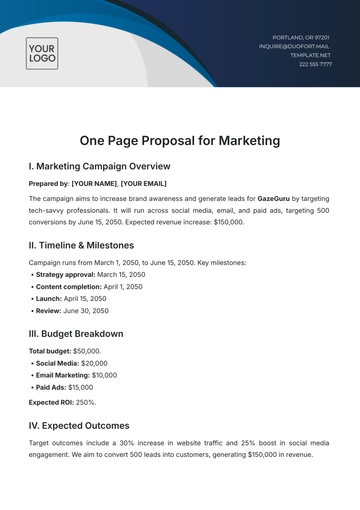
marketing proposal template small business download
Source: Template.net
marketing proposal template small business google docs

Source: Smartsheet
small business proposal template
Source: Template.net
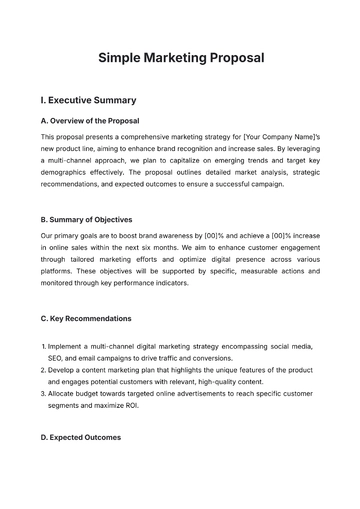
small business proposal template sample
Source: Template.net
small business proposal template examples

Source: Smartsheet
small business proposal template doc
Source: Template.net
small business proposal template format
Source: Template.net
small business proposal template for sales
Source: Template.net
Frequently Asked Questions
What should a marketing proposal for a small business include?
A useful proposal normally includes an executive summary, client problem, objectives, audience or market insight, proposed strategy, scope of work, deliverables, timeline, pricing, measurement approach, qualifications, terms, and next steps. The exact sections should be adjusted to the project rather than included simply because they appear in a standard template.
How long should a small business marketing proposal be?
There is no universal page count. A simple campaign may be adequately explained in a few pages, while a complex engagement may require more detail. Clarity is more important than length. Remove information that does not help the reader understand or evaluate the proposed engagement.
Should a marketing proposal include a budget?
Yes, when the proposal is asking for approval or payment. The investment should clearly distinguish professional fees, advertising spend, production expenses, software or third-party costs, and optional items when those distinctions matter.
What is the difference between a marketing proposal and a marketing plan?
A marketing plan is generally a strategic management document describing how a business intends to pursue marketing objectives. A marketing proposal is typically an offer or recommendation presented to obtain approval, funding, or a client engagement. They can contain many of the same strategic elements but serve different decision-making purposes.
Can a marketing proposal template be reused?
Yes. Reusing the structure is one of the main reasons to maintain a template. However, the client problem, objectives, research, strategy, deliverables, pricing, evidence, and assumptions should be customized for each opportunity. A reusable framework should increase consistency without producing generic proposals.
What should a small business proposal template include for sales?
A sales-oriented proposal should make the buyer’s decision easy. It should connect the customer’s problem to the recommended solution, define the scope, explain the value, show the investment, address responsibilities and timing, provide relevant proof, and finish with a clear next action.
The most effective proposals are not simply attractive documents. They are decision-making tools that organize evidence, strategy, scope, investment, and next steps into a logical story. When a marketing proposal template small business is built around that principle, it can save preparation time while helping agencies, consultants, freelancers, and business teams produce clearer and more credible proposals that are easier for prospects to understand and evaluate.
