A well-structured pay per click ppc marketing campaign Template turns a complex advertising plan into a clear working system. Instead of keeping campaign goals, keywords, ad groups, budgets, landing pages, and performance notes in disconnected documents, a good template brings the important decisions into one organized framework. It can be used before launch, during campaign management, and during regular performance reviews.
The strongest templates are not simply blank forms. They help marketers make decisions in a logical order: define the business objective, identify the audience, research search intent, organize keywords, establish campaign structure, prepare advertisements, connect landing pages, set measurement rules, and establish a review process. The template therefore becomes a planning control rather than just a place to record information.
For a small business, agency, ecommerce team, or in-house marketing department, the same basic structure can be adapted to different markets and advertising platforms. The important principle is consistency. Campaign information should be organized so another person can understand what the campaign is trying to accomplish, why particular keywords were selected, how spending is allocated, and which results determine future decisions.
What a PPC Campaign Template Should Contain
A useful template begins with campaign identity. Record the campaign name, business unit, primary objective, target market, advertising platform, campaign period, geographic focus, language, and responsible owner. These fields seem basic, but they prevent confusion when several campaigns have similar names or when multiple markets are managed simultaneously.
The next layer is strategic intent. A campaign designed to generate qualified leads should not be measured in exactly the same way as a campaign designed to increase ecommerce purchases or build awareness. The template should therefore connect the objective to one or more measurable outcomes. Examples include qualified enquiries, purchases, booked consultations, revenue, or another clearly defined business action.
A strong structure also separates planning assumptions from actual results. Estimated CPC, expected conversion rate, planned spend, and projected conversions belong in the planning area. Actual clicks, cost, conversions, and revenue belong in the performance area. Keeping these categories separate makes it easier to determine whether a campaign is meeting expectations without confusing forecasts with observed results.

Start With the Campaign Objective
The first substantive section of a campaign template should answer one question: what business result is this campaign expected to produce? A vague objective such as “get more traffic” is difficult to optimize because traffic alone does not explain whether visitors are valuable. A better objective identifies the desired action and the business reason behind it.
For example, a local service business might use a template to define its primary objective as generating qualified enquiry forms and phone leads. An ecommerce company might focus on profitable purchases. A software company might track demo requests or qualified trial registrations. These examples are hypothetical, but they illustrate why the campaign objective should be selected before keywords and advertisements are organized.
The objective should then determine the core measurement fields. A lead campaign may need lead volume, cost per lead, qualified-lead rate, and lead value. An ecommerce campaign may need transactions, revenue, advertising cost, conversion value, and return on advertising spend. The template should make the connection between the objective and these metrics visible rather than leaving measurement decisions until the end.

Keyword Research and Search Intent
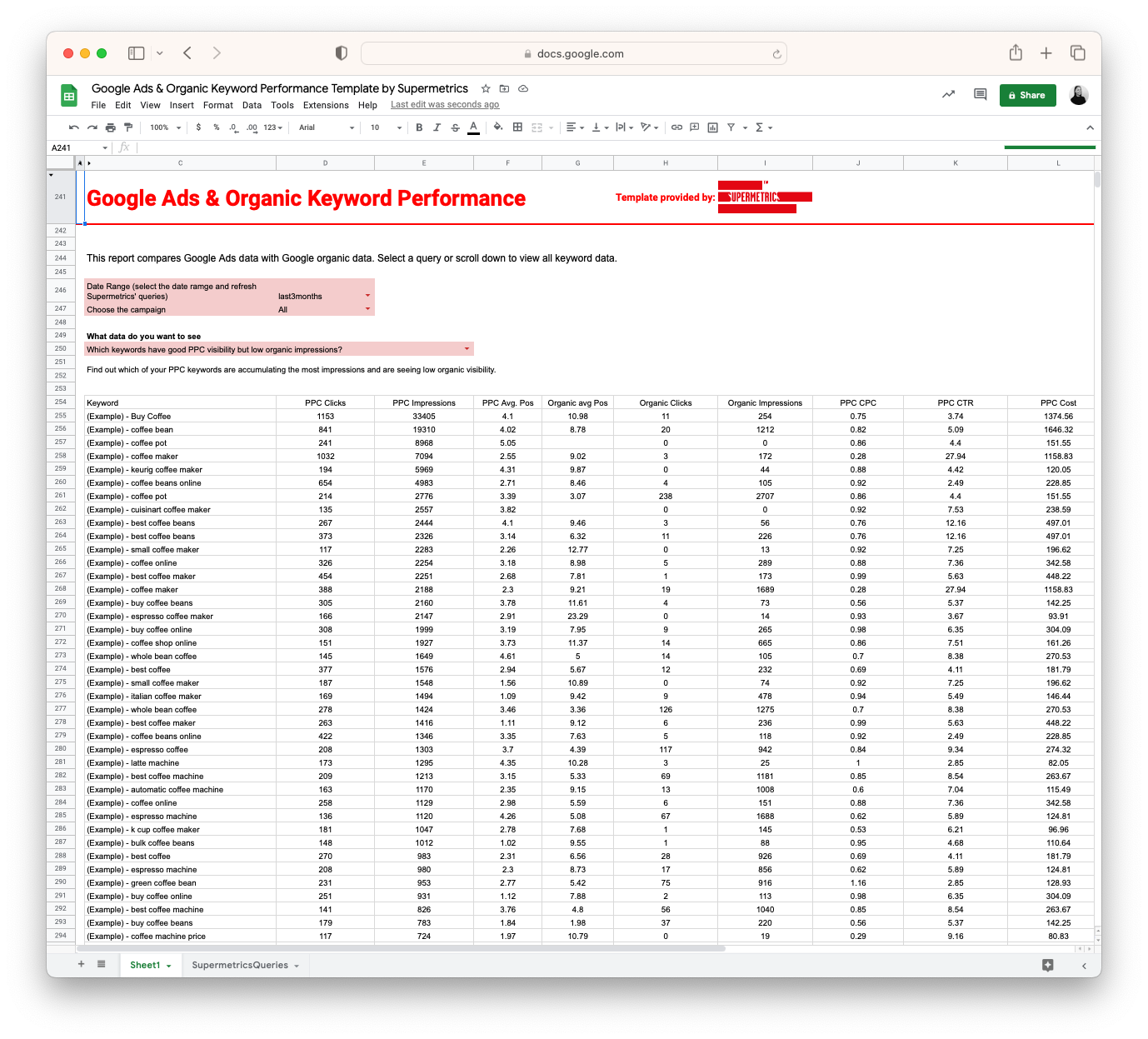
Keyword research is one of the most important sections of a PPC planning framework because keywords connect customer searches with advertising messages. A practical worksheet should include the keyword, topic, intent, match type, campaign, ad group, landing page, and notes. Additional fields can record estimated demand, competition, commercial value, or historical performance when those data points are available.
Search intent deserves special attention. A person searching for “what is accounting software” has a different need from someone searching for “accounting software pricing” or “buy accounting software for small business.” The template should allow keywords to be grouped according to the problem the searcher is trying to solve, not simply because the phrases contain similar words.
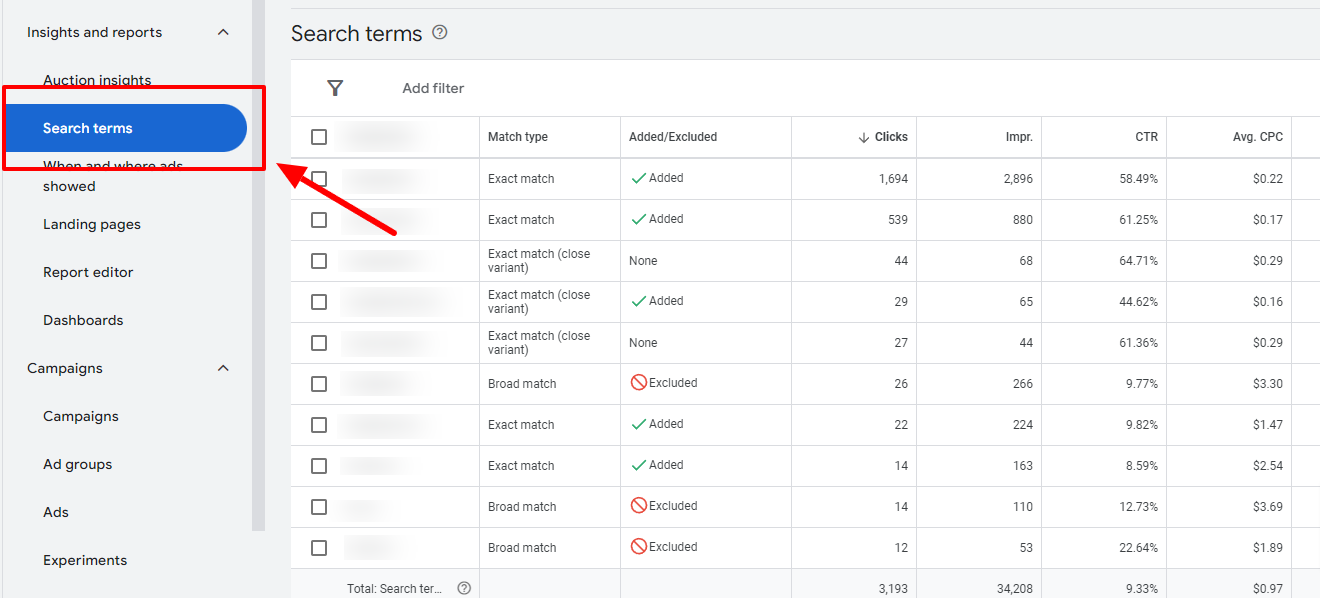
Modern search advertising also requires attention to keyword matching. Google Ads currently describes broad, phrase, and exact matching as different ways of controlling how closely searches relate to selected keywords. Negative keywords provide an additional control by excluding unwanted searches. A template should therefore include a dedicated field for negative terms and a process for reviewing actual search queries after launch.


Organizing Campaigns and Ad Groups
Campaign structure should make management easier rather than creating unnecessary complexity. A template can begin with campaign-level fields and then connect each campaign to focused ad groups. Each ad group should contain a coherent set of keywords and advertisements that address a closely related search theme.
Consider a hypothetical home-services company. One campaign could focus on emergency services while another targets planned installations. Within the emergency campaign, separate ad groups could represent different service categories. This organization makes it easier to create advertising messages that closely match the searcher’s needs and to understand which themes are producing valuable results.
The template should also document geographic segmentation when different locations require different offers, budgets, or landing pages. If the business serves multiple countries, cities, or regions, location should be a deliberate planning field rather than something added casually during setup. A clear structure makes later reporting and budget decisions much easier.
Budget Planning and Bid Strategy
A PPC template should make the financial side of the campaign visible before advertising begins. Record the planned daily or monthly budget, campaign allocation, expected traffic assumptions, and the performance threshold that would justify increasing or decreasing spending. This creates a clear financial framework for optimization.
Budget planning should not be based only on how much money is available. It should consider the economic value of the conversion being pursued. For example, a business selling a high-value service may tolerate a higher cost per qualified lead than a business selling a low-margin product. The correct threshold depends on business economics, sales conversion, margin, and customer value.
A useful template also includes pacing fields. Compare planned spending with actual spending for the period, then identify whether the campaign is ahead, behind, or roughly aligned with its spending plan. Budget pacing is especially important when a campaign has a fixed monthly limit or when several campaigns compete for the same marketing resources.


Writing and Testing PPC Ad Copy
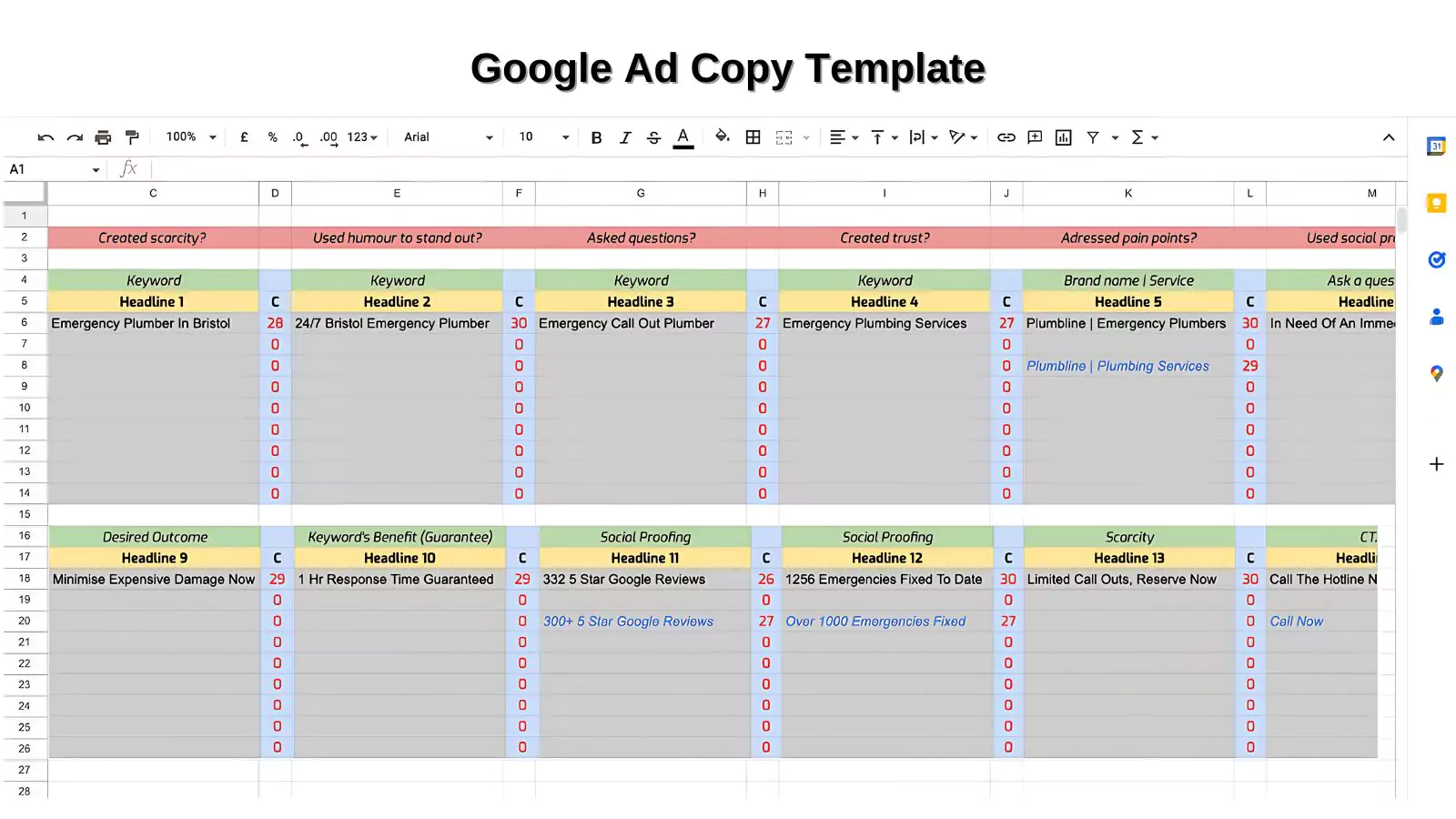
The advertising section of the template should give each ad group enough room for multiple message variations. Useful fields include headline ideas, descriptions, value propositions, calls to action, promotional details, landing page destinations, and notes about the audience problem being addressed.
Strong ad planning begins with relevance. The advertisement should reflect the intent behind the associated keyword group and should prepare the searcher for the landing page experience. If an advertisement promises a particular service, price structure, feature, or benefit, the destination page should make that information easy to find.
Testing should also be documented systematically. Instead of changing several variables at once and then guessing what caused a performance change, record what message was changed, why it was changed, the date of the change, and the resulting observation. This creates an institutional record that becomes increasingly valuable as the campaign matures.
Landing Page Alignment
The landing page should be treated as part of the PPC campaign rather than as a separate web project. The campaign template should identify the destination URL or page, the main conversion action, the headline promise, the offer, and any important notes about relevance.
A simple alignment test is to compare three things: the user’s search intent, the advertising message, and the landing-page message. If these three elements address different needs, the campaign can create friction even when the keyword targeting is sound. A visitor should quickly understand that the destination page relates to the reason they clicked the advertisement.
The template can also include a landing-page review checklist covering mobile usability, page clarity, conversion path, form requirements, calls to action, trust information, and measurement. This keeps landing-page quality inside the campaign workflow instead of leaving it as an afterthought.

Conversion Tracking and Measurement
Measurement needs to be defined before performance data starts accumulating. The template should identify each primary conversion, its business meaning, its source, and how the value is interpreted. A conversion should represent a meaningful action rather than simply a convenient metric.
Tracking should also distinguish between primary outcomes and supporting events. A completed purchase may be a primary outcome, while a product-page visit could be a supporting event. The exact configuration depends on the business model, but the template should make the distinction clear so performance reports do not treat every interaction as equally valuable.
Record tracking checks as part of the launch process. Confirm that important actions are being recorded, that values are sensible where values are used, and that reporting systems are aligned. A campaign can have excellent advertisements and keywords but still make poor decisions if the measurement layer is incomplete or inconsistent.


Performance Reporting
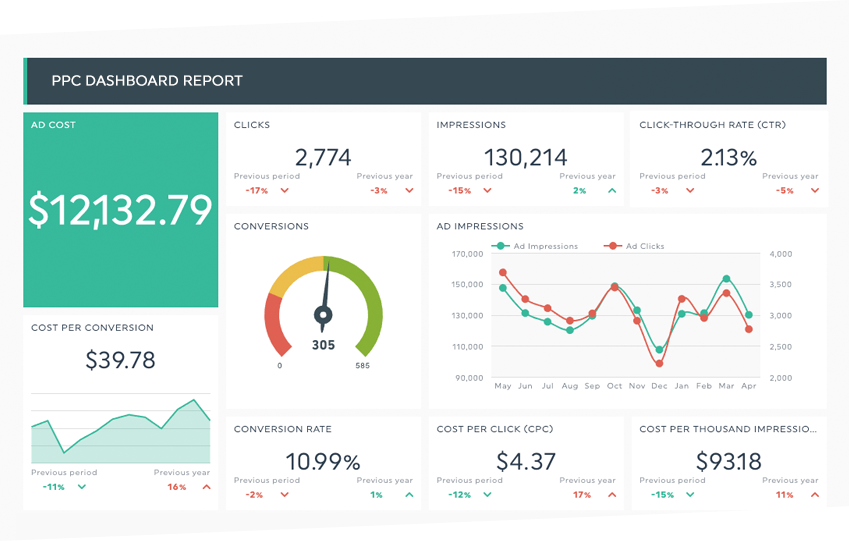
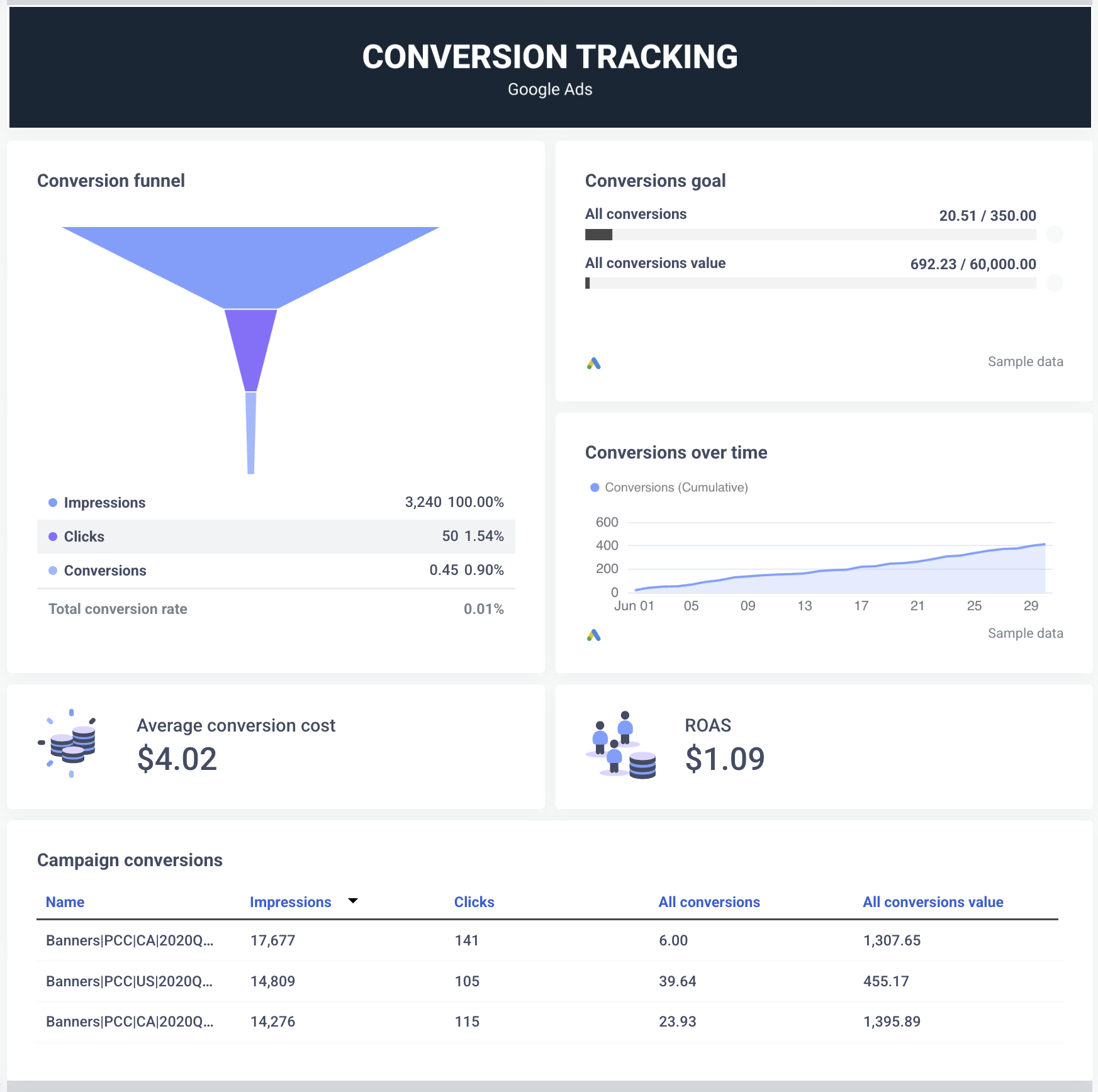
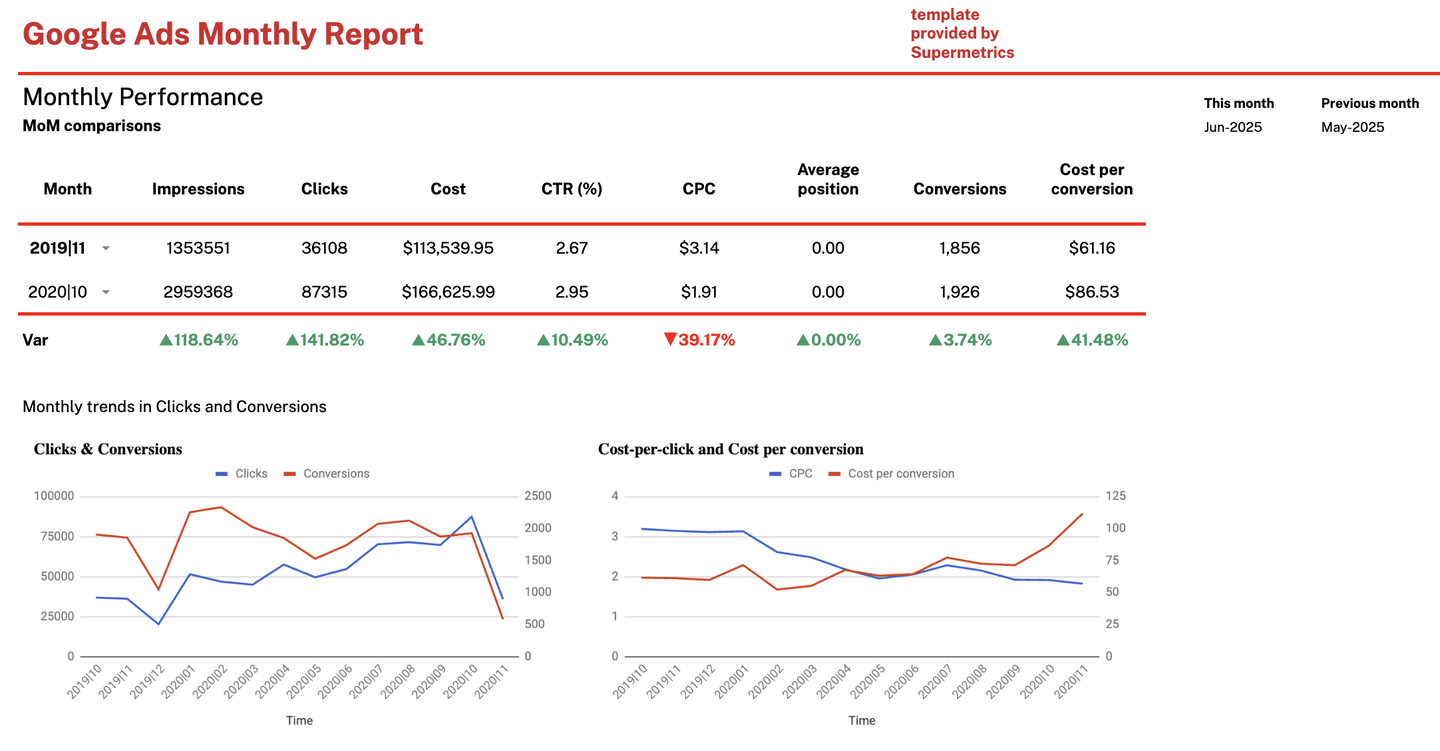
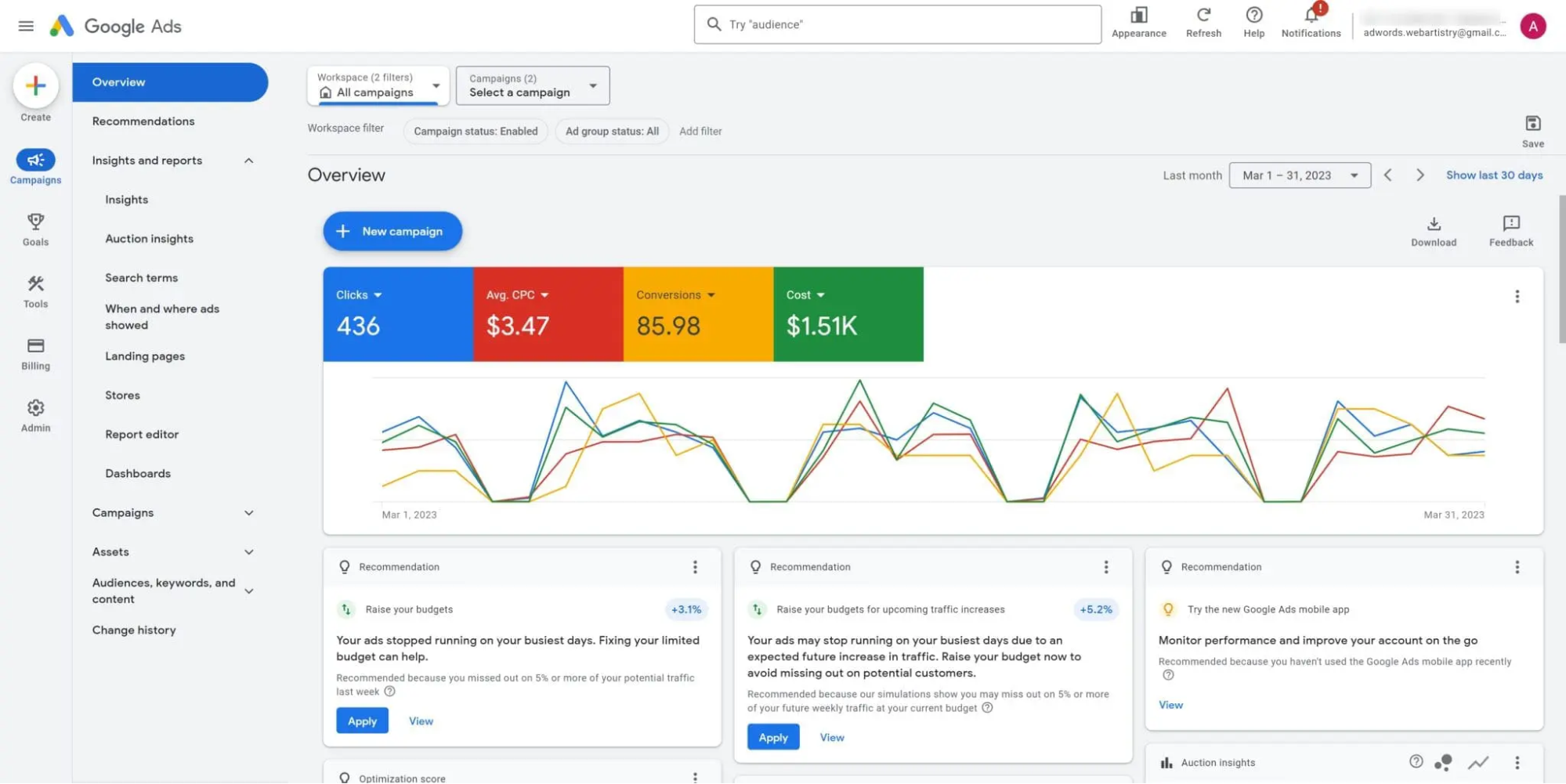
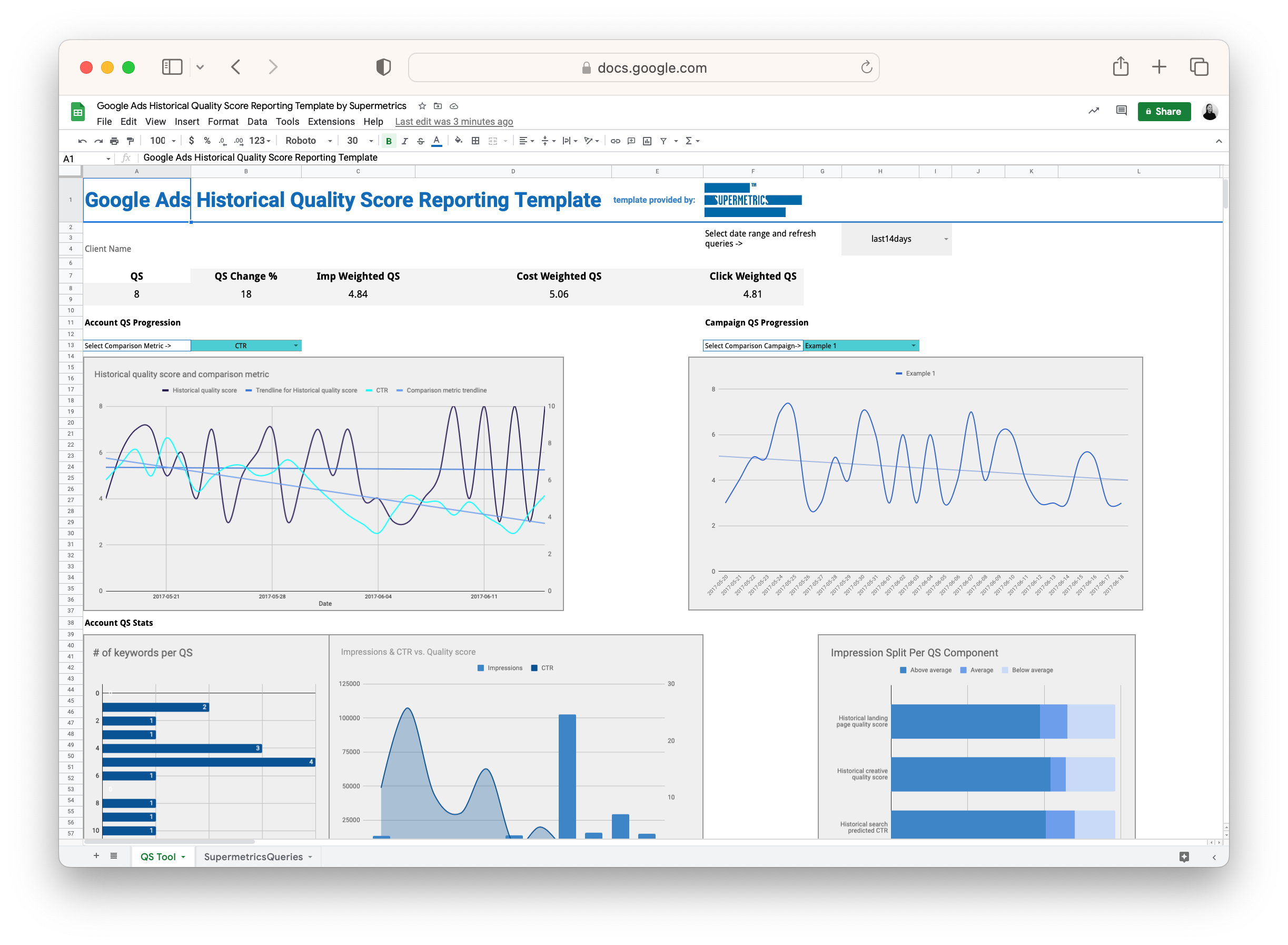
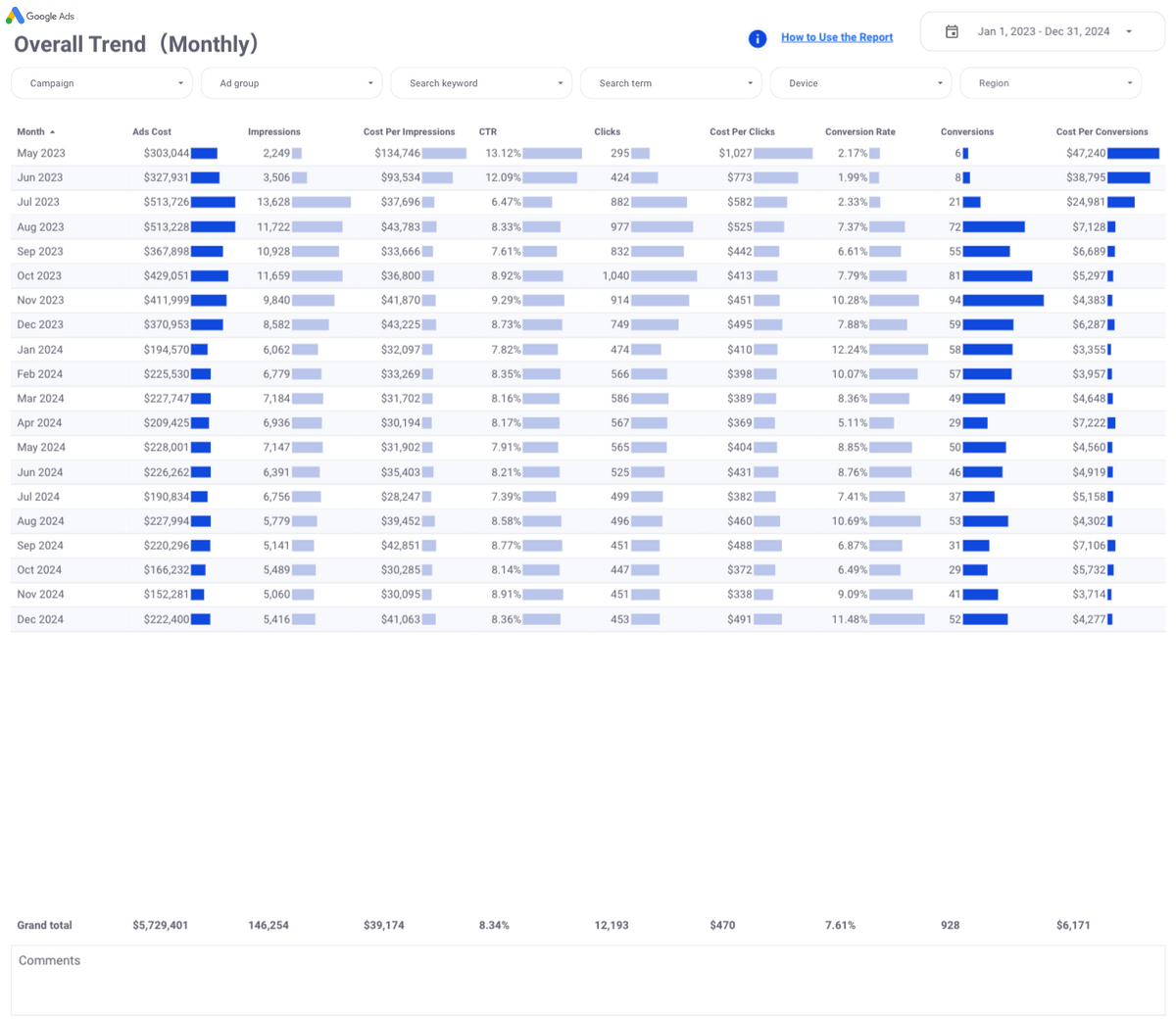
A good campaign template should evolve into a reporting framework. At minimum, the reporting area can track impressions, clicks, click-through rate, cost, average cost per click, conversions, conversion rate, cost per conversion, and revenue or conversion value when those figures are meaningful to the business.
Metrics should be interpreted together rather than individually. A lower CPC is not automatically better if the resulting traffic produces fewer valuable conversions. Likewise, a higher click-through rate may look positive while the landing page fails to convert those visitors. The template should encourage decisions based on relationships between metrics rather than isolated numbers.
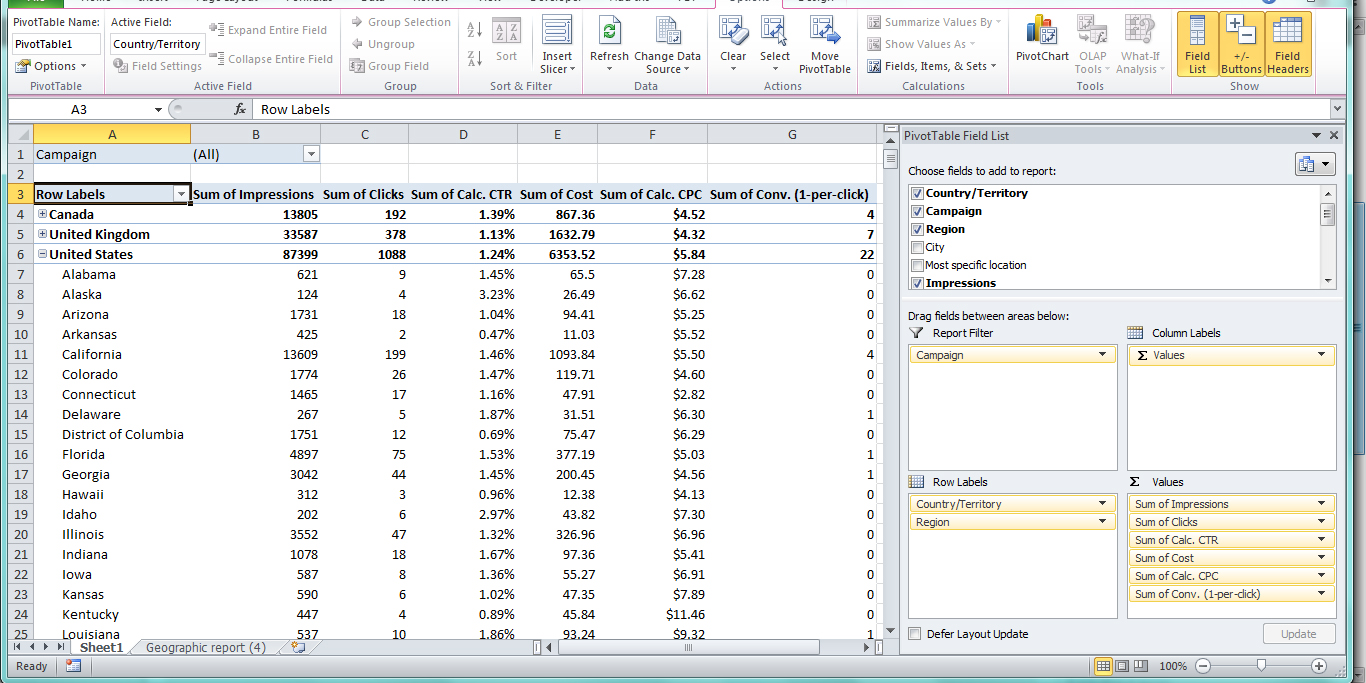
Segmented reporting is equally important. Review performance by campaign, ad group, keyword, device, geography, audience, and time period when those dimensions are relevant. Segmentation helps reveal whether an overall result is being driven by one strong area, several weak areas, or a change affecting the entire account.
Regional Planning for International Campaigns
Campaign templates become particularly useful when a business operates across several markets. A regional planning area can record country, region, language, currency, timezone, landing page, campaign objective, and budget. This prevents assumptions from one market being copied into another without review.
For the UK, a useful template should distinguish local terminology, geographic targeting, currency, and landing-page considerations from campaigns designed for other markets. The same principle applies to Australia, where location coverage and local commercial terminology may require their own planning fields. These are planning considerations rather than universal regulatory requirements.
When several markets are managed together, the template should provide both local detail and an account-level summary. Local rows preserve operational information, while summary fields make it possible to compare spending and outcomes consistently. This structure can support a pay per click ppc marketing campaign Template uk workflow or a comparable international setup without forcing every market into exactly the same configuration.

Choosing the Right Template Format
Different teams need different document formats. A spreadsheet is usually strongest when the campaign contains many keywords, ad groups, budgets, or performance rows. A document format can work better for a campaign brief, strategic narrative, or approval process. A presentation format is useful when campaign objectives, strategy, and results need to be communicated visually to stakeholders.
A pay per click ppc marketing campaign template google sheets workflow can be useful when multiple team members need to review the same planning document. A pay per click ppc marketing campaign template excel workflow can be useful when the team relies heavily on formulas, structured analysis, or established spreadsheet processes. A pay per click ppc marketing campaign template word structure is more suitable when the main requirement is a narrative plan with headings, responsibilities, and approval notes.
For presentation-led planning, a pay per click ppc marketing campaign template powerpoint structure can summarize goals, audience, campaign architecture, budget, creative direction, and reporting. A document intended for printing can use a pay per click ppc marketing campaign template pdf structure, while teams collaborating inside Google’s document environment may prefer a pay per click ppc marketing campaign template google docs format. The best choice is the format that matches the team’s actual workflow.

Common Mistakes to Avoid
One common mistake is creating a template that records everything but helps with nothing. Do not add dozens of fields simply because they might be useful someday. Each field should support a decision, provide context, or make campaign management easier. If nobody knows why a column exists, it probably does not belong in the core planning sheet.
Another mistake is separating strategy from execution too aggressively. A keyword list without intent notes is less useful than a keyword list connected to audience needs and landing pages. Likewise, a budget sheet without business targets provides limited context. The strongest templates connect each major decision to the objective that justified it.
A third mistake is failing to maintain the template after launch. Campaign structure changes, search behavior changes, landing pages change, and performance patterns evolve. Schedule regular reviews so the template remains an accurate representation of the campaign. Outdated documentation can be almost as problematic as having no documentation.
Practical Solution
Build the pay per click ppc marketing campaign Template as a sequence rather than a single blank worksheet. Start with campaign identity and business objective. Add audience and geographic information next. Then create the keyword research area, including intent, theme, match type, negative terms, and destination page. After that, organize campaigns and ad groups so each group has a clear purpose.
Next, create an advertising section that connects each ad variation to its keyword theme and landing page. Add budget fields for planned spend, actual spend, and pacing. Add measurement fields for primary conversions and supporting events. Finally, create a reporting section that compares results against the original objective and records the decision taken after each review period.
For a practical operating routine, review the template before launch, after the first meaningful body of search data is available, and at regular intervals thereafter. During each review, identify one of three outcomes for major campaign components: retain, revise, or remove. Record the reason rather than changing settings silently. This turns the template into a decision history that can help future campaign managers understand what has already been tested.
If the campaign serves several markets, create a shared master structure and then add market-specific fields where necessary. This approach is useful for a pay per click ppc marketing campaign template australia workflow as well as campaigns covering other countries. The structure should remain consistent enough for comparison while allowing local keywords, language, geography, offers, and landing pages to be managed correctly.


How to Keep the Template Useful Over Time
The best campaign template is a living management document. Its role changes as the campaign moves from research to launch and then optimization. Before launch, the emphasis is on assumptions and structure. After launch, the emphasis shifts toward observed search behavior, performance, budget pacing, and decisions.
Use clear naming conventions so campaigns, ad groups, and reporting rows remain understandable months later. Keep dates beside major changes. Record important tests and their purpose. If a keyword is removed because it repeatedly produced irrelevant searches, document that reason. If a landing page is changed because the previous version did not support the advertising message, record that too.
Finally, keep strategic information separate from raw performance data when the sheet becomes large. A concise campaign overview can provide the decision-maker with the essential picture, while detailed tabs or sections can preserve keyword, search-term, ad, budget, and conversion information. This balance keeps the template useful for both day-to-day management and higher-level review.
Reference Examples
A pay per click ppc marketing campaign Template is most useful when it represents the full decision path of a paid search campaign rather than one isolated task. A strong reference should show how objectives connect with keyword research, campaign structure, ad messaging, budgets, landing pages, measurement, and reporting. Spreadsheet examples are particularly useful for understanding how information can be organized into rows and columns, while dashboards demonstrate how campaign results can later be summarized for decision-makers. The most useful visual references are therefore practical working structures rather than decorative marketing graphics, because they reveal how campaign information can be organized and reviewed.
The following examples show different parts of the pay per click ppc marketing campaign Template concept, including planning worksheets, keyword structures, reporting dashboards, budget pacing views, conversion measurement, and ad copy organization. They should be treated as visual references rather than universal formats. A campaign manager can adapt the structure to the business objective, advertising platform, market, budget, measurement model, and reporting requirements. Comparing several formats makes it easier to identify which fields are genuinely useful and which elements would create unnecessary complexity in a working campaign document.
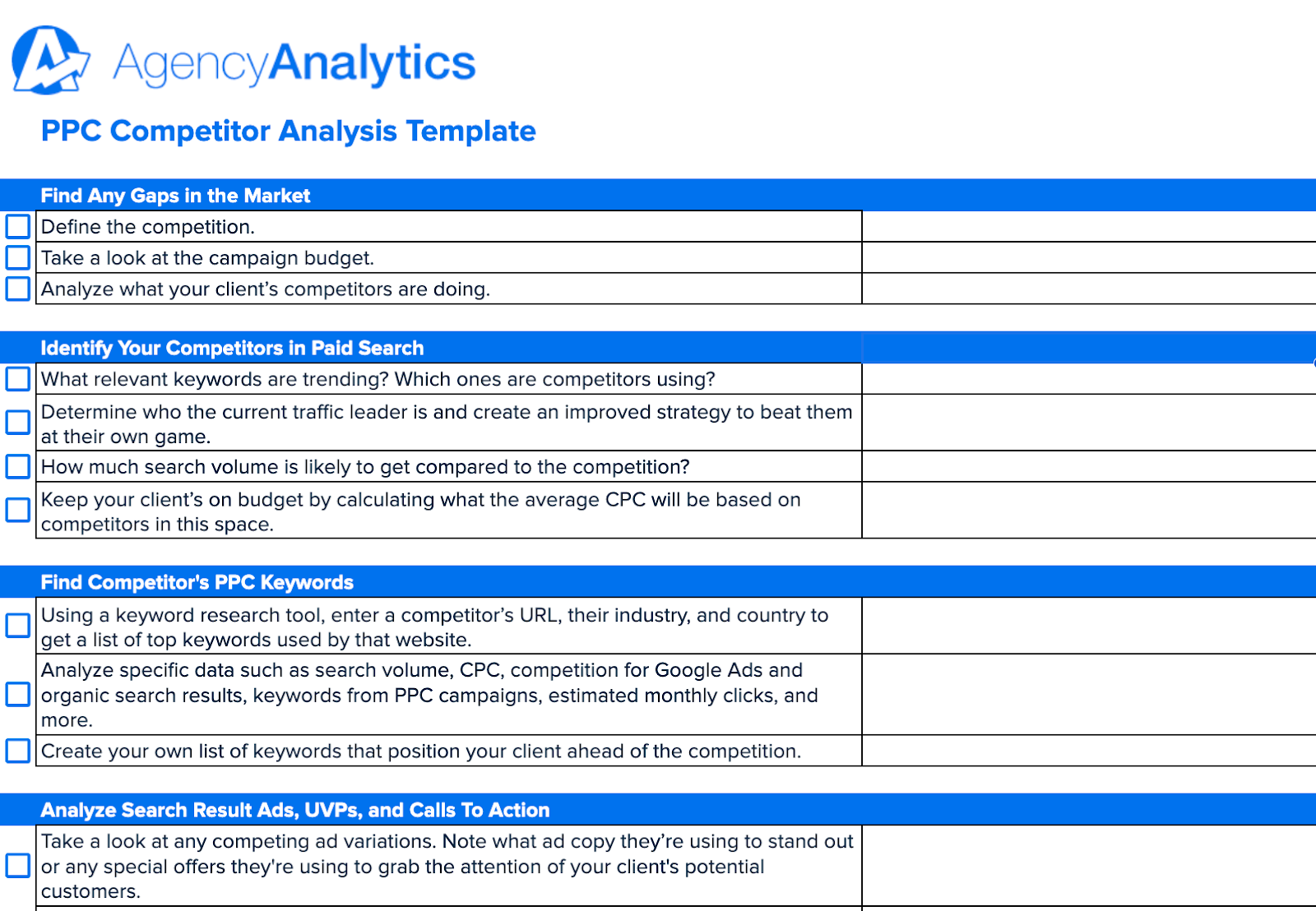
PPC Competitor Analysis Checklist
Source: AgencyAnalytics
Google AdWords Planning Template
Source: SlideShare
Google Ads Search Campaign Performance
Source: Business Antidote
How to Conduct a PPC Audit

Source: Scribd
Sample Keywords List for Bulk Upload
Source: Bounteous
Google Ad Copy Template Overview
Source: PowerAdSpy
Google Ads Pacing Dashboard Overview
Source: Funnel
Google Ads Conversion Tracking Dashboard
Source: Whatagraph
Adwords Campaign Planner Spreadsheet
Source: Learn Digital Advertising
Google Ads & Organic Keyword Performance Template
Source: Supermetrics
