A business separation agreement is a written record of how two or more business owners will end, restructure, or separate their commercial relationship. The central purpose is to turn a difficult transition into a defined set of obligations covering ownership, money, assets, liabilities, records, intellectual property, customers, confidentiality, and future responsibilities. A well-structured business separation agreement Template can provide a useful starting framework, but the document should be adapted to the actual business entity, existing governing documents, transaction terms, and law of the relevant jurisdiction.
People searching for a business separation agreement template are usually looking for more than a blank page. They want to understand what clauses belong in the document, how a departing owner’s interest should be handled, how payment should be documented, and how remaining owners can continue operating without leaving unresolved obligations behind. Those questions make the structure of the agreement just as important as the wording of individual clauses.
The term “business separation agreement” can describe several different situations. One partner may be leaving while the company continues. Two owners may be dividing the business into separate operations. A shareholder may transfer shares to another owner. An LLC member may sell a membership interest. Alternatively, all partners may agree to wind up the partnership. The correct document therefore depends on whether the business relationship ends completely or only one owner’s participation ends.

What a Business Separation Agreement Is Designed to Accomplish
The strongest agreements begin by defining the separation event precisely. The document should identify the parties, the legal name of the business, the ownership structure, the effective date, and whether the business itself will continue. If one owner is departing and another owner is acquiring that interest, the agreement should say so directly rather than using broad language that could be interpreted as a complete business dissolution.
A separation agreement also creates a written record of the financial settlement. This may involve a purchase price for an ownership interest, repayment of a capital account, treatment of outstanding loans, assumption of liabilities, allocation of unpaid invoices, or another negotiated arrangement. Payment terms should be specific enough that both sides can determine what is owed, when it is due, and what happens if a payment is late.
Another important function is closing the operational gaps that often appear after an owner leaves. The parties may need to address bank access, accounting records, customer contracts, websites, domain names, equipment, inventory, intellectual property, insurance, tax records, passwords, business names, and continuing obligations. A good agreement does not merely announce that the relationship has ended; it explains how the practical transition will occur.
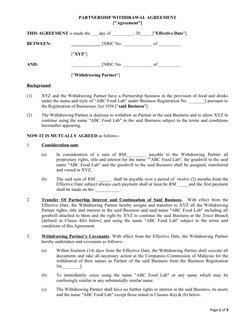
Separation, Withdrawal, Buyout, and Dissolution Are Not the Same
A useful first step is deciding what type of separation is actually occurring. A withdrawal generally describes an owner leaving an ongoing business. A buyout involves the purchase of that person’s ownership interest. A dissolution involves ending the partnership or entity’s business relationship and typically leads to winding-up activities. A separation agreement may combine elements of more than one of these concepts.
This distinction matters because the document’s provisions will change depending on the transaction. If one partner sells an interest and the remaining partner continues the enterprise, the agreement should focus heavily on valuation, purchase price, transfer of ownership, liabilities, management authority, and transition obligations. If the entire partnership is ending, the agreement needs much more attention to liquidation, creditor obligations, asset distribution, final accounting, and closing procedures.
Existing governing documents should be reviewed before drafting. A partnership agreement, operating agreement, shareholder agreement, buy-sell agreement, articles, or other organizational document may already contain rules governing transfers, withdrawal, valuation, voting, consent, or dissolution. A new separation agreement should not casually contradict those provisions. Instead, the parties should determine whether the existing document controls, is being amended, or is being supplemented by the new agreement.

Core Information to Put at the Beginning
The opening portion should identify every party accurately. Use the full legal names of individuals and entities, their relevant addresses, and the legal name of the business. If an entity is involved, the agreement should identify the entity type where relevant. This reduces ambiguity when several businesses or similarly named entities are involved in the transaction.
The document should then state the effective date and define important terms. Examples include “Business,” “Departing Owner,” “Remaining Owner,” “Ownership Interest,” “Closing Date,” “Purchase Price,” “Assets,” “Liabilities,” and “Confidential Information.” Definitions are particularly useful when the transaction involves several categories of property or multiple dates.
The background section can briefly explain how the parties became owners, what has been agreed, and why the agreement is being signed. It does not need to describe every disagreement that led to the separation. The goal is clarity rather than creating an unnecessary narrative that could introduce conflicting statements.

Ownership and Valuation Provisions
Valuation is often the most commercially significant part of a business separation. The agreement should state exactly what ownership interest is changing hands and how its value was determined. Possible methods include a previously agreed formula, book value, an independent valuation, a negotiated fixed amount, or another method selected by the parties.
The valuation method should be described clearly enough that someone reviewing the agreement later can understand the calculation. If an independent valuation is used, identify the valuation date, the type of valuation, and who selects or pays the professional. If a formula is used, specify the financial period, accounting definitions, adjustments, and percentage ownership to which the formula applies.
Good drafting also separates the business valuation from the final amount payable to the departing owner. The final settlement may be reduced by amounts the departing owner owes the business or increased by amounts the business owes that owner. The agreement should identify these adjustments rather than leaving them to an informal accounting exercise after signing.

Payment Terms and Closing Mechanics
The purchase price is only one part of the financial arrangement. The agreement should state whether payment occurs at closing, through installments, or through another negotiated structure. For installment arrangements, specify the amount of each payment, payment dates, interest if any, permitted payment methods, and the consequences of missed payments.
Closing mechanics should identify what must happen before ownership changes. For example, the parties may need to sign an ownership transfer, deliver company records, return property, obtain required consents, update banking authority, assign contracts, or complete organizational filings. Listing these actions as closing conditions helps prevent one side from believing the transaction is complete while important steps remain outstanding.
The agreement should also identify when economic ownership changes. That date can affect profits, losses, voting rights, distributions, expenses, insurance, and responsibility for new obligations. If the business continues operating during a transition period, the agreement should state who has authority to make decisions during that period and how unusual transactions will be handled.

Assets, Liabilities, and Business Property
A separation agreement should distinguish between assets that remain with the continuing business and assets that transfer to the departing owner. Business property may include equipment, inventory, vehicles, furniture, domain names, websites, trademarks, customer lists, contracts, intellectual property, accounts receivable, deposits, and other rights.
Liabilities require equal attention. The agreement should identify existing debts, loans, leases, taxes, vendor balances, guarantees, pending claims, and other obligations. The parties should specify who will be responsible for each category after the separation. Merely stating that one party “assumes the liabilities” may be inadequate if the liabilities are not clearly identified.
Personal guarantees deserve particular care. A separation agreement between owners does not automatically release a departing owner from obligations owed directly to a bank, landlord, supplier, or another third party. If the transaction requires a departing owner to be released from a guarantee, the agreement should identify the steps required to obtain that release rather than treating the internal promise between the owners as sufficient.


Intellectual Property, Records, and Confidential Information
Intellectual property can be one of the most valuable parts of a small business, even when it does not appear prominently on a balance sheet. A separation agreement should identify who retains rights to business names, trademarks, copyrighted materials, designs, software, domain names, social media accounts, marketing materials, proprietary processes, customer databases, and other intellectual property.
Business records should also be addressed. Financial statements, tax records, invoices, contracts, customer communications, employee records, licenses, insurance documents, and historical accounting information may be needed by both parties after separation. The agreement can establish which records each party receives, how confidential information is handled, and how long records should be retained.
Confidentiality provisions should be drafted around the actual information that needs protection. A useful clause can distinguish ordinary public information from genuinely confidential business information. If the agreement contains restrictions concerning customers, employees, or competition, those provisions should be reviewed for jurisdictional enforceability rather than copied from a generic form.


Representations, Releases, and Indemnification
Representations are statements about facts that the parties are relying upon when signing the agreement. Depending on the transaction, they may address ownership, authority to sign, accuracy of financial information, absence of undisclosed claims, ownership of assets, or the parties’ right to transfer the interest. The appropriate representations depend on the transaction’s size and complexity.
A release provision can define which known or unknown claims between the parties are being resolved. It should be drafted carefully because a broad release can have consequences beyond the immediate financial settlement. The agreement should distinguish between claims being released and obligations that are expressly intended to survive signing.
Indemnification provisions allocate responsibility if a covered claim, liability, or loss arises after separation. For example, the parties might agree that one owner remains responsible for obligations attributable to that owner’s period of control. The exact scope, limitations, notice procedures, defense rights, and survival period should be negotiated rather than assumed from a generic form.


Dispute Resolution and Governing Law
A well-drafted agreement should explain what happens if the parties later disagree about performance. The parties may select negotiation, mediation, arbitration, court proceedings, or another process permitted by their circumstances. The agreement should identify the relevant procedure and avoid vague language that leaves the dispute mechanism uncertain.
Governing law provisions identify the jurisdiction whose law the parties intend to apply to the agreement. This is particularly important when owners live in different states or when the business operates in several jurisdictions. Governing law does not necessarily answer every procedural question, so venue and dispute provisions may need to be addressed separately.
Severability is another common provision. It is intended to address the situation in which a particular clause is later found invalid or unenforceable. The drafting should make clear whether the remaining provisions are intended to continue operating to the extent permitted by law.
A better visual comparison can be made by looking at the way different agreement forms separate the transaction into identifiable sections. The examples above show recurring document architecture: party identification, transaction terms, property or ownership provisions, closing mechanics, liability treatment, governing law, and signatures. The precise wording should not be copied automatically, because a clause designed for an asset sale may not fit an LLC interest transfer or a partnership withdrawal.
The useful lesson is structural. A business separation document becomes easier to review when every important business question has a clear home in the agreement. Readers should be able to locate the ownership change, financial settlement, asset allocation, liability allocation, continuing obligations, dispute mechanism, and signature requirements without searching through unrelated paragraphs.
How to Create a Separation Agreement Template
When considering how to create a separation agreement template, begin with the transaction rather than the document format. Write a short description of what is happening in plain language: who is leaving, whether the business continues, who receives the departing owner’s interest, how the financial settlement works, and what date the separation becomes effective. This simple outline becomes the foundation for the formal clauses.
Next, create a clause map. A practical structure usually includes parties and definitions, background, separation or transfer, valuation, payment, assets, liabilities, records, intellectual property, confidentiality, representations, releases, indemnification, continuing obligations, dispute resolution, governing law, miscellaneous provisions, and signatures. Not every transaction needs every clause, but the map helps expose important omissions before drafting becomes more detailed.
Finally, compare the proposed document with the business’s existing organizational records. Confirm ownership percentages, legal names, existing transfer restrictions, outstanding debts, contracts, and prior agreements. The objective is to produce one coherent transaction record rather than several documents that contradict each other. Where significant ownership, tax, employment, real estate, intellectual property, or liability issues exist, professional review is prudent before execution.
How to Write a Separation Agreement Template That Is Practical
When evaluating how to write a separation agreement template, use precise verbs and measurable obligations. “The parties will cooperate” is less useful than identifying the exact action, responsible party, deadline, and required document. For example, a clause can specify that a departing owner must return identified company property by a stated date and provide designated records in a defined format.
Avoid combining unrelated issues into one broad paragraph. Ownership transfer, payment, liability allocation, confidentiality, and dispute resolution each answer different questions and should normally be separated into distinct provisions. This makes negotiation easier because the parties can revise one commercial issue without unintentionally changing another.
Use schedules or exhibits when the information is extensive. An asset schedule can list equipment and inventory. A liability schedule can identify debts and guarantees. An ownership schedule can state percentages before and after the transaction. A payment schedule can identify installment dates. These supporting sections can make the main agreement easier to read while preserving detailed information that needs to be precise.
Choosing a Word or PDF Format
People searching for a business separation agreement template word often want an editable working document that can be revised during negotiation. That format can be useful during drafting because names, dates, ownership percentages, payment terms, and schedules may change several times before the parties settle on final language.
A business separation agreement template pdf is more useful when the document has reached a stable review stage and the parties want a consistent visual record. A PDF can preserve pagination and formatting, but it should not be treated as proof that the underlying terms are legally appropriate. The substance of the agreement matters more than the file format.
The best workflow is generally to draft and negotiate in an editable format, conduct a careful legal and financial review, confirm the final version, and then create a final record for signature and retention. Regardless of format, keep the executed version together with the supporting schedules and documents that establish how the transaction was calculated.
State-Specific Considerations and California
A business separation agreement template california should not be treated as automatically suitable for every California transaction. California businesses may involve partnerships, LLCs, corporations, professional entities, or other structures, and each can have different organizational rules. The entity’s governing documents and the relevant California statutes should be checked before finalizing the separation terms.
California also requires special care when an agreement contains post-separation restrictions. A restriction concerning competition, customers, employees, or business activities should be reviewed under current California law rather than copied from an agreement used in another state. A clause that is common elsewhere may have a very different legal effect in California.
For a California transaction involving a partnership or other entity, consider whether additional state filings, ownership records, tax matters, licenses, fictitious business name records, or third-party consents are required. The separation agreement records the parties’ contractual arrangement, but it may not by itself complete every external step necessary to change public or third-party records.

Using a Template Without Treating It as the Final Agreement
A template for separation agreement is most useful as a checklist and drafting framework. It can help reveal the categories that need discussion, but it cannot know the parties’ ownership structure, tax position, contracts, debts, or negotiated business terms. Those facts must come from the actual transaction.
An example separation agreement template can also be useful for understanding document organization. When reviewing an example, look for the sequence of provisions and the questions each provision answers. Ask whether the example addresses ownership, consideration, assets, liabilities, confidentiality, records, releases, indemnification, dispute resolution, governing law, and signatures.
A written separation agreement template should ultimately be converted into a transaction-specific document. Replace generic placeholders with verified information, remove clauses that do not belong, add schedules where necessary, and make sure every financial number matches the parties’ accounting records. A document that looks polished but contains incorrect ownership or payment information is still a poor agreement.

Common Mistakes to Avoid
One common mistake is treating a business separation as a single payment event. Ownership changes often affect taxes, records, bank authority, contracts, insurance, management, intellectual property, and future liabilities. If those subjects are ignored, the parties can complete the financial payment while leaving operational uncertainty behind.
Another mistake is using inconsistent dates. The signing date, effective separation date, closing date, valuation date, and final payment date may be different. The agreement should define each date clearly and explain which rights and obligations attach to each one.
A third mistake is failing to distinguish internal responsibility from third-party responsibility. An owner can promise to reimburse another owner for a debt, but that internal allocation does not necessarily change the creditor’s rights. The agreement should therefore identify the parties’ internal obligations and separately identify any releases or consents that must come from outside parties.

Practical Solution
The most practical way to build a business separation agreement is to use a five-stage workflow. First, identify the transaction type and review every existing ownership and governance document. Second, create a written inventory of ownership interests, assets, liabilities, contracts, intellectual property, records, and outstanding payments. Third, agree on valuation and financial settlement terms before attempting to finalize detailed legal language.
Fourth, convert the commercial agreement into clearly organized clauses. State who transfers what, who pays whom, when the transfer occurs, which obligations continue, which obligations end, and which responsibilities survive closing. Attach schedules for assets, liabilities, payments, or ownership calculations when those details are too extensive for the main body. This makes later verification much easier.
Fifth, conduct a final consistency review. Check every name, entity designation, percentage, dollar amount, date, deadline, asset description, and signature block. Confirm that the separation agreement does not contradict the partnership agreement, operating agreement, shareholder arrangements, financing documents, or other controlling records. Where the transaction is substantial or legally complex, have qualified legal and financial professionals review the final terms before signing.

A useful final check is to read the document from the perspective of a person who was not involved in the negotiations. Could that reader determine exactly who owns the business after closing? Could they calculate the remaining payment? Could they identify which debts belong to each party? Could they determine who controls records, intellectual property, customer relationships, and confidential information?
If the answer to those questions is unclear, the document probably needs more precise drafting. The strongest agreements reduce the number of assumptions that must be made after signing. Every major commercial issue should have an identifiable provision, and every important obligation should have a responsible party and a measurable deadline where appropriate.

Practical Document Checklist
Before signing a separation agreement, review the document against the transaction rather than simply checking whether every heading is present. A shorter agreement can be better than a long agreement if it accurately covers the issues that matter. Conversely, a complex business may need extensive schedules and detailed provisions because a short form would leave important questions unanswered.
- Parties: Verify every legal name, entity name, address, and ownership role.
- Effective date: Distinguish signing, valuation, closing, and separation dates.
- Ownership: State the interest being transferred, retained, cancelled, or redistributed.
- Valuation: Explain the method used to determine the financial value.
- Payment: State the amount, timing, installments, interest, and payment conditions.
- Assets: Identify property, inventory, equipment, intellectual property, records, and accounts.
- Liabilities: Allocate debts, taxes, guarantees, leases, claims, and other obligations.
- Confidentiality: Identify information that must remain protected after separation.
- Records: Establish who receives financial, operational, tax, and historical records.
- Releases: Clearly identify claims being resolved and obligations that survive.
- Indemnification: State how covered losses or claims will be handled.
- Disputes: Define the process for handling disagreements after signing.
- Governing law: Identify the intended governing jurisdiction where appropriate.
- Signatures: Include the required parties, dates, and any needed witnesses or formalities.

Separation Agreement Paper Template Structure
A separation agreement paper template should be organized so that a reader can move logically from identification to transaction terms and then to completion requirements. A practical sequence is: title, parties, background, definitions, separation terms, ownership transfer, valuation, payment, assets, liabilities, records, continuing obligations, releases, indemnification, dispute resolution, governing law, miscellaneous provisions, and signatures.
The document should avoid unnecessary legal language that does not add meaning. Precision is more valuable than complexity. If a term has a specialized meaning, define it. If a deadline matters, state the date or calculation method. If a payment depends on an event, identify that event. If an asset is transferred, describe it clearly enough that the parties can identify it without relying on memory.
For a business with multiple owners, a schedule can be especially useful. It can show each owner’s percentage before the separation, the interest being transferred, the resulting ownership after closing, and the financial amount associated with the transaction. This gives the main agreement a clear factual reference point without forcing every calculation into the body of the contract.

Reviewing the Final Agreement Before Signing
The final review should be performed against source records. Ownership percentages should match organizational records. Financial figures should match the agreed valuation and accounting information. Asset descriptions should match inventories or schedules. Payment dates should be realistic. The names and addresses in the signature section should correspond to the parties identified at the beginning.
It is also useful to check internal consistency between clauses. For example, the ownership-transfer provision should agree with the payment provision, and the effective date should agree with the point at which management authority changes. A release should not accidentally contradict an indemnification clause. A confidentiality provision should not unintentionally prevent a party from retaining records it has a legitimate reason to keep.
Finally, consider what happens six months after signing. If a customer disputes an invoice, a tax notice arrives, a payment is missed, a former owner requests records, or a third party raises a claim, the agreement should provide enough direction to determine the parties’ respective responsibilities. Thinking through these future scenarios is one of the best ways to identify drafting gaps before execution.


Reference Examples
A business separation agreement is easiest to evaluate when its structure is viewed as a sequence of connected decisions rather than as isolated legal clauses. The examples below illustrate several related document formats used for ownership transitions, including LLC buyouts, partnership withdrawal notices, and joint venture arrangements. These documents demonstrate recurring elements such as party identification, ownership interests, payment terms, closing procedures, transfer restrictions, governing law, records, and signatures. They are useful visual references for understanding how a business separation agreement can be organized, while the exact wording and legal effect of any real agreement depend on the transaction and governing jurisdiction.
The following visual references also help distinguish between a departing-owner transaction and a complete dissolution. An LLC buyout document may concentrate on membership interests and closing, while a withdrawal notice focuses on the owner’s intention to leave. A joint venture agreement can show how ownership percentages, records, financial responsibilities, and dispute procedures are structured before a separation occurs. Comparing these formats can help readers recognize which provisions belong in their own business separation agreement and which provisions may belong in a different type of transaction document.
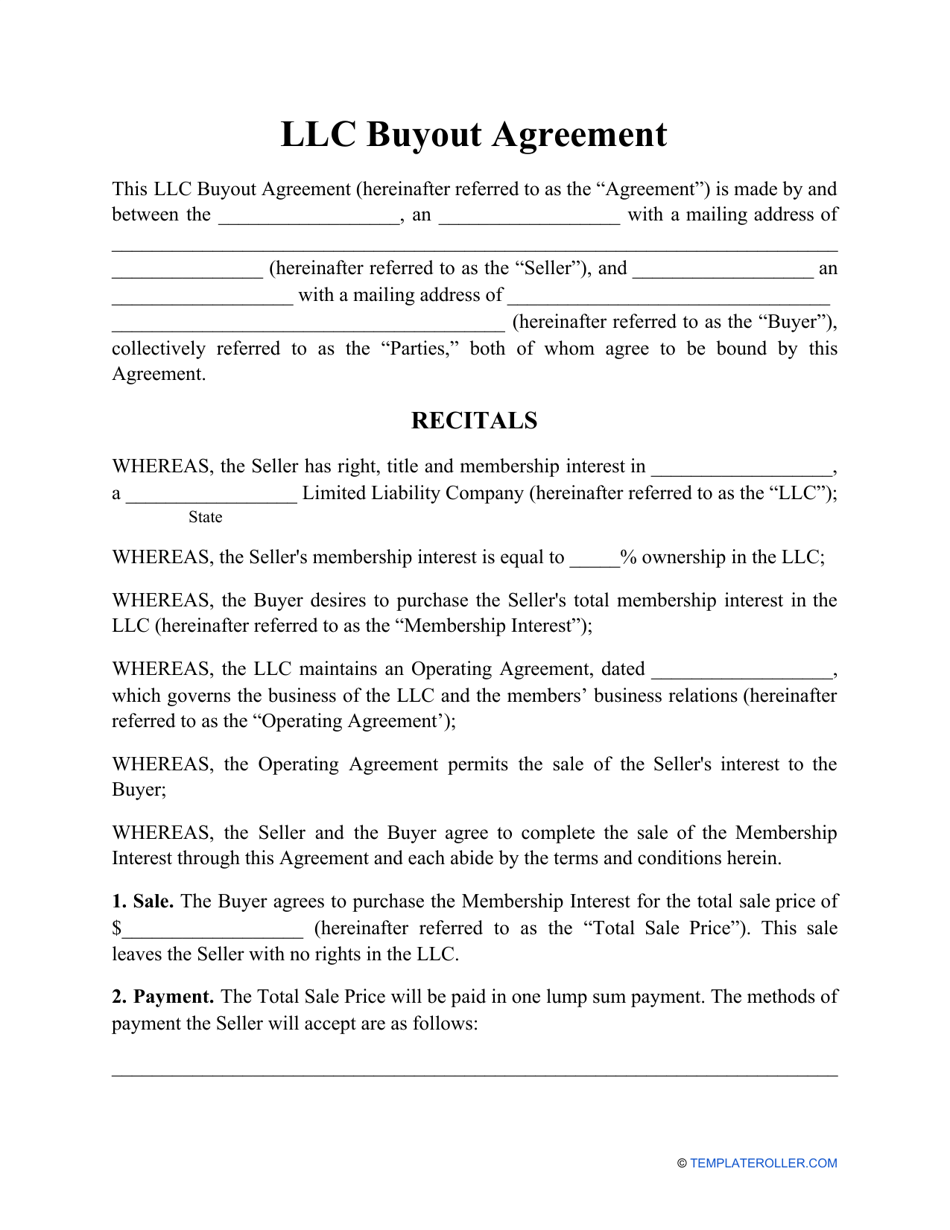
LLC Buyout Agreement, Page 1
Source: TemplateRoller

LLC Buyout Agreement, Page 2
Source: TemplateRoller

LLC Buyout Agreement, Page 3
Source: TemplateRoller

LLC Buyout Agreement, Page 4
Source: TemplateRoller

Notice of Withdrawal From Partnership
Source: TemplateRoller

Joint Venture Agreement, Page 1
Source: TemplateRoller

Joint Venture Agreement, Page 2
Source: TemplateRoller

Joint Venture Agreement, Page 3
Source: TemplateRoller

Joint Venture Agreement, Page 4
Source: TemplateRoller
