A financial hedge fund template is most useful when it turns a complex investment workflow into a consistent structure for research, analysis, documentation, monitoring, and review. Rather than treating a template as a single spreadsheet or report page, it is better to view it as a repeatable framework that connects the fund thesis, manager assessment, portfolio construction, risk controls, operating procedures, performance review, and investor reporting. This structure helps an analyst or investment committee compare information consistently while making it easier to identify missing evidence, unusual exposures, and changes over time.
The strongest template designs also recognize that hedge fund analysis is multidimensional. A manager can have an attractive historical record yet still require deeper review of leverage, liquidity, valuation, governance, service providers, concentration, conflicts, and operational resilience. Investor.gov advises prospective investors to understand where money is invested, who manages it, how the strategy works, and how investors can exit, while AIMA describes due diligence as a continuing process rather than a one-time event.
For that reason, a useful template should not simply collect numbers. It should preserve the reasoning behind an investment decision. The record should show what was reviewed, what evidence supported the conclusion, which risks were accepted, which issues remained unresolved, and what conditions would trigger another review. The result is a working research framework rather than a decorative document.
What a financial hedge fund template should accomplish
A well-designed financial hedge fund template begins with a clear purpose. An allocator may need a manager-selection worksheet, while an internal fund team may need a portfolio-monitoring structure or investor-reporting framework. These uses overlap, but they should not be mixed without clear labels. A selection document focuses on whether a manager deserves capital; a monitoring document focuses on whether the original thesis remains intact; a reporting document focuses on communicating verified results and exposures.
The template should therefore define its intended user, decision point, reporting period, source of information, review owner, and required evidence. Those fields may sound administrative, but they prevent a common weakness in investment research: collecting large amounts of information without establishing how the information affects the decision. A simple scoring field is useful only when the underlying criteria and evidence are also visible.
A practical structure can contain sections for fund identity, strategy, investment philosophy, portfolio construction, performance, risk, liquidity, leverage, operations, governance, service providers, terms, legal review, monitoring events, and final recommendation. AIMA’s due-diligence questionnaire framework similarly covers strategy, manager background, organization, fund terms, governance, performance, controls, risk management, and third-party service providers.

Core sections to include in the template
Fund profile and mandate
The opening section should establish exactly what is being reviewed. Record the fund name, strategy classification, launch period, investment objective, target market, geographic scope, instruments used, liquidity terms, valuation frequency, and reporting frequency. If the fund has several share classes or vehicles, identify which one is being evaluated so that terms and performance figures are not accidentally mixed.
The mandate section should also describe the strategy in plain language. Instead of relying on a broad label such as long/short equity or macro, explain the sources of expected return, typical holding periods, principal instruments, use of hedges, expected portfolio turnover, and the conditions under which the strategy may struggle. This makes later performance analysis much more meaningful because the reviewer knows what the manager claims to do.
A useful template can include a separate field for “stated process” and another for “observed process.” The distinction matters because a manager’s written philosophy may differ from actual portfolio behavior. Comparing the two over several review periods can reveal style drift, changing risk tolerance, or a strategy that has evolved beyond its original mandate.
Legal and structural information
Hedge funds can use different legal structures, investor vehicles, jurisdictions, and service-provider arrangements. A template should therefore document the fund entity, management entity, general partner or equivalent control structure, administrator, auditor, prime broker or financing counterparties, custodian arrangements where relevant, and legal counsel. The goal is not to assume that one structure is universally correct, but to make the relationships visible.
Master-feeder structures are one example of why structural mapping matters. A simplified SEC-filed example shows feeder entities investing into a master fund, which then invests in underlying investment funds. Such diagrams can help a reviewer understand where capital moves and which entities perform different functions.
The template should also include a field for unresolved structural questions. Examples might include uncertainty over beneficial ownership, unclear delegation, unusual related-party arrangements, or differences between documents. A blank field is not a weakness; it is a control that prevents unanswered questions from disappearing during committee review.

Investment philosophy and process
The investment-process section should explain how an idea moves from research to portfolio position. Record the source of ideas, research methods, investment committee involvement, portfolio-manager authority, trading rules, position-sizing logic, exit conditions, hedging practices, and escalation procedures. A strong record should let another reviewer understand the chain of reasoning without needing a verbal explanation from the original analyst.
This is where a hedge fund process template can be particularly useful. It can divide the workflow into sourcing, screening, research, thesis formation, risk review, position construction, execution, monitoring, and exit. Each stage can have required evidence and an owner. That creates an auditable sequence without forcing every manager into the same investment style.
FERI’s published description of hedge fund portfolio construction illustrates a related two-sided framework: top-down strategy selection and bottom-up manager analysis, including quantitative analysis, qualitative analysis, and manager due diligence. The lesson for template design is that strategy-level reasoning and manager-level reasoning should be connected but separately documented.
Performance analysis and financial modeling
Performance should never be represented by a single return figure. A financial hedge fund template should capture the measurement period, gross and net performance where available, benchmark or reference comparison, volatility, drawdown, correlation, and relevant risk-adjusted measures. The exact metrics should match the strategy rather than being included merely because they are familiar.
Performance attribution is equally important. A manager may report a positive return, but the reviewer needs to understand whether the result came from market exposure, security selection, sector positioning, trading, leverage, or a small number of unusually successful positions. Attribution can help distinguish repeatable sources of return from outcomes that may be difficult to reproduce.
A useful financial model can also separate management revenue, incentive revenue, operating expenses, financing costs, assets under management, and scenario assumptions. One published hedge fund projection model, for example, describes monthly three-statement projections, fee calculations, assets under management, operating costs, borrowing, and dashboard outputs. For an internal template, the key lesson is to make assumptions visible rather than burying them inside formulas.

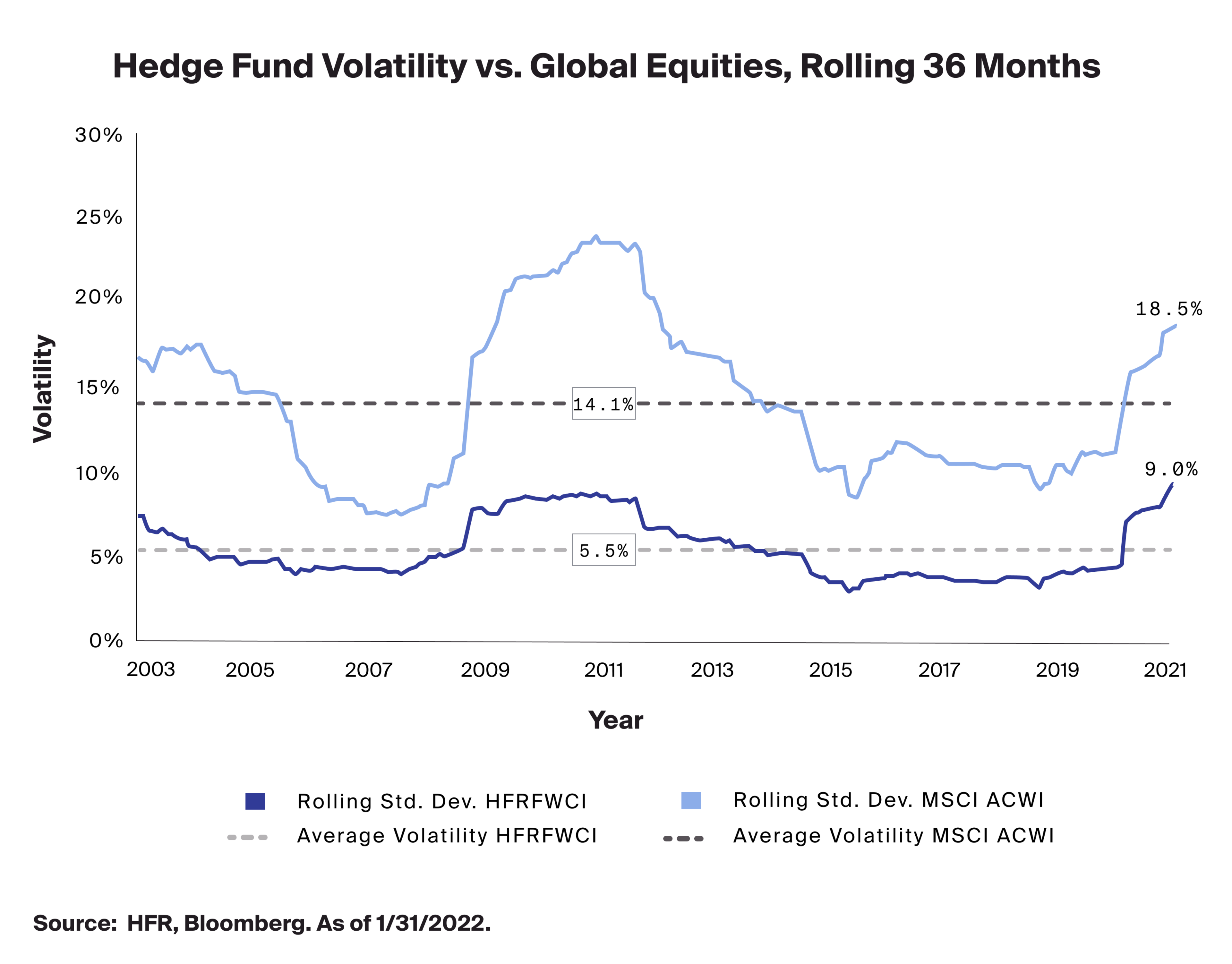
A hypothetical example might contain a monthly return series, a benchmark series, maximum drawdown, rolling volatility, and attribution by strategy. The figures in such an example should be clearly marked as illustrative. The template itself should provide fields for the source date and data provider so that historical numbers are not later mistaken for current information.
Risk management fields that matter
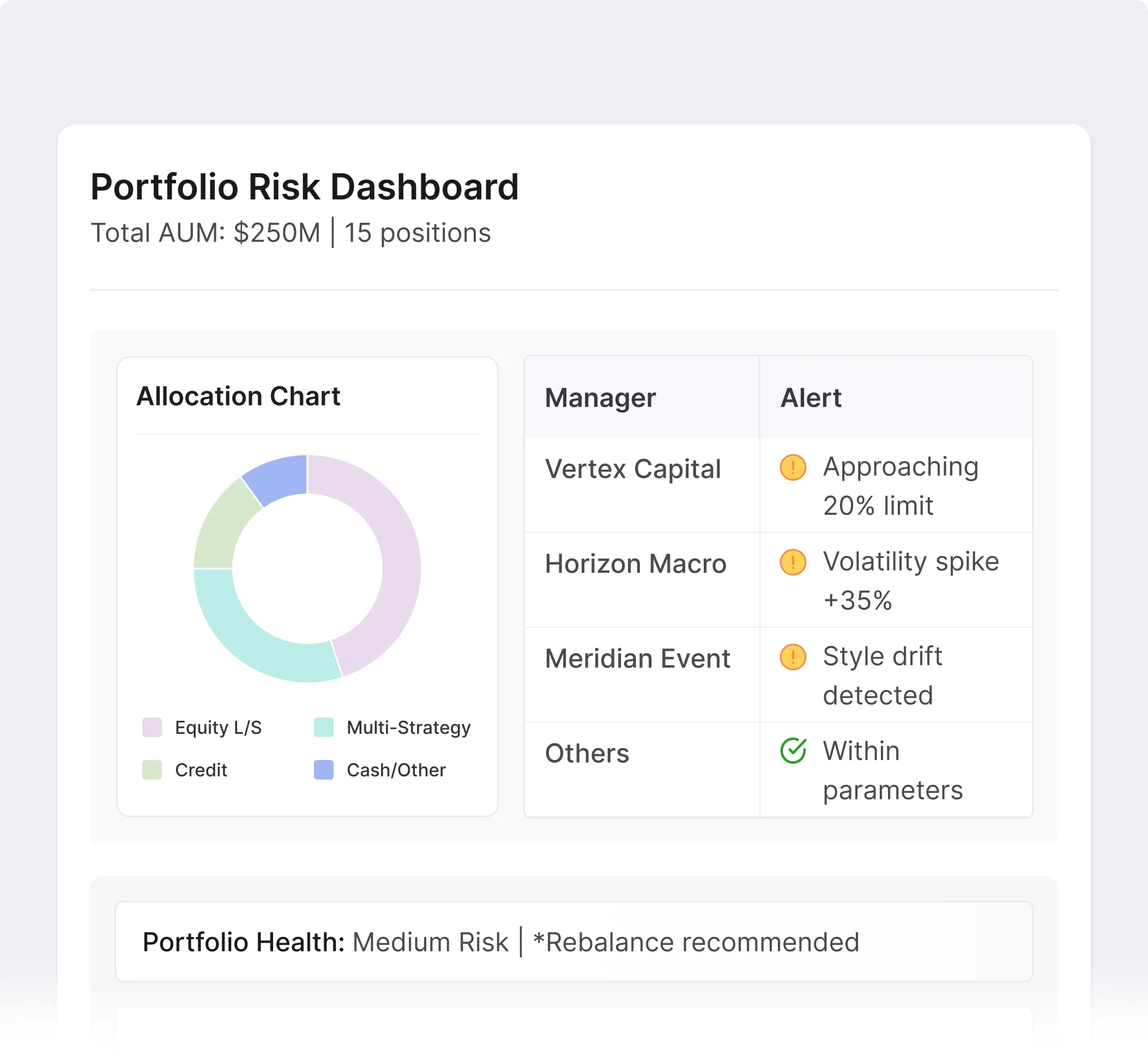
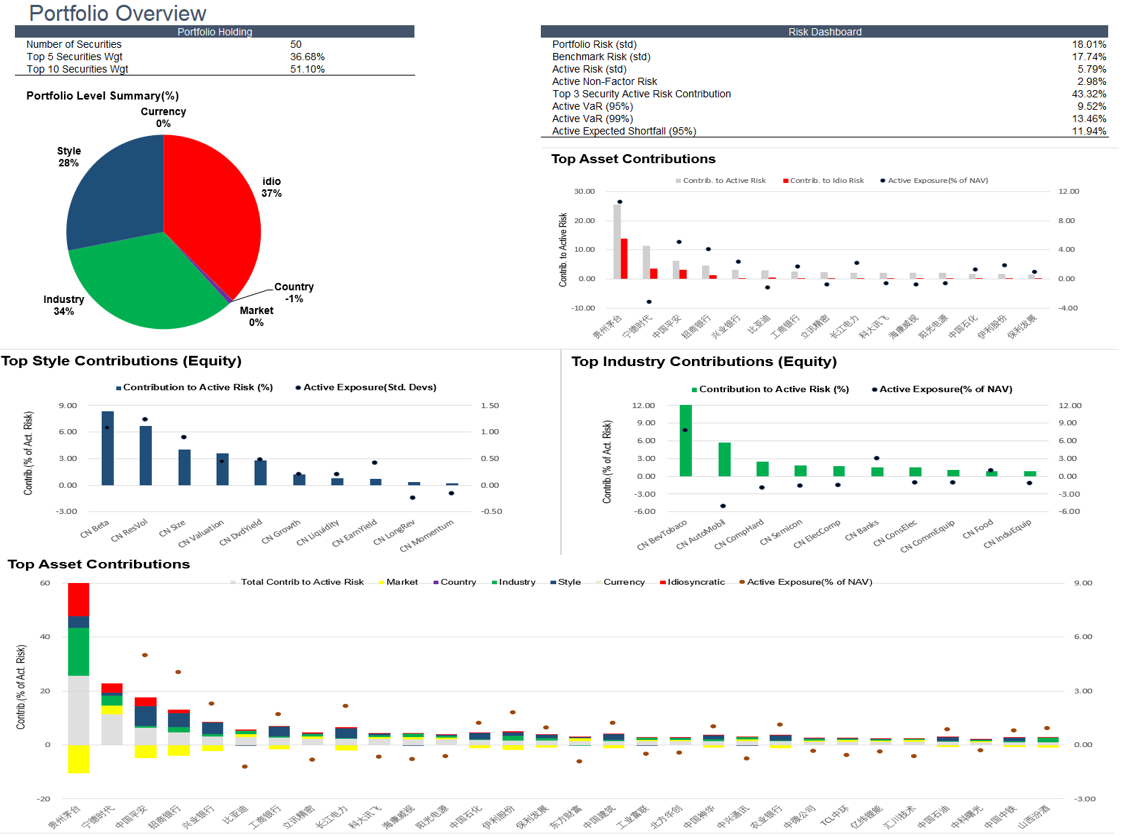
Risk management deserves its own section because diversification by label does not necessarily mean diversification by risk. A portfolio may contain many securities while remaining highly exposed to one factor, industry, market direction, financing source, or liquidity condition. A template should therefore record both position-level information and aggregated exposures.
Core risk fields can include gross exposure, net exposure, leverage, concentration, factor exposure, liquidity profile, counterparty exposure, derivative usage, stress-test results, Value-at-Risk where used, drawdown, and risk-limit breaches. The SEC’s historical guidance on hedge fund risk monitoring distinguishes market, credit, liquidity, and operational risk and emphasizes that risk measures should be supplemented by stress testing and scenario analysis.
It is also useful to distinguish risk measurement from risk response. A number by itself does not tell the committee what should happen next. The template should record the limit, current reading, threshold for escalation, responsible owner, action taken, and date of resolution. This turns risk reporting into a control process rather than a passive dashboard.

Leverage and financing
Leverage should be documented in a way that reflects both the source and the economic effect. Record borrowing, financing arrangements, derivatives that create synthetic exposure, collateral requirements, margin terms, and changes in financing capacity. Gross exposure can be particularly useful because a portfolio with modest net exposure may still contain substantial long and short positions.
Financing relationships also create counterparty risk. The template can record each major financing provider, collateral arrangements, concentration, credit assessment, contractual termination provisions, and contingency plans. This is especially relevant when the fund depends heavily on one financing relationship.
A financing diagram can make these relationships easier to understand. A hedge fund margin-loan lifecycle diagram, for example, illustrates interactions between a treasury function, prime broker, hedge fund, custody account, and securities market. A template should capture the same relationships in text and structured fields so that the diagram is supported by documented controls.

Liquidity and redemption review
Liquidity analysis should connect the liquidity of portfolio assets with the liquidity promised to investors. A fund may offer periodic redemption while holding assets that take substantially longer to sell under stressed conditions. The template should therefore record asset-liquidity buckets, financing maturity, investor redemption terms, lockups, gates, side pockets where relevant, and estimated liquidity under stressed conditions.
The Office of Financial Research identifies portfolio liquidity, financing liquidity, investor liquidity, and unencumbered cash among the useful dimensions for understanding hedge fund liquidity. A good worksheet should preserve the measurement date because liquidity conditions can change quickly.
Liquidity should also be tested under adverse conditions. Instead of asking only whether assets can be sold under normal markets, the reviewer should consider what happens if prices gap lower, financing terms change, margin requirements increase, or several investors seek redemption around the same period. These scenarios can expose weaknesses that normal-period liquidity ratios do not show.

Manager due diligence and scoring
Manager assessment should combine qualitative and quantitative evidence. The qualitative side can cover experience, decision rights, team stability, investment philosophy, culture, incentives, succession, conflicts, and business strategy. The quantitative side can cover performance consistency, drawdowns, volatility, factor exposure, concentration, liquidity, capacity, and correlation with other managers.
A scoring system is useful when it forces the reviewer to explain the score. For example, a five-point rating for operational resilience should be linked to evidence about reconciliation, valuation, business continuity, cybersecurity, staffing, service providers, and oversight. A high score without evidence is simply an opinion written in numerical form.
AIMA describes its due-diligence questionnaires as standardized tools that assist investors in evaluating hedge fund investments and managers, while emphasizing that not every question will fit every manager. That principle is useful for building a custom hedge fund checklist template: keep the core questions consistent, then add strategy-specific questions where the risk profile demands them.

Operational due diligence
Operational review should test whether the business can reliably execute the investment strategy and protect investor assets. Key areas include trade capture, reconciliation, valuation, cash controls, accounting, cybersecurity, disaster recovery, vendor oversight, staffing, access controls, and record retention. Operational weaknesses can become investment risks when they interfere with accurate positions, valuation, liquidity, or reporting.
A useful template separates internal controls from outsourced functions. For every major external provider, record its role, contract relationship, oversight owner, review date, backup arrangement, and known dependency. This makes it easier to see where the fund has concentration in operational infrastructure.
The template should also contain an exceptions register. Each exception can record the issue, date identified, severity, owner, corrective action, supporting evidence, and closure date. Repeated exceptions may be more informative than isolated incidents because they can reveal a systemic weakness in the operating model.

Portfolio construction and allocation
For a multi-manager portfolio, the template should move beyond simply listing allocations. Record strategy weight, manager weight, expected risk contribution, liquidity contribution, factor overlap, correlation, concentration, and the rationale for each allocation. The goal is to understand how the portfolio behaves as a whole.
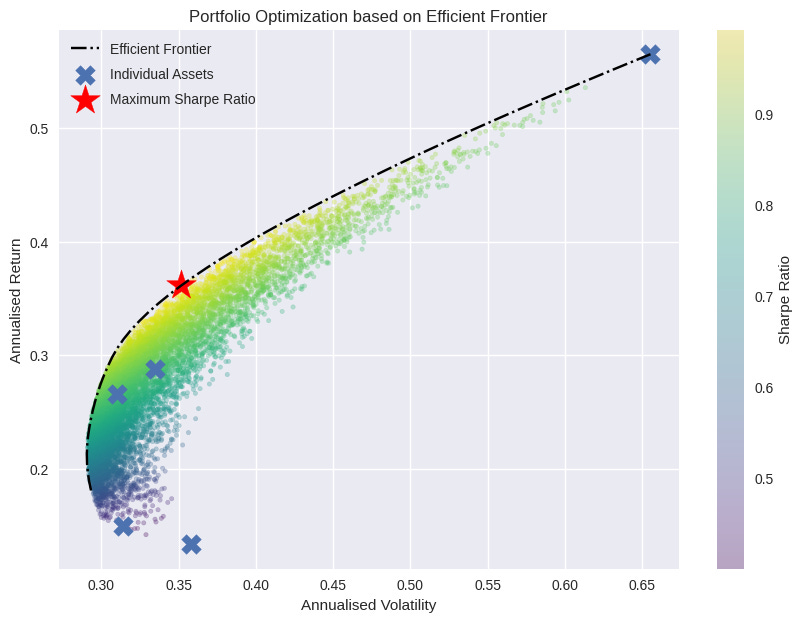
Mean-variance tools and efficient-frontier charts can help illustrate the relationship between expected return and volatility, but they should not replace qualitative judgment. Historical correlations can change, estimated returns can be uncertain, and hedge fund return series can contain smoothing or reporting limitations. The template should therefore preserve both the model output and the assumptions behind it.
A portfolio optimization example can be especially useful for committee discussions because it visually separates capital allocation from risk allocation. The efficient-frontier illustration below shows how portfolios can be compared by expected return and volatility, while a separate risk contribution view can highlight which holdings drive overall risk.

Performance attribution and monitoring
Monitoring begins after selection, not before. The template should define the frequency of performance review and identify which changes require immediate escalation. Examples include unexpected leverage increases, material style drift, unusually large drawdowns, changes in key personnel, significant liquidity changes, new counterparties, or departures from the documented investment process.
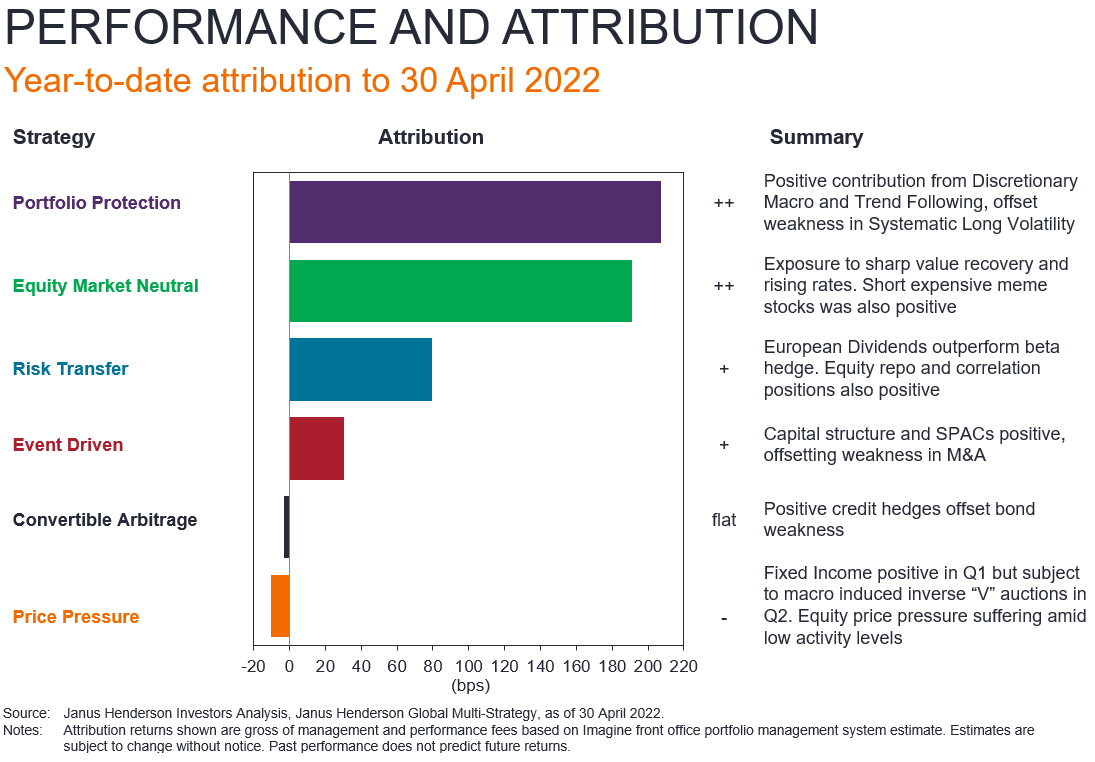
Performance attribution can be recorded by strategy, sector, position, factor, or trading activity depending on the available data. A published attribution chart, for example, separates contributions across several strategies and provides a visual way to see which sleeves helped or detracted from portfolio results.
The monitoring page should compare the current state with the original investment thesis. This is one of the most valuable functions of a template because it prevents a manager from being evaluated solely on the latest return. A fund can perform well while its underlying process deteriorates, or perform poorly while its original thesis remains intact.
Investor reporting structure
A professional investor report should make important information easy to locate without hiding material risk behind presentation. A practical structure can include an executive summary, performance review, attribution, exposure, risk metrics, liquidity, portfolio changes, material events, and outlook. The exact contents should depend on the mandate and reporting agreement.
Factsheets can be useful visual references because they combine fund terms, performance statistics, charts, strategy allocation, and selected holdings or exposures in one document. A strong internal template can use the same principle while ensuring every figure has a defined period, source, and calculation method.
Reporting should also distinguish verified facts from commentary. Historical returns are factual observations for a defined period; an explanation of why those returns occurred is an interpretation. Keeping these layers separate makes reports easier to review and reduces the chance that an opinion will later be mistaken for a measured result.

Common mistakes when building a hedge fund template
The first mistake is building a template around presentation rather than decision-making. A polished layout cannot compensate for missing evidence, unclear definitions, or inconsistent data. Every important field should have a reason for existing and should contribute to a specific research or monitoring decision.
The second mistake is treating every hedge fund as if it carries the same risks. A global macro fund, equity long/short fund, event-driven fund, relative-value strategy, and managed-futures strategy may require very different questions. The core structure can remain consistent, but strategy-specific risk fields should be added where needed.
The third mistake is failing to preserve historical versions. A current score can hide deterioration if the prior assessment is overwritten. A better structure keeps dated review records so analysts can compare changes in performance, personnel, exposures, liquidity, leverage, and risk controls over time.

How to make the template more useful
Use controlled definitions for recurring metrics. For example, define whether leverage means gross exposure divided by net asset value, a financing ratio, or another measure. Define the observation date, calculation period, currency, and treatment of derivatives. Consistency is more valuable than having a large number of metrics that change definition from one review to another.
Next, separate input fields from analyst judgment. Source data should be traceable to a document, report, administrator record, manager communication, or other identifiable evidence. The analyst’s interpretation should sit in a separate commentary field. This makes the review easier to challenge and update.
Finally, build an exception workflow. A template becomes much more valuable when it shows what needs attention. Use categories such as information missing, limit exceeded, thesis changed, performance concern, operational concern, liquidity concern, governance concern, or review required. Each exception should have an owner and target review date.
Practical Solution
The most practical solution is to build the financial hedge fund template as a modular research system rather than one oversized document. Start with a fund profile, then add investment-process review, performance analysis, risk assessment, liquidity, operations, governance, terms, and monitoring. Each module should contain a small number of clearly defined fields, evidence references, analyst comments, and review dates. This keeps the framework usable while still providing enough depth for institutional-style research.
For a new manager review, begin by recording the mandate and strategy in plain language. Then document the investment process and identify the main expected sources of return. After that, review historical performance and determine whether the observed results are consistent with the stated process. Move next to risk, leverage, liquidity, operations, governance, and service providers. Finish by recording unresolved questions and the conditions that would cause the manager to be rejected, approved for further review, or monitored more closely.
For ongoing monitoring, reuse the same structure instead of creating a completely new document each period. Compare current figures with the original baseline and prior review. Flag material changes, investigate exceptions, record explanations, and preserve the final decision. This creates a history of the investment thesis and makes it easier to determine whether a manager is still doing what the investment committee originally evaluated.
A concise workflow can therefore be organized as: define the mandate, document the process, verify evidence, measure performance, analyze risk, review liquidity, examine operations, assess governance, record exceptions, make the decision, and monitor changes. A hedge fund checklist template can serve as the control layer around that workflow, while a financial model can handle calculations and a reporting layout can communicate the final findings.
The same framework can also support internal review meetings. Before each meeting, populate the latest verified data, compare it with prior periods, highlight exceptions, and identify the few questions that require committee attention. After the meeting, record the decision, rationale, follow-up owner, and next review date. This turns the template into a living record of investment governance rather than a static form.

Reference Examples
A financial hedge fund template is easiest to evaluate when readers can see how real financial documents organize information. Useful references include factsheets, risk dashboards, attribution charts, strategy allocation graphics, and manager-selection frameworks. These visuals show how complex investment information can be grouped into recognizable sections such as performance, risk, exposure, liquidity, strategy, and portfolio construction. A good reference should not be copied as a finished document; instead, it should be studied for hierarchy, information density, metric definitions, and the relationship between narrative explanation and quantitative evidence.
The following visual references help demonstrate different ways a financial hedge fund template can present portfolio information. Some emphasize performance and risk, while others focus on strategy allocation, factor attribution, or manager evaluation. When adapting any visual structure, retain the underlying purpose of the field and verify the source, measurement period, calculation method, and context. That makes the resulting template more reliable and easier for analysts, committees, and investors to interpret consistently.
Risk and Performance Analysis Dashboard
Source: Northstar Risk

Liquid Alternatives Investment Dashboard
Source: Amundi MyAltPlatform
