A clear business administration accounting job description helps employers define responsibilities, qualifications, skills, and expectations for a role that combines accounting with essential administrative duties. A well-written description can also help qualified candidates understand the position before applying.
Because business administration accounting roles can vary between organizations, the job description should clearly explain the daily tasks, reporting responsibilities, required qualifications, software knowledge, and communication expectations. Whether you are creating a new position or updating an existing one, a structured template makes the process easier and more consistent.
What Is a Business Administration Accounting Job Description?
A business administration accounting job description is a document that explains the purpose, responsibilities, qualifications, and expectations of an accounting-focused administrative position. The role may support financial recordkeeping, accounts payable and receivable, reporting, budgeting, office administration, and general business operations.
Depending on the size of the organization, the position may be called an accounting administrator, accounting assistant, finance administrator, administrative accountant, or business administration accounting specialist.
The main purpose is to give applicants and hiring teams a clear understanding of what the job involves. It can also help organizations compare candidates against consistent requirements during the recruitment process.
Key Responsibilities of a Business Administration Accounting Professional
The responsibilities included in a business administration accounting job description should reflect the actual needs of the organization. Combining accounting and administrative duties means the employee may work with financial records while also supporting everyday office operations.
Financial Recordkeeping
Maintaining accurate financial records is often one of the most important responsibilities. Employees may record transactions, organize supporting documents, update accounting systems, and help ensure that financial information remains accurate and current.
Accounts Payable and Receivable
The role may involve processing invoices, monitoring outstanding payments, preparing payment documentation, recording customer receipts, and communicating with vendors or customers about account-related questions.
Financial Reporting
A business administration accounting professional may prepare routine financial reports, summaries, spreadsheets, and supporting schedules. These reports can help managers understand expenses, revenue, cash activity, and other financial information.
Administrative Support
Because the position combines accounting and business administration, responsibilities may also include scheduling, document management, filing, correspondence, data entry, meeting support, and coordination with other departments.
- Maintain accurate accounting and administrative records.
- Process invoices, receipts, and payment documentation.
- Monitor accounts payable and accounts receivable.
- Prepare financial reports and administrative summaries.
- Assist with budgeting, forecasting, and expense tracking.
- Reconcile bank statements and investigate discrepancies.
- Organize financial documents and business records.
- Support general office and administrative operations.
- Communicate with vendors, customers, and internal departments.
- Follow company policies and applicable accounting procedures.
Business Administration Accounting Job Description Qualifications
The qualifications for this position depend on the seniority and complexity of the role. Employers should distinguish between essential qualifications and preferred qualifications so that applicants can understand which requirements are truly necessary.
Education
A bachelor’s degree in accounting, finance, business administration, or a related field may be preferred for professional-level positions. Some organizations may accept an associate degree, relevant coursework, or equivalent practical experience for entry-level accounting administrative roles.
Professional Experience
Experience with accounting, bookkeeping, financial administration, or office administration can be valuable. The required experience should match the responsibilities listed in the job description.
Technical Skills
Candidates may need experience with Microsoft Excel, accounting software, enterprise resource planning systems, document management tools, and other business applications. Employers should identify specific software only when it is genuinely required for the role.
Communication and Organizational Skills
Strong organization, attention to detail, written communication, and time management are important because accounting administrative employees often handle multiple deadlines and work with sensitive business information.
Essential Skills for the Role
A strong business administration accounting job description should describe the skills that support successful performance rather than simply listing generic qualities.
- Attention to detail: Ability to identify errors and maintain accurate records.
- Accounting knowledge: Understanding of basic accounting principles and financial documentation.
- Excel proficiency: Ability to organize, calculate, and analyze financial information.
- Organization: Ability to manage documents, deadlines, and multiple administrative tasks.
- Communication: Ability to communicate clearly with coworkers, customers, and vendors.
- Problem-solving: Ability to investigate discrepancies and resolve routine financial issues.
- Time management: Ability to prioritize work and meet reporting and payment deadlines.
- Confidentiality: Ability to handle financial and business information responsibly.
How to Write an Effective Business Administration Accounting Job Description
Writing an effective job description involves more than listing every task an employee might perform. The document should be specific enough to attract appropriate candidates while remaining easy to scan.
1. Start With a Clear Job Title
Use a recognizable title such as Business Administration Accounting Specialist, Accounting Administrator, Accounting Assistant, or Finance and Administration Coordinator. Choose the title that most accurately reflects the actual level and responsibilities of the position.
2. Add a Short Job Summary
The summary should explain why the role exists and how it contributes to the organization. Keep it concise and focus on the most important responsibilities.
3. Separate Responsibilities From Qualifications
Applicants should be able to quickly identify what they will do and what they need to bring to the position. Use separate sections for responsibilities, required qualifications, preferred qualifications, and skills.
4. Include Measurable Expectations Where Appropriate
Specific expectations can make a job description more useful. For example, instead of saying that the employee will “manage financial records,” explain whether the person will maintain monthly records, reconcile accounts, prepare reports, or process a particular volume of invoices.
5. Keep the Language Inclusive and Accessible
Use straightforward language and focus on job-related requirements. Avoid unnecessary qualifications that do not directly support successful performance.
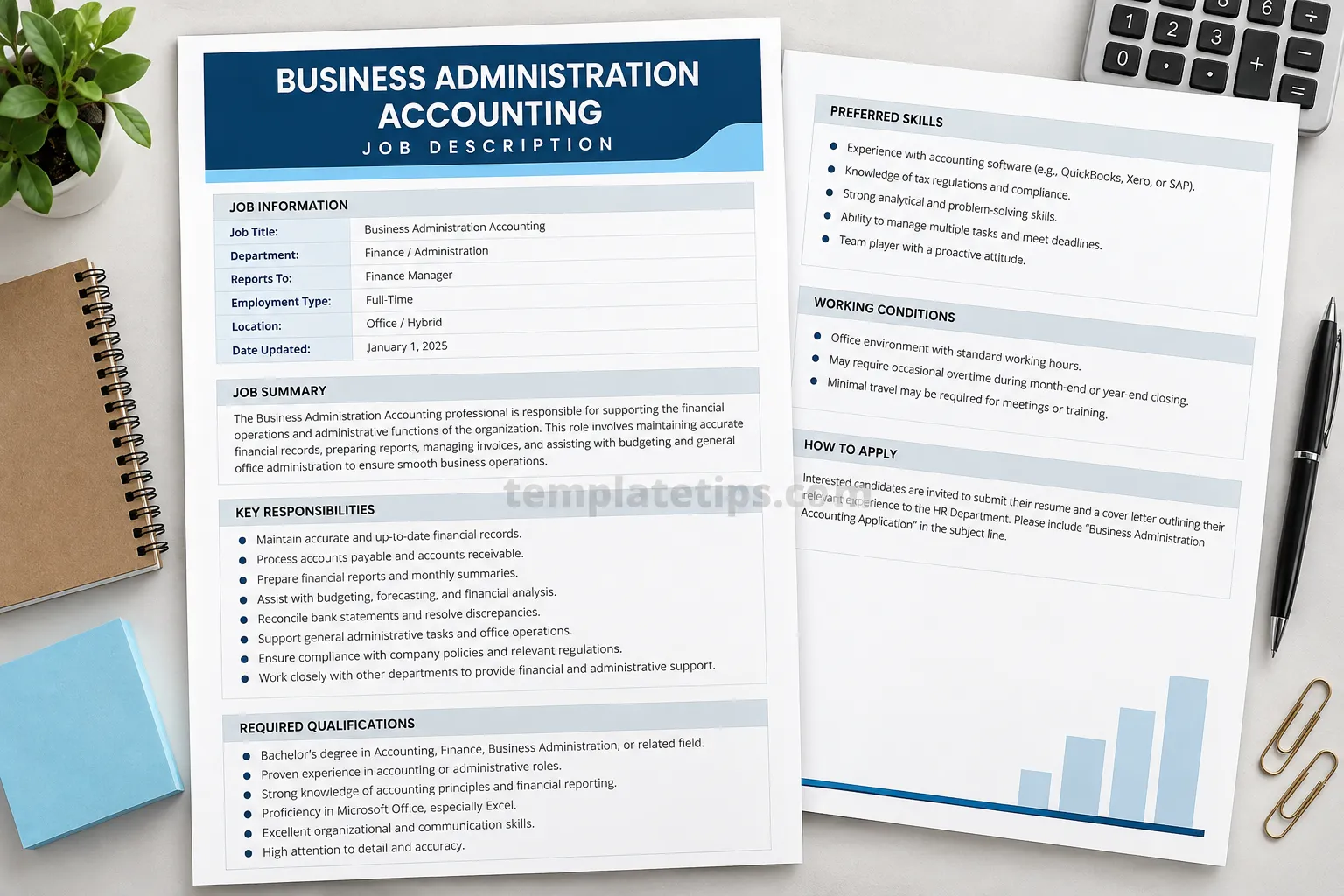
Sample Job Description Structure
A practical template can follow this structure:
- Job Title: Business Administration Accounting Specialist
- Department: Finance and Administration
- Reports To: Finance Manager or Accounting Manager
- Employment Type: Full-time or part-time
- Job Summary: Brief overview of the position and its purpose.
- Key Responsibilities: Main accounting and administrative duties.
- Required Qualifications: Essential education, experience, and technical knowledge.
- Preferred Qualifications: Additional experience or skills that may be beneficial.
- Working Conditions: Office, hybrid, remote, travel, or other relevant conditions.
- How to Apply: Application instructions and required documents.
Business Administration Accounting Job Description Template Tips
When using a template, customize each section instead of publishing generic text without reviewing it. The most useful template is one that accurately represents the organization and the actual position.
- Update the job title to match the organization’s internal structure.
- Review every responsibility with the hiring manager.
- Separate required skills from preferred skills.
- Specify accounting software only when relevant.
- Include the reporting relationship.
- Clarify whether the position is office-based, hybrid, or remote.
- Review the description regularly as responsibilities change.
- Use consistent terminology across related job postings.
Common Mistakes to Avoid
Even a detailed job description can be ineffective if it contains unclear or unnecessary information. Avoid making the position sound broader than it actually is.
- Using an unclear job title: Candidates may not understand the position or find it in job searches.
- Listing too many generic duties: Focus on responsibilities that are genuinely part of the job.
- Mixing requirements with preferences: Clearly distinguish essential qualifications from desirable ones.
- Using excessive jargon: Simple language improves readability and accessibility.
- Ignoring administrative responsibilities: Explain the business administration component when it is a significant part of the role.
- Failing to update the template: Old requirements can create confusion during recruitment.
Why a Well-Structured Job Description Matters
A clear job description benefits both employers and applicants. Employers can use it to communicate expectations, structure recruitment processes, support onboarding, and establish a foundation for performance discussions.
For candidates, the document provides an early view of the position’s responsibilities, qualifications, work environment, and expectations. This helps applicants determine whether their experience and skills align with the opportunity.
A consistent structure can also make multiple job postings easier to manage, especially for organizations that regularly recruit accounting and administrative professionals.
Conclusion
A well-written business administration accounting job description should clearly connect accounting responsibilities with administrative support duties. It should explain the purpose of the position, daily responsibilities, qualifications, technical skills, communication expectations, and working conditions.
Using a structured template can make the writing process faster while helping hiring teams create consistent and informative job postings. Before publishing the final version, review every requirement and responsibility to ensure that it accurately reflects the position. A clear, specific, and readable job description can provide a better starting point for both employers and candidates.
